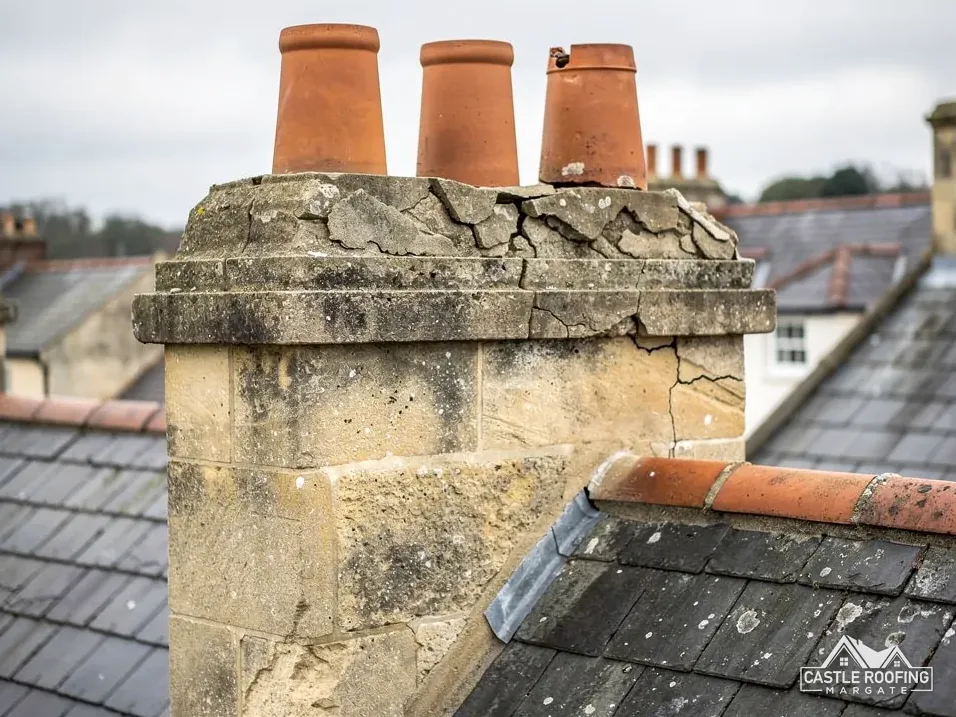
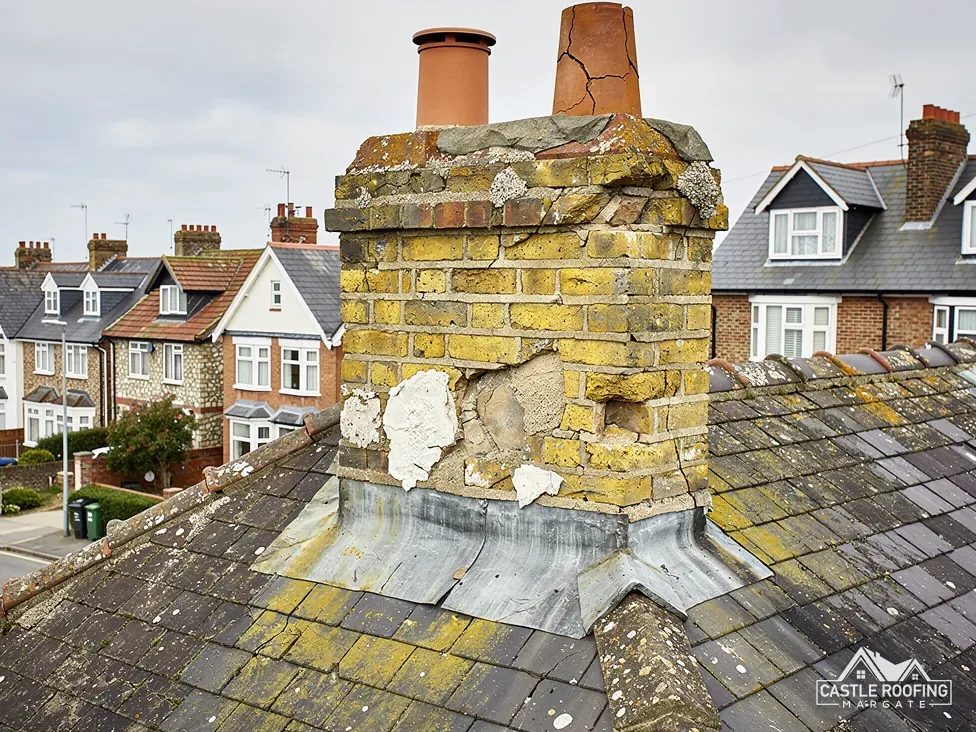
The signs that point to a rebuild
A stack that is only weathered can usually be repaired. One that has moved or broken up inside is a different job. You can look for the signs from the ground with binoculars or a phone on zoom, and a roofer checks them closer at the survey.
Signs that suggest a rebuild rather than a patch:
- A visible lean, where the stack is no longer square to the ridge or the wall below.
- Open joints you can see daylight through, or a stack that rocks if the cowl is touched.
- Bricks with their faces flaking away, or crumbling across several courses rather than in one place.
- Cracks that run through the brick as well as along the joints.
- Staining or damp on the breast inside the house, which says water is getting in through the stack.
None of these on its own proves a rebuild. A single leaning course, for example, can sometimes be rebuilt from the top down, while the lower stack is repointed and kept. The aim is to find how far down the damage goes. Related reading: a leaning chimney stack.
Rebuilding like for like
A rebuild means taking the stack down to sound masonry and building it back up. Done like for like, in the same position, the same size and in matching brick, it is a repair to the roof rather than a new feature.
The planning rules have a wrinkle here. Class C of the General Permitted Development Order lets owners change a house roof, but condition C.1(d) takes out any job involving a chimney, flue or soil pipe, new, altered or replaced. Whether a faithful rebuild counts as alteration or replacement is a judgement for the council's planning team, so ask them rather than assume.
On the job itself, the usual order is: scaffold, take down the stack to the first sound course, rebuild in brick and mortar chosen to match, fit new lead flashings and a flaunching round the pots, then reset the pots or cowls. Flaunching is the sloping mortar around each pot that fixes it and sheds rain. If the old pots are sound they go back; if not, they are replaced to the same pattern.
Approvals, neighbours and shared stacks
A rebuild on a listed house needs thought before anyone lifts a brick. Listed building consent, required by section 7 of the Planning (Listed Buildings and Conservation Areas) Act 1990 for changes to character, is likely to be in play because a stack often defines the roofline. In a conservation area, ask the council whether an Article 4 direction applies to your street.
Where the stack sits on a party wall between two houses, the neighbour matters as well. Under the Party Wall etc. Act, the adjoining owner has to be served notice at least two months in advance. If the adjoining owners and occupiers agree in writing, the work can go ahead without the full procedure, and GOV.UK warns that silence is not agreement. Party wall questions go to a party wall surveyor.
If the chimney breast inside is also coming out, building regulations approval always applies. Our guides to shared chimney stack repairs and chimney stack removal go through those cases in more detail. Agreeing the programme with the neighbour early also saves a second visit from the scaffolders.
Weighing repair against rebuild
A repair is the better choice while the damage sits in the joints and the bricks are sound. A rebuild makes sense when repairs would only cover a problem that is still moving. Paying to repoint a stack that then has to come down in a year or two is the cost to avoid.
The decision rests on what the survey finds: how far the lean goes, how deep the brick damage runs, whether the flaunching and flashings are failing, and whether the flues below are in use. A flue in use for a stove or boiler may need a liner, and that is a separate job from the brickwork.
Weather and timing matter too. Fresh mortar needs protecting from frost and driving rain, so a rebuild in a wet or freezing spell is usually delayed rather than rushed.
Height, reach, the number of pots and the brick below the damage all move the cost of a rebuild. Our survey measures them and a written total follows, once the approvals above are settled. Everything on stack work sits under chimney repairs.