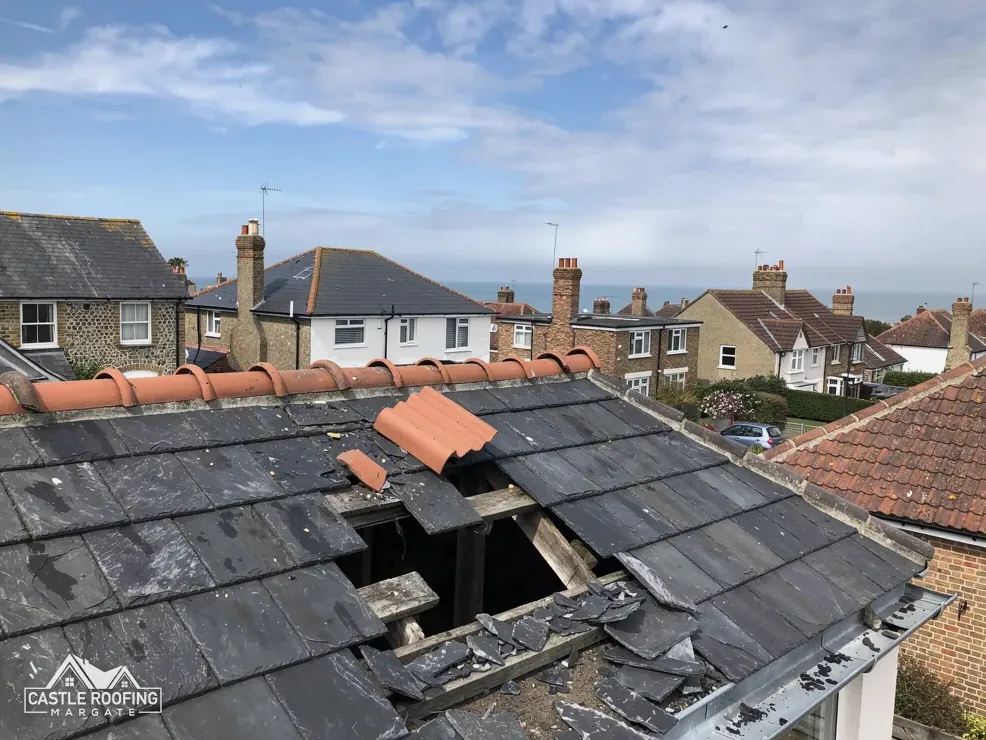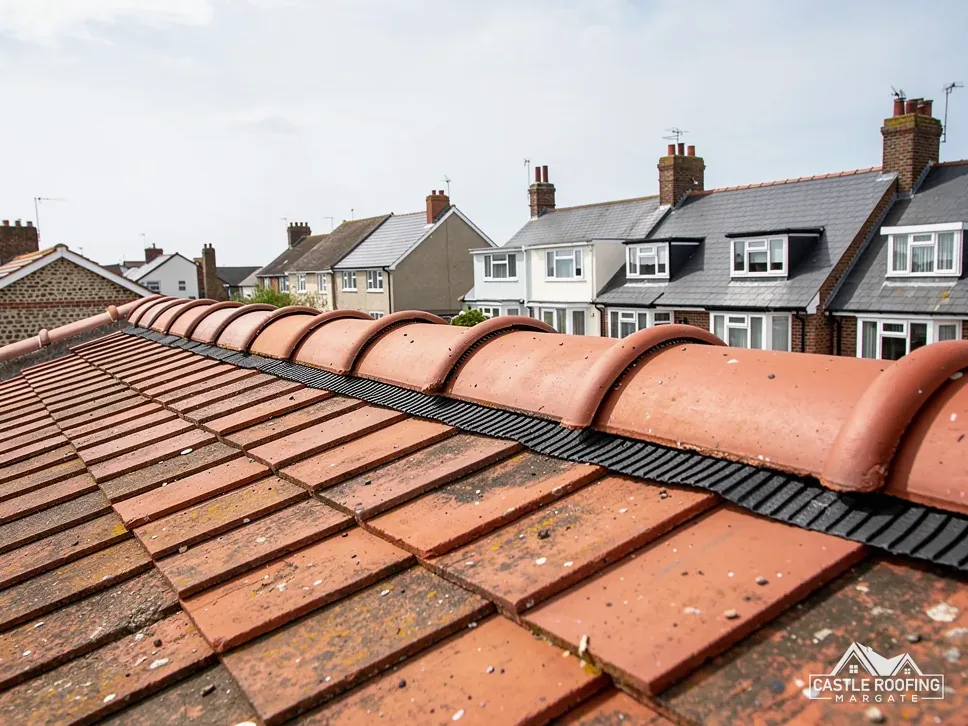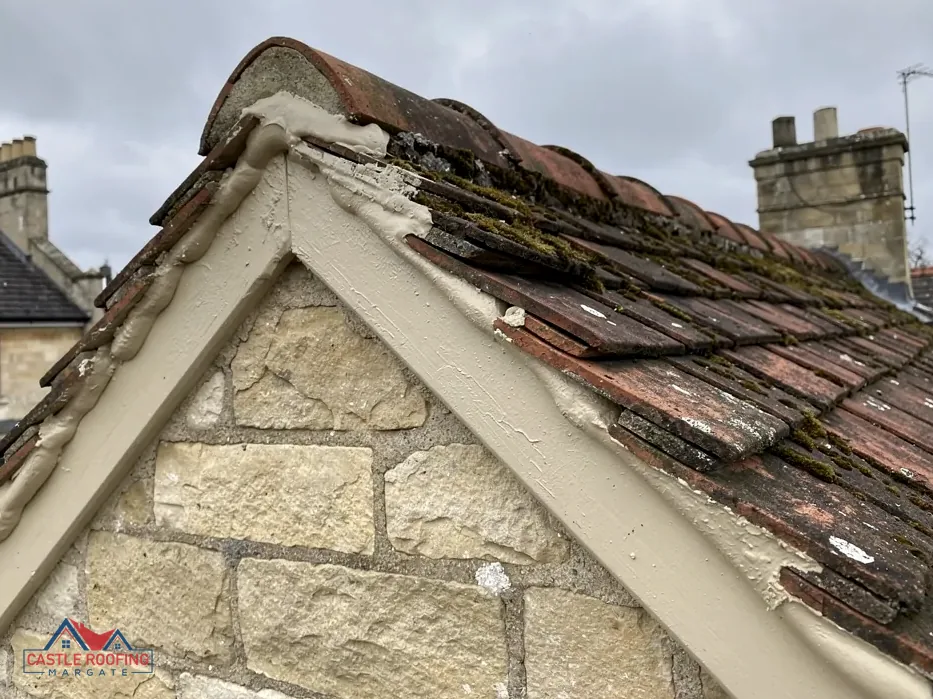
Use this to decide whether your ridge needs re-bedding, what the work should include under BS 5534, which consents a listed or conservation area home might need, and when dry-fix is the better choice.
The ridge is the top of a pitched roof, capped with a row of tiles where the two slopes meet. For a long time those tiles were laid on a bed of mortar, and a sound mortar ridge on an old roof is still a reasonable thing to own. Over the years the mortar weathers, shrinks away from the tile and lets go, and the ridge needs re-bedding: the tiles are lifted, the old mortar is cleared, and the line is laid again.
What has changed is the standard the work is judged by. BS 5534:2014+A2:2018, which governs slating and tiling, no longer accepts mortar by itself as enough, and a re-bedded ridge is built with a mechanical fixing as well. That does not mean mortar is out of date. It means it is rarely the whole answer.
This guide covers what re-bedding involves, how mortar and fixings work together, what happens on a listed or conservation area house, and when a dry-fixed ridge suits better. It sits inside our dry ridge and verge work, and our guide to cracked ridge mortar covers the earlier warning signs.
What re-bedding actually involves
Re-bedding is a repair to the capping, not to the roof covering below it. The slopes stay as they are and only the ridge line is taken apart and rebuilt.
The usual stages:
- The roofer surveys the ridge and photographs it from above, so you can see what is loose.
- The ridge tiles are lifted off in order and set aside, with any cracked ones separated out.
- Old mortar is chiselled off the top course and brushed away to a clean surface.
- A fresh bed is laid along the ridge and the tiles are set back into it, lined up, level and with even joints.
- Mechanical fixings are added, and the joints are pointed and finished.
- The surplus mortar is cleared, and the debris is taken away.
Tiles that are sound go back on the roof. A tile that is cracked or has lost a corner is replaced, so a re-bedded ridge may include a few new tiles. The covering beneath, the battens and the underlay are only touched if they are damaged.
The job sits somewhere between pointing, which only renews the exposed edge of the mortar, and a full replacement of the ridge, and the survey decides where your ridge falls on that scale. A ridge that is loose and not only cracked needs the full re-bed. The roofer also looks at the ridge ends, where the tiles meet a gable or a hip, since those joints sit at the open end of the line, with nothing beyond them to shelter the last tile.
Re-bedding is done from a safe working position, such as a tower or a scaffold, and never from a ladder leaning on the ridge. A scaffold on the pavement takes a Kent County Council licence, which the scaffolder applies for.
Mortar after the 2015 amendments
Mortar is not banned. That point matters, because a belief that it is could push an owner towards a dry-fixed ridge the roof does not need, or towards ignoring a loose ridge on the idea that mortar is finished.
The facts, from the maker's side: Marley, the tile maker, says the 2015 amendments to BS 5534 ended the use of mortar as a covering's sole fixing, and that the 2018 amendment extended the standard to ordinary re-roofing and repair work. BS 5534:2014+A2:2018 is the current edition, according to BSI.
Three things follow:
- The standard is not the law. Marley is plain on this: installing to BS 5534 is not required by law.
- It is the benchmark for good practice, and a repair judged against it is expected to include a mechanical fixing for the tiles.
- On Marley's reading, mortar by itself is no longer enough to hold a tile down, which is not the same as barring it, so a mortar-bedded ridge with fixings is a correct repair.
This is the point where advice differs between roofers. Some say mortar is dead, others say nothing has changed. The accurate position sits between the two.
Mortar still does useful work. It packs the space under each tile, it keeps wind and driven rain out of the ridge, and on a period roof it gives the traditional look. What it is no longer trusted to do on its own is hold a ridge tile down in a gale.
Mortar with mechanical fixing
A re-bedded ridge built to the current standard combines both methods, each doing the job it is good at.
| Part | Does | Cannot do |
|---|---|---|
| Mortar bed | Seals gaps and sets the line | Hold tiles alone |
| Fixings | Hold each tile down | Seal the joints |
The fixings are screwed or clipped to the ridge structure and the tile, so that if the mortar fails in the future the tile stays where it is. The length and type are chosen for the site. Marley notes that BS 5534 includes formulas for wind uplift, from which fixing specifications are calculated, and the calculation takes the exposure of the building into account.
On the Thanet coast that matters. Cupa, the slate maker, gives tall buildings, and any building on a hillside or the shoreline, a higher exposure grade. A ridge on a tall house with a clear view of the sea sits in a different grade from a sheltered one in a back street, so the fixings are worked out for each roof and not taken from a standard list. Length, material and spacing all follow from that calculation, which is why the written price is given after the survey.
The practical result of combining the two is a ridge that looks like the traditional one from below, with the mortar visible along the line, and holds like a modern one.
Consents for listed and conservation homes
Re-bedding a ridge is repair work on a roof, and on most houses the planning side is simple. On a listed building or in a conservation area, the consent route needs a check before a tile is lifted.
What applies:
- A house: Class C of the permitted development rules is the one for changes to a house roof, and a change of covering normally falls within it.
- A flat: house rights do not extend to flats. Canterbury City Council says there are no permitted development rights for flats and maisonettes.
- A listed house: Class C still applies, but listed building consent is needed for works which affect the building's character, under section 7 of the Listed Buildings Act. Canterbury City Council puts it as consent for any changes which affect the building's character.
- A conservation area: Class C stays in place for a house there unless an Article 4 direction has removed it, though the area is article 2(3) land, which takes away Class B dormers.
Thanet District Council's conservation area page says that if the work is like for like, you are less likely to require planning permission. Like for like means the same tile, the same bedding and the same line, so a ridge rebuilt with the same profile and mortar finish is easier to defend than one swapped for a different style.
Article 4 differs by council, so ask the council whether a direction covers your street before work begins. Ridges on listed buildings are covered in our guide to ridge tiles on a listed building.
When dry-fix suits better
Re-bedding is the right repair for a ridge that is basically sound, on a roof where the traditional appearance matters or the owner wants a like-for-like repair. It is not the right repair for every ridge.
A dry-fixed ridge suits better in the following cases, and the survey tells you which one you are in:
- the ridge has been re-bedded before and has failed again
- the mortar has broken down along most of the length, so there is little left to re-use
- the roof is exposed and the ridge takes the full force of the wind
- the ridge is being rebuilt as part of a re-roof
- you want a ridge that does not depend on mortar at all
BS 8612:2018 sets the specification for dry-fixed systems, which hold each ridge tile with a manufactured fixing and a continuous support, so there is no bedding to crack. Marley's page weighing mortar against dry-fix gives the reasoning: the pulling strength of mortar by itself stopped being something a roofer could rely on.
Dry-fix is not automatically the better answer. It changes the look of the ridge slightly, and it needs to match the tile profile. On a listed building the council decides whether it is acceptable. Our guide to what a dry ridge is explains the system in full, and the choice comes down to the roof actually under the ladder, not to a rule.
Checking the finished ridge
A re-bedded ridge is easy to judge from the ground and from your photographs. You are looking for a straight, even line with the joints neatly finished.
On the completed job:
- the ridge runs straight, with no dips between the tiles
- the joints are even and the mortar is tidy, without smears on the tile faces
- the mortar colour sits reasonably close to the old
- the end tiles and the junction with any hips are closed and sound
- the photos show the fixings in place before the pointing covers them
Colour is the detail to settle early. Fresh mortar is pale, and it takes time to weather towards the old. If a close match matters to you, ask the roofer how it is being handled, and there are ways to tint the mortar towards the old.
Colour and finish are cosmetic, and they can be argued over for a season. The structural checks come first, and the photographs are your evidence for them. Ask for a close shot of the ridge ends and of the line from one gable to the other, since one angle never shows both, and keep them with the paperwork. Look at the ridge again after the first strong wind. A tile that has moved or a joint that has opened tells you early that a fixing needs attention. Waste, loose tile pieces and mortar crumbs should be cleared from the gutters and the ground around the house before the job is signed off, and the skip or sacks taken away with them.