Read this before booking ridge work on a listed home. It explains the consent that can apply, why mortar may be the right like-for-like detail, how matching tiles are chosen and what to ask the council.
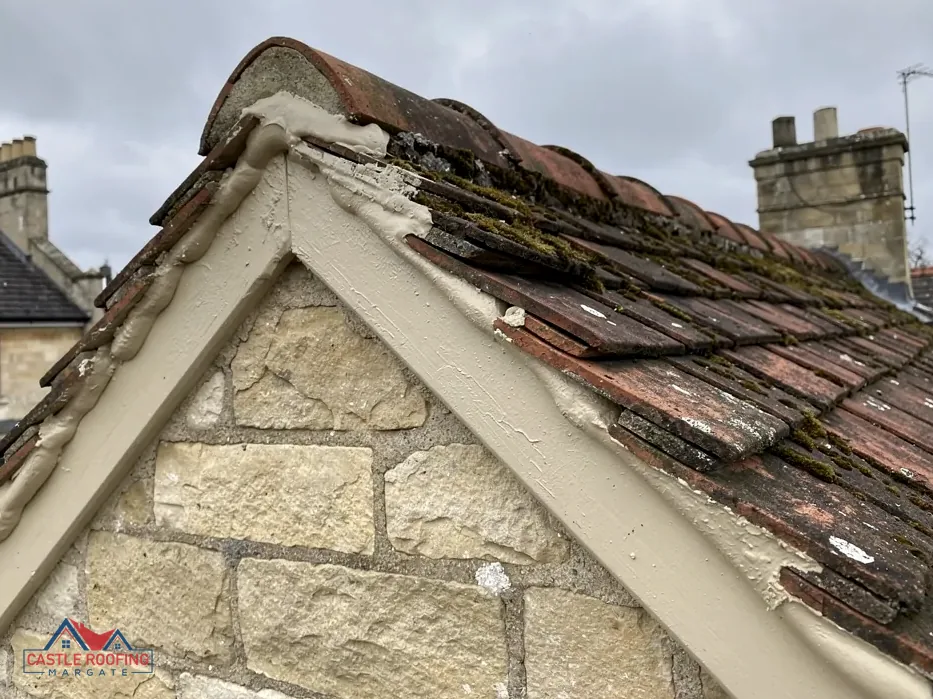
A listed house is protected by law, and the protection covers the roof as well as the front door. The ridge, the strip of capping tiles running along the top, is part of the building's outline against the sky, and councils pay attention to it for that reason. A repair that would pass without comment on a 1960s semi can need a conversation on a listed one.
That does not make ridge repair impossible. Listed roofs are repaired under the consent system, and the process is a matter of asking the right question in the right order. The question is whether the work would affect the building's character. If the answer is yes, listed building consent comes before the repair rather than after it.
Below, we set out what the law says in plain terms, which details a council is likely to care about on a ridge, why a mortar bed is sometimes the correct repair on an old roof, and how matching tiles are chosen. It sits within our dry ridge and verge work. Nothing here replaces a conversation with the council's listed building officer, who knows the entry for your house.
What listing does to roof work
Section 7 of the Planning (Listed Buildings and Conservation Areas) Act 1990 requires consent for any works that bear on a listed building's character. The roof is part of that character, so a ridge is within what the section reaches. Canterbury City Council puts it directly: you will need listed building consent for any changes which affect the building's character.
What counts is character, which is wider than a list of forbidden materials. Replacing a ridge with something that looks different, moving to a deeper or shallower profile, or changing how the ends are finished could all alter what the building looks like. Putting back the same tile in the same bedding usually changes nothing a passer-by would notice, but whether it does is the council's judgement, never the roofer's or the owner's.
Planning permission is a separate system. Listed houses keep the permitted development rights that cover other roof alterations to a house, known as Class C, and re-covering a roof normally falls inside it. Even so, a listed house still needs consent under the 1990 Act for works affecting its character. The two do not cancel each other out.
- Planning permission: usually not needed for like-for-like roof work on a house.
- Listed building consent: needed where the work affects character.
- Conservation area rules: can apply on top, if the house stands in one.
Asking first costs one email, and the reply can be kept on file with the other papers for the house.
Repair or alteration: where the line falls
Councils separate repair from alteration. A repair puts back what was there, using the same material and the same method. An alteration changes something visible or structural. A ridge sits on the boundary, because a repair that swaps mortar for clips, or half-round tiles for angled ones, looks like a repair to the owner and an alteration to a conservation officer.
This is the table we work from when a listed ridge is on the list.
| Work | Often seen as |
|---|---|
| Re-seat the same tiles on a new bed | Repair |
| Replace a few tiles with matching ones | Repair if they match |
| Change the tile profile or colour | Alteration |
| Add a dry-fix system to the whole ridge | Ask before starting |
The right-hand column is a guide to how work is often read, not a ruling. The only answer that counts is the council's, so get the reply in writing before booking any access.
If the ridge is the only thing being touched, the council's answer may be a short one. If other parts of the roof are included, one application can cover them all, which spares you a second wait. Send photos of the existing ridge, close up and from a distance, with the first enquiry. Include the gable ends and any hips, since they are capped in the same way and the officer will want to know whether they are part of the job.
Why mortar can be the like-for-like detail
It is sometimes said that standards have turned against mortar on ridges. That is not what they say, and on a listed roof the difference matters. Marley, the tile maker, reads the 2015 amendments to BS 5534 as meaning mortar can no longer be the only thing securing a ridge tile. It does not say the tile cannot sit on a mortar bed. The standard, BS 5534:2014+A2:2018, is guidance for good practice rather than a statute.
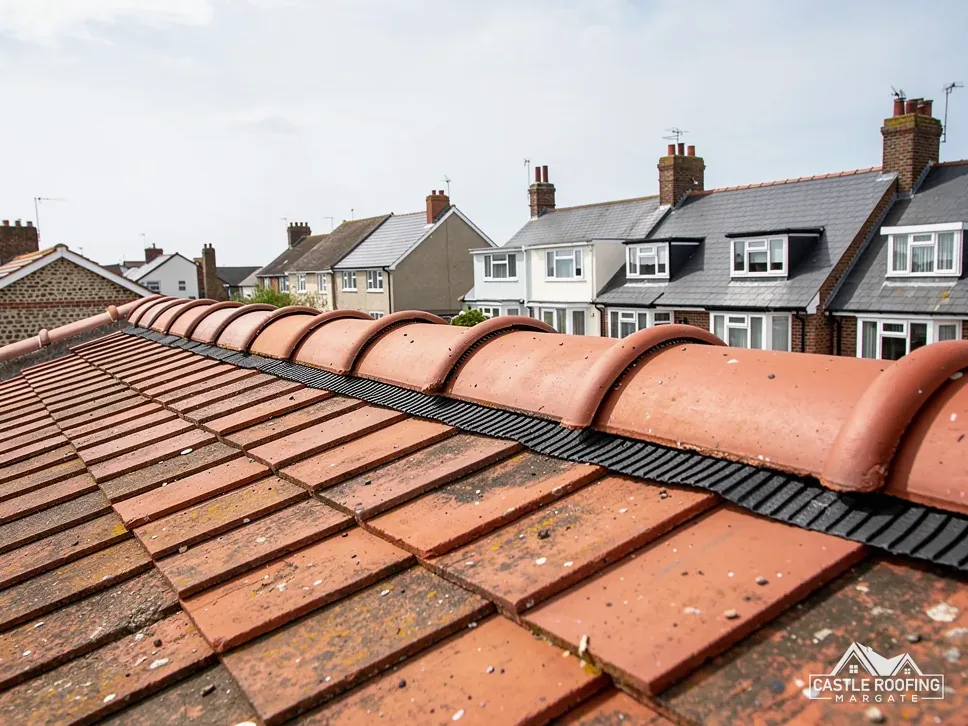
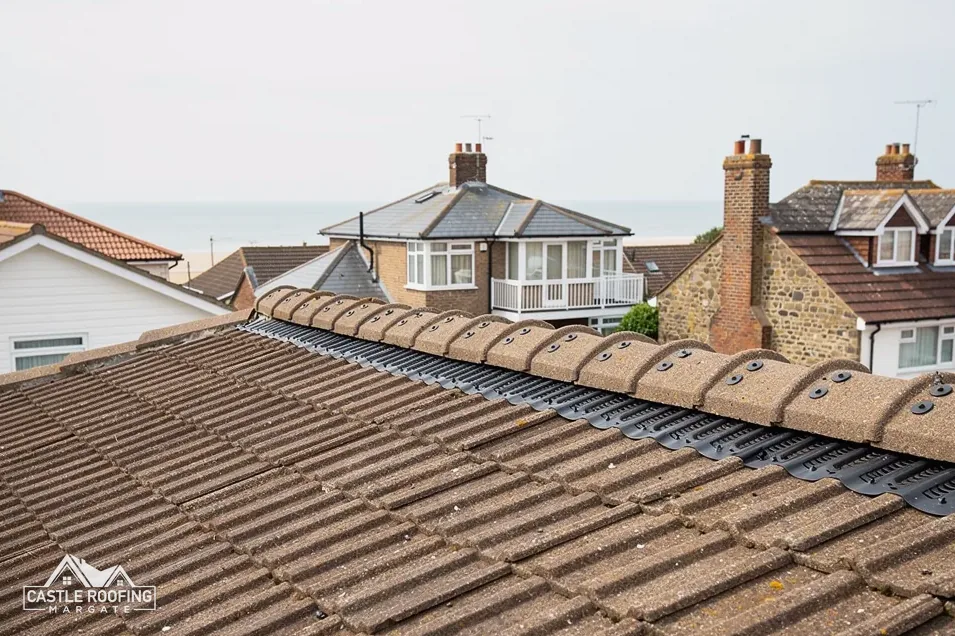
The modern route is a dry-fixed system built to BS 8612:2018, where clips, brackets and screws hold the tiles. Those systems add metal and plastic components to the top of a roof that may have carried a lime or sand and cement bed for a century or more. On a listed building a council may prefer to see the original method kept, with a mechanical fixing hidden in or behind the bed as a back-up.
That compromise serves both aims. The visible detail is the traditional joint, and the tiles are no longer held by mortar alone. We would set it out for the council in the application, with a note of how the fixing is concealed.
The point to keep hold of is that neither method is automatically right. The roof, the tile and the entry in the list decide it. Our page on what the standards say about mortar on ridges goes into more detail.
Matching ridge tiles to what is already there
Matching starts with looking, not ordering. Ridge tiles differ in shape and size, and the shape is what shows from below: a rounded half-round, a pointed angled section, or a decorative pattern with a crest. The colour and texture of an old tile are the other half of it.
The first step is to check whether the existing tiles are sound. Tiles taken off a ridge can often go straight back, especially if they were bedded and the fault lay in the mortar, not the clay. Reusing them is the closest match there is. Where some are cracked, the survivors can be used at the visible end and the replacements placed where they are less obvious.
Where new tiles are needed, the choice runs in this order:
- Salvaged tiles of the same profile, if a source is available.
- New tiles of the same shape, with the colour weathered or blended to suit.
- A close substitute, agreed with the council before it is ordered.
Councils that have appraised a conservation area write down what they value in its roofs, and the appraisal for your street is free to read. It tells you which details the council already treats as part of the area's character, and so which ones a matching repair needs to keep. Our guide to ridge mortar colour matching covers the mortar side of a ridge repair on a listed roof.
Conservation areas and Article 4 directions
Listing is one layer of protection, and it is the one owners tend to know about. A listed house can also stand in a conservation area, and the council that covers it may have added rules of its own. Know which apply before you start, because a ridge repair that is fine under one layer can need a second look under another.
Councils publish how many conservation areas they have: Thanet 27, Canterbury 97, Dover 57 and Swale 51. Article 4 directions, which withdraw chosen permitted development rights across a defined area, can add further requirements.
| District | Position |
|---|---|
| Thanet | Has directions in three named conservation areas; ask Thanet District Council which classes apply |
| Dover | Dover District Council says its directions can cover roof alterations on the street, waterway or open-space side of a house |
| Swale | Faversham direction covers front roof coverings |
| Canterbury, Folkestone & Hythe, Ashford | Ask whether a direction applies at your address |
Our page on dry ridge in a conservation area goes through the same question for ridges.
Church roofs and monuments follow separate routes. Church roofs and monuments follow separate routes: the faculty system for an Anglican church that is in use, a denomination's own scheme for Roman Catholic, Methodist, URC or Baptist churches, listed building consent for a Quaker, Unitarian or CCT building, and scheduled monument consent for a scheduled monument. Ask the denomination or the council which applies before any roofer is booked. The same goes for a house that stands within the grounds of a protected building, where the setting can matter as well as the roof itself, and for outbuildings that are listed in their own right.
Working with the council and arranging the job
A tidy application makes the process shorter. Whoever is doing the work should provide the building's list entry number, photos of the ridge along its full length, a short description of the repair and a note of the materials. Ask the council whether it wants a drawing for a like-for-like ridge.
Here is the order we follow on a listed ridge:
- Close survey up on the roof, with photographs of each tile and joint.
- Draft the repair, naming the tile, the bed and any hidden fixing.
- Check with the council whether consent is needed, and apply if so.
- Order the tiles and book the scaffold once consent is in hand.
- Carry out the work as described, with photos at each stage.
Scaffold is often needed on a listed house, because a ridge is the highest line and the tiles have to be lifted off and handled carefully. Where scaffolding stands on or over the highway, Kent County Council issues the licence and expects the scaffolding company to submit the application. Notice is 5 working days, and Kent County Council charges £52 per week for 2026 to 2027, so the dates are planned around the consent.
Allow for the council's reply in your plans, since the work waits for it. If the roof is leaking while you wait, a temporary make-safe that changes nothing permanent is worth raising with the council at the same time. Send the photos, the list entry and the description together, and keep every reply with the deeds. When consent is granted it may come with conditions, such as agreeing the tile sample or the mortar mix before work starts, and those conditions are part of the job rather than an afterthought. We build them into the programme so that the sample is approved while the scaffold is still being booked.