Two Thanet conservation area appraisals on roofs, the designation dates for Margate's protected areas, and a covering-by-covering guide to faults, so you can read your own roof from the pavement.
It is tempting to expect a house of a certain age to have a certain kind of roof, as though the date on the deeds settled it. It does not. A roof is replaced once or twice in a long life, so the covering you can see is often younger than the walls under it, and the walls may be much older than the extension beside them. The age of the house is a clue. The covering is the evidence.
Local evidence on what Margate's roofs are made of is limited. Thanet District Council's appraisals describe the roofs in two Cliftonville conservation areas, and the council publishes designation dates for the old town, the seafront and Cliftonville. The rest is general roofing knowledge, tied to the covering and not to a street.
No single covering belongs to every road in Margate, and guessing helps nobody, so here you learn to identify what is on your own roof, what it is likely to need, and what to ask the council in a protected area. Should you want a roofer to come and look, the main page at Castle Roofing Margate explains how a survey works, and our guide on spotting a dodgy roofer is worth a read before anyone is hired.
Read the covering, not the date on the deeds
Stand across the road and look at the slope that faces you. Three questions get you most of the way.
- Is the surface made of thin, flat, overlapping pieces in a grey or blue-grey tone, or of thicker, rougher pieces in orange-red or brown?
- Are the pieces the same size across the whole slope, which suggests one re-roof, or do areas differ, which suggests repairs over the years?
- Is there a parapet, a low wall at the edge of the roof, hiding part of the slope from the street?
The answers separate natural slate, which is thin and flat and splits into layers at the edge, from clay tiles, which are thicker and have a slightly uneven surface, and from concrete tiles, which are regular and heavier.
A covering's age is a better guide to its condition than a house's age. HomeBuilding (30 September 2025) gives typical life ranges as published: Welsh slate 100+ years, clay tile 60 to 80 years, and plain concrete tiles 40 to 50 years. Those figures are typical, not guaranteed, and a covering laid well and looked after can outlast them while a poorly fixed one can fail early.
Chimneys also tell a story. Whether a stack has been shortened, capped or rebuilt is something to check up close. Rain tends to enter at the base, where brickwork and slope are sealed together. Our page on terraced house chimney repairs covers the usual faults.
What Thanet's appraisals say about two Cliftonville areas
Thanet District Council has written appraisals of its conservation areas, and two of them describe the roofs. Each covers only its own area, and each reports what the council's authors saw, not every house.
- Cliftonville Clifftop: the appraisal describes the roof materials as "quite mixed", with clay tile in red and natural slate both named, and notes that tall chimney stacks survive in many places.
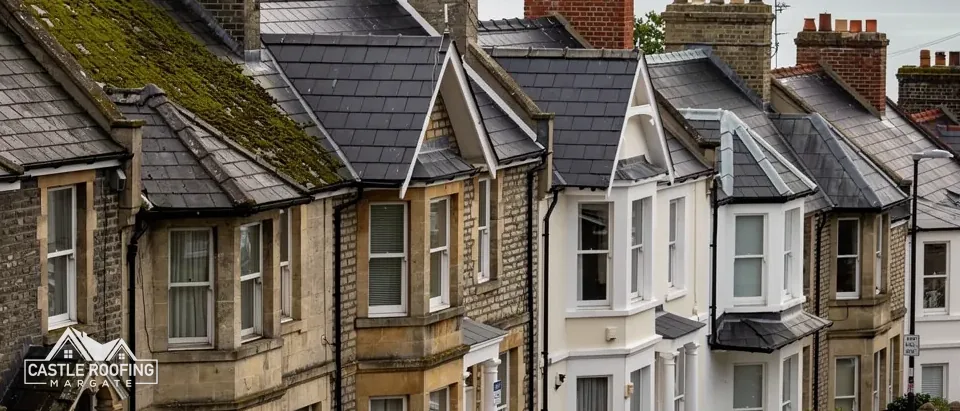
- Northdown Road: slate or tile covers the roofs, many tucked behind parapets that screen them from the street, and some are finished in fishscale slates.
Two things follow from those lines. First, even in one conservation area the council describes the roof materials as mixed, so a neighbour's roof may be quite different from yours. Second, a parapet changes what you can see from the street. Behind a parapet there is usually a gutter, often lined with lead, and a fault in that hidden channel can go unseen until a stain appears indoors.
Fishscale slates have rounded ends and are laid in rows that look like scales. They are decorative and hard to match, and a repair needs the same shape. If your roof has them, say so before any roofer quotes, and ask whether the quote allows for matching them.
Neither appraisal speaks for the roof over your own front door, so treat them as local context and not a verdict on one house.
Our page on parapet gutter repairs explains how those hidden channels fail and how they are put right.
Margate's protected areas and their dates
If you live in a conservation area, the work you can do without permission changes. Thanet publishes 27 conservation areas, and the table below lists four entries near Margate with the council's own designation dates.
| Area | Designated |
|---|---|
| Margate | 7 February 1978, extended 7 July 1994 |
| Margate Seafront | 29 January 1997 |
| Dalby Square, Cliftonville | 15 July 2010 |
| Clifftop, Northdown Road and three more Cliftonville areas | 20 October 2016 |
Conservation areas are article 2(3) land under the General Permitted Development Order, which takes away the permitted development right for dormers. Re-roofing a house falls under Class C, which has no such exclusion, so swapping the covering on a house normally stays permitted development. Conditions apply, and flats have none of these rights, so check before ordering materials.
Article 4 directions can withdraw further rights. Thanet places its directions in three Ramsgate-side conservation areas, Pegwell among them, and for what any direction covers on a roof, check with Thanet District Council. Thanet's own page adds a hopeful note for repairs that copy what is already on the roof.
Our guide to changing roof tiles and planning permission goes through what to ask. If the building is listed, consent is needed on top, and that route is separate.
The designation date matters less for the roof itself than for the paperwork. What decides the rules is the boundary line, and the council's planning team can confirm whether your own address sits inside a boundary before you commit to a design or a quote.
Slate: the faults to look for
Slate lasts well, but it is held on by fixings that do not last as long as the stone. The usual story is that the slate is sound and the nail is not.
- Slipped slates: a slate that has dropped out of line because its nail has rusted or its fixing has worn through. From the pavement it shows as a gap or a slate that sits lower than its neighbours.
- Cracked or delaminated slates, which split into layers, often at the exposed lower edge.
- Moss and lichen in the overlaps, which hold water against the slate and the batten behind.
- Failed lead at the abutments, valleys and stacks, where slate meets wall or chimney.
- Tired underlay, the sheet beneath the battens, which shows in the loft as dark patches or daylight.
A few slipped slates in an otherwise sound slope are a repair. A slope where slates are dropping out in many places, with nails rusted through across the area, points to a strip and relay or a re-roof, which is a bigger and dearer job. We tell you which you are looking at, and show you the photographs.
For a sense of national ranges, Which? Trusted Traders (November 2025) quotes £75 to £400 before VAT for swapping a handful of broken or missing standard tiles, with South East jobs likelier to land high in that scale. Larger jobs are priced once there has been a survey, with photographs of your own slopes.
Our guide to a slate re-roof, in order explains the sequence.
Clay and concrete tiles, ridges and verges
Tiled roofs fail in different places. The tiles themselves are tough, so trouble starts at the details.
On a clay or concrete roof, the ridge caps the top of the slope and the verge finishes the sloping edge at a gable. Both were traditionally bedded in mortar. After the 2015 amendments to BS 5534, mortar alone could not be trusted to hold them, and dry-fix systems to BS 8612:2018 became an option for ridge, hip and verge. Mortar that has cracked lets water into the roof and lets tiles loosen in wind.
- Cracked or missing mortar bedding along a ridge or hip.
- Verge tiles that have shifted outwards or a gap at the wall.
- Tiles that have slipped because a clip or nail has failed, leaving a visible gap in the course.
- Cracking and surface flaking on older clay tiles after frost.
- Moss in the overlaps and valleys, which keeps the surface damp for longer.
None of these faults depends on which street the house stands in. They follow the covering, and a photograph of each slope taken from the pavement is the quickest way to see them.
A change of material can change the load. If a roof is re-covered in a heavier material, the Planning Portal sets the line for building control approval at a rise of 15 per cent or more. AD A speaks of a change of more than 15%. Either way, ask the roofer to say which test they are using.
Our guides to the cost of repairing ridge tiles and to replacing a single roof tile cover the details.
Flat roofs, extensions and older garages
Most streets have houses that were altered after they were built. A flat-roofed extension, a porch, a dormer or a garage brings a second roof to look after, and these roofs age differently from the main one.
Flat roofs are covered in felt, rubber (EPDM), GRP or lead. HomeBuilding gives typical lives of 10 to 15 years for torch-on felt, 25 to 30 years for EPDM and 25 to 30 years for GRP, while Less puts felt at 10 to 20 years, EPDM at 30 to 50 and GRP at 25 to 40. Where sources differ, treat the range as a rough guide, not a date. Our page on flat roof lifespan by material sets the figures side by side.
The faults to look for are these.
- Ponding where the fall is poor.
- Blistering and splits in felt.
- Lifted edges and corners.
- Blocked outlets.
- Failed joints along the line where a flat roof abuts a wall.
Age matters most on older outbuildings. HSE's advice for buildings dating from before 2000 is to assume asbestos is present, and it calls asbestos cement roofs always fragile. Do not walk on one, and do not break it up. Our guide to whether a garage roof is asbestos explains the next step.
In a house converted to flats, find out who owns the roof before calling anyone.
- A roof over several flats may be a shared responsibility.
- A repair arranged by one occupier can raise questions with the others.
- Leasehold paperwork usually says who may instruct work.