
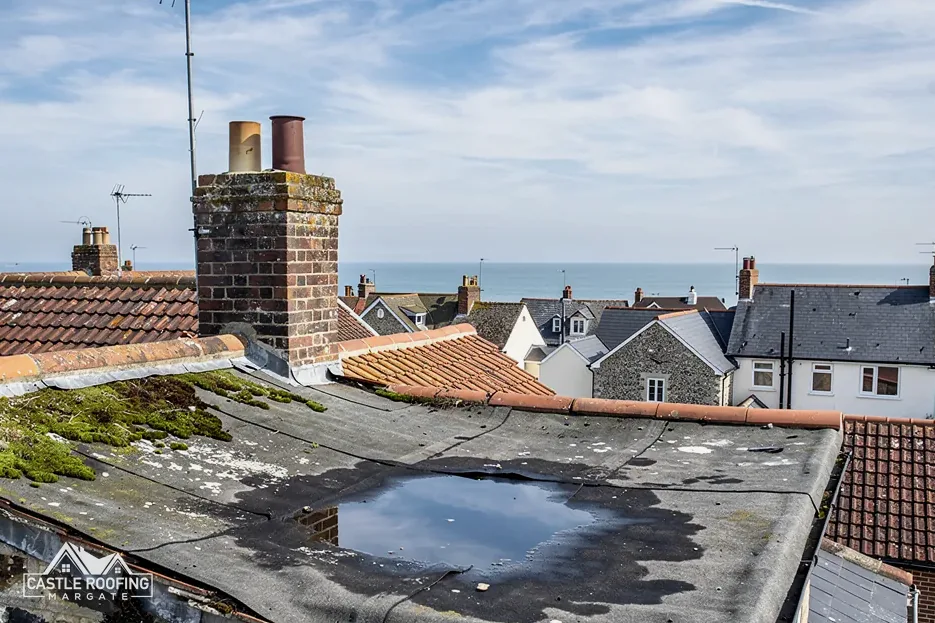
Use this to judge how much life a flat roof may have left. It sets two published guides side by side for each covering, explains why they differ, and lists what shortens any membrane's life.
Ask three roofers how long a flat roof lasts and you will get three answers, and all three can be defended. A covering's age matters, but so does the deck under it, the fall that drains it and the edges where it meets a wall. That is why published lifespans come as ranges, and why two guides often give different ones for the same material.
This guide uses two sources throughout: HomeBuilding, whose cost and life figures were last updated on 30 September 2025, and Less, whose flat roof page was updated on 27 October 2026. Where they disagree we print both rather than pick the kinder number. Lead is covered by HomeBuilding alone.
Every figure here is a typical range for the covering, never a promise about a particular roof, and a maker's cover period is a separate thing from how long a roof lasts. A roof on a Margate extension, a Ramsgate garage or a Broadstairs dormer may fall short of its range or run beyond it. If you want a view on your own roof, a flat roofing survey is the way to get one, because it looks at the layers underneath that the surface hides.
What a typical lifespan figure means
A published lifespan is a general statement about a covering done well, in ordinary conditions, on a sound deck. It is not a countdown. A membrane laid over a wet deck, or one that has held a pond for years, sits at the short end of its range or below it, and a roof with good falls and clear outlets can reach the far end. Nobody can read the remaining years off the surface, and a roofer who says otherwise is guessing.
Three habits make the figures easier to use when you read them against your own roof:
- Read the low number as the planning figure and the high number as the best case.
- Count from the day the current membrane was laid, not the day the building was built.
- Treat a patched roof as older than it looks, because each patch marks a spot where the original failed.
Weather works on the surface too. The Met Office's Manston averages for 1991 to 2020 give about 613 mm of rain a year, 110.05 days with 1 mm or more of rain and 21.43 days of air frost. A flat roof is wetted often, and frost cycles flex the edges and the joints, so the same covering ages faster where water lingers.
None of this tells you how many years a given roof has left. It tells you what a roofer is weighing when they look at it: the covering, its age, the details, and the deck beneath. The sections below take those in turn, covering by covering.
Four coverings side by side
The table sets the two guides next to each other. Where a cell reads not listed, that guide gives no figure for the covering.
| Covering | HomeBuilding | Less |
|---|---|---|
| EPDM | 25 to 30 | 30 to 50 |
| GRP | 25 to 30 | 25 to 40 |
| Torch-on felt | 10 to 15 | 10 to 20 |
| Lead | 60 to 100 | Not listed |
EPDM is a synthetic rubber membrane laid as one sheet. GRP is glass-reinforced plastic, a resin and glass-fibre skin built up on site. Torch-on felt is bitumen sheet melted onto the layer beneath it with a gas torch. Lead is milled sheet metal worked by hand, and it belongs in a different league of cost and craft.
The overlap is useful. For EPDM, the two guides disagree by two decades at the top end, so plan on the first range and treat the second as what a very good roof may reach. For GRP they agree at 25 and part at 30 or 40. For felt they agree at 10 and part at 15 or 20, so a felt roof is the covering most likely to need attention early.
Our page on how long EPDM lasts takes that membrane further. Whichever covering you are weighing, the two guides give a range to plan around, and a survey of your own deck, falls and edges is what places a roof within it.
Why the ranges for EPDM, GRP and felt overlap
The same covering can sit at either end of its range, and the overlap between materials shows why. A well-laid felt roof at 20 years can outlast a poor GRP roof at 15, which is why age and material alone do not settle the question.
What pulls a membrane toward the low end:
- Seams and laps. EPDM relies on adhesive and sealed seams, felt on welded laps, and GRP on the resin bond to the deck. A weak joint is where each one starts to fail, and a good installer spends the most care there.
- Deck movement. A deck that flexes or shrinks can crack a rigid GRP skin and open felt laps.
- Foot traffic. A roof used as a terrace wears faster than one that is only maintained.
- Heat and sun. Bitumen softens and weathers, and a mineral cap sheet or reflective finish slows it.
What pushes it toward the high end:
- A deck in good order, laid to a proper fall, so the surface dries between rains.
- Clear outlets and well-formed edge trims, so water leaves the roof instead of sitting at the perimeter.
- Careful detailing at walls, upstands and penetrations, which is where leaks tend to begin.
None of these show in a published range. All of them show at a survey, which is why we look at the details as well as the surface and send you photos of your own roof, with the weak spots marked.
Lead, the long-lived exception
HomeBuilding gives lead on a flat roof a typical life of 60 to 100 years, far past any membrane. A separate MyJobQuote page on chimney leadwork gives lead flashing a life of over 80 years, and that is a lower bound, not a ceiling or a promise. Zinc, another sheet metal, is stated at 100 years by its maker VMZinc, citing the BRE Environmental Product Declaration. That figure comes from the maker, and it binds no particular roof.
Lead is not a membrane, and the standards differ. BS 6229:2025, the code for membrane roofs on a continuous deck, does not cover it. For sheet lead, Approved Document C points to BS 6915. The sheet is sold by code, a weight and thickness class, and the specification names the code for each detail on the roof.
Lead suits roofs where the cost is justified by the age of the building or the length of life wanted:
- bay window and porch roofs on period homes
- flat roofs on listed buildings, which may need listed building consent for a change of covering
- small, complex roofs, where hand-formed sheet follows the shape better than a sheet membrane
On a lead roof the weak points are the details, laps and fixings. A lead roof therefore still wants a periodic look at the joints, even when the sheet itself is sound and the roof looks fine from below.
What to do as a roof nears its range
Reaching the bottom of a range is a reason to look, not to replace. A felt roof at 12 years or an EPDM roof at 25 can still be sound, and a roof half that age can be failing. The decision comes from the roof's condition, not its birthday, and a calm look in good weather beats a rushed one after the first leak.
A sensible order of questions for an ageing roof:
- Is water getting in, or is the surface only weathered or discoloured?
- Is the deck dry and firm, checked from above and below where possible?
- Are the failures local, at one edge or one outlet, or spread across the sheet?
- What would a repair achieve against the number of years the covering has left?
Local failures, such as a split at an upstand or a lifted seam, can usually be repaired. Spread failures, a soft deck or a membrane that has gone brittle point toward replacement. Our page on whether to repair or replace a flat roof works through that choice, and the signs a flat roof is failing list what to look for from the ground and from a window.
If you do plan a replacement, the survey fixes the covering, the build-up and the details, and the written price follows it. Cost is the other half of the decision, and it is covered in our guide to what a flat roof replacement costs.
Setting a quote against these lifespans
Lifespan figures are most useful when you hold them against a written quote. A covering with a longer typical range usually costs more to lay, so the useful comparison is cost against years, and against the condition of the roof you have today. A cheap covering laid over a failing deck is a short-lived answer, whatever its range says.
When two quotes name different coverings, ask each roofer:
- which covering is proposed, and what range its makers or published guides give
- whether the deck is being kept, repaired or replaced, and why
- what fall the finished roof will have, and where the water leaves it
- how the edges, upstands and outlets are finished
- whether the quote includes VAT and any scaffold the job needs
Citizens Advice advises collecting written quotes from at least 3 different traders before choosing one. A quote that names the covering and the build-up lets you compare like with like; one that says only a new flat roof does not.
A covering with a short typical range is not a poor choice by that fact alone. A small porch roof that will be rebuilt with the house in a few years may not need 30 years of membrane. A kitchen extension you plan to keep for decades might. Match the covering to how long you want the roof, and ask for the reasoning in writing. If a quote cannot say why it chose one covering over another, that is worth a question before you sign.


