
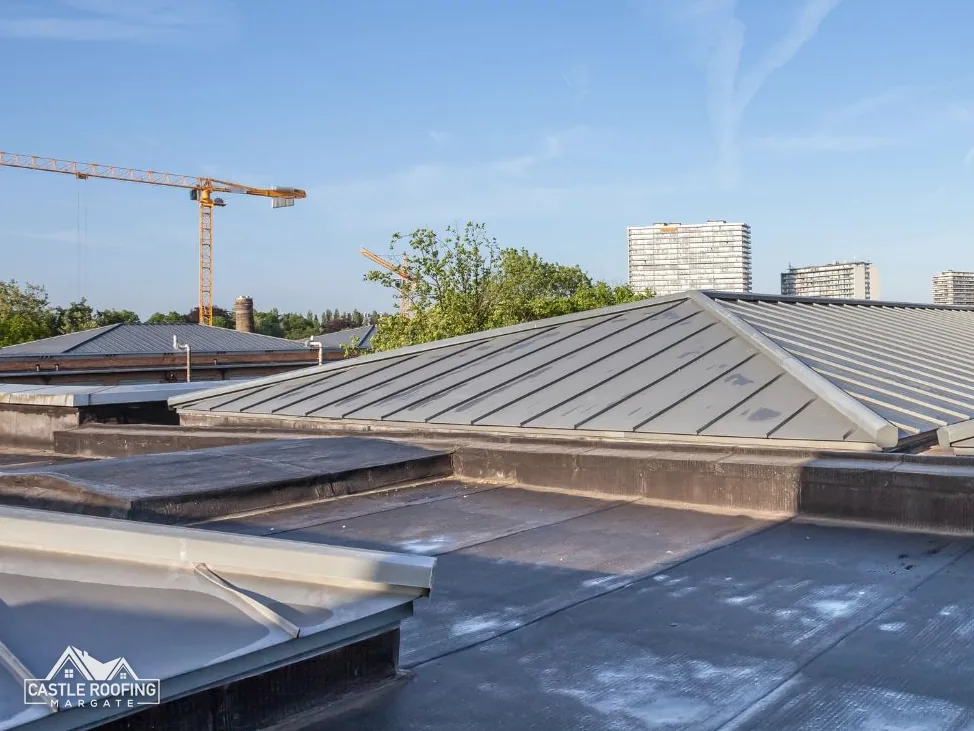
You will learn what fall a flat roof should have, why pools form, which causes you can spot from the ground, and who is responsible for putting each one right.
You look up at the extension roof the morning after a downpour and there is a shallow lake sitting on it. A day later it is still there, with a dark ring around the edge where it has been shrinking. The first question is whether this is normal. The second is whether it will leak.
Some wet patches dry out within hours and mean very little. Standing water that never clears is another matter: it shortens the life of the covering, gathers dirt and leaves, freezes in winter and loads a deck that was never designed to carry a pond. The cause is usually one of three: a roof laid with too little fall, an outlet that has stopped working, or a deck that has dipped.
These need different fixes and often fall to different people, so naming the cause matters before anyone quotes for a cure. This guide takes each in turn and shows how to tell them apart. If you want a surveyor's view, our flat roofing service starts with a look at the roof.
What ponding is, and what it is not
Ponding means water that lies on the surface of a flat roof instead of running off. It forms in a hollow, against an upstand or in front of an outlet that is not taking the flow. A wet roof is not the same thing. Every flat roof is damp for a while after rain, and a little water at the lowest corner is to be expected. Ponding is when pools stay put long after the sky has cleared.
Rain is a fair test of a roof that cannot drain. Met Office averages for Manston, 1991 to 2020, give about 613 mm of rain a year across 110.05 days with at least 1 mm. Manston's air-frost count in the same Met Office averages is 21.43 days a year. These describe one station over thirty years, so read them as a rough guide to how often a flat roof has to shed water, and how often a pool could freeze on it.
Ponding matters for four reasons:
- It rests on the covering for days, which ages seams, laps and any weak spot faster.
- It collects silt and leaf litter, which feeds moss and algae.
- It adds weight to the deck, because water is heavy.
- It hides what is going on, because a leak under a pond may not show for weeks.
None of that makes every pond an emergency. It makes one that stays worth explaining.
The fall a flat roof should have
A flat roof is built with a slope so rain drains towards an outlet. That slope is called a fall. BS 6229:2025 is the current standard for roofs finished in continuously supported flexible membranes. The 2018 edition is withdrawn. The standard applies to membrane roofs and not to lead sheet.
| Figure | What it means | Per metre |
|---|---|---|
| 1:80 | Least finished fall | 12.5 mm |
| 1:40 | Fall to design for | 25 mm |
The roofing federation reads the 2025 edition as holding 1:80 as the lowest finished slope over general roof areas as well as in internal gutters. IKO, a single-ply membrane maker, advises designing for 1:40. One is a design figure and the other a finished minimum, and the difference is worth understanding before you judge a roof by eye.
The 1:80 figure is therefore the least a finished roof should have, not the target on the drawing. At 1:80 a 3 metre run drops only 37.5 mm, which a ruler on a wet roof will not show you, so the eye alone is a poor judge. A roof built exactly to 1:80 on paper has no margin, and a small dip or an upstand set too high is enough to leave water behind it.
Our page on the minimum fall for a flat roof goes through how falls are formed in the deck, with tapered insulation, or with firring pieces, which are tapered timber strips laid over the joists.
Blocked outlets and overflowing gutters
Start with the simplest reason for a pond. The outlet, the gap through which water drains off the roof, is partly blocked. Leaves, moss, grit from the surface and the odd bit of debris collect there, and the water backs up until the level reaches the roof's low point. That is a maintenance job, not a design fault.
You can check a good deal safely from the ground or a window:
- Look at the outlet or downpipe top. Is it clear, or has it a cap of leaves?
- See whether the gutter at the lower edge is full. Water that cannot leave a gutter stays on the roof.
- Run your eye along the gutter. A sagging run holds water, and gutters need a fall of their own. Brett Martin's installation advice gives 1 mm for every 600 mm of length.
- Check the downpipe at ground level for water that backs up or never comes out.
- Note whether the pond is deepest at the outlet, which suggests a block, or in the middle of the roof, which suggests a dip.
Do not go up on a wet flat roof to clear it yourself. The membrane is slippery, can be damaged by boots and may hide a weak deck. Our page on a blocked flat roof outlet shows what a roofer does and what you can safely do from the ground.
If the outlet is clear and water still sits, the cause is elsewhere in the structure.
A deck that has dipped
The deck is the layer under the covering, usually boards or sheets over the joists, the timbers that span the room below. If the deck has softened, sagged or bowed between supports, it forms a hollow, and water runs into it. This is deflection, and no amount of outlet clearing will cure it.
Causes include a deck that was thin for its span, joists that were never big enough for the roof, boards that have rotted from a past leak, and weight added since, such as a stack of paving or a water tank. In some cases the dip came with the roof, because it was laid over a deck that was already uneven.
Signs that point to the deck rather than the outlet:
- The roof feels springy or soft underfoot when someone is on it for maintenance.
- The ceiling below has a slight belly, or the cornice has opened a hairline gap.
- The pond is in the middle of the span, away from every outlet and edge.
- It has grown deeper over a few years, not shrunk.
A rotten deck needs cutting out and replacing, which means lifting the covering over that section. A bowed deck on sound joists can sometimes be corrected with tapered insulation laid over it to restore the fall. Joists that are too small are a structural question and an engineer's job.
Our page on a sagging flat roof deck covers what is checked before a decision is made.
Design fault or maintenance job?
This is the question that decides who pays and who is responsible. A design fault means the roof was built wrongly: too little fall, a deck too flexible, outlets in the wrong place or too few. A maintenance job means the roof was built right and has been allowed to clog. The honest answer often needs a look at the roof, a note of where the water lies, and a level.
| What you see | Likely cause | Type |
|---|---|---|
| Deepest at the outlet | Blocked outlet | Maintenance |
| Deepest mid-span | Dipped deck | Repair |
| Pools beside upstands | Too little fall | Design |
| Whole roof dishes | Fall never formed | Design |
Photograph the roof a day or so after rain, from the same window or ladder-free spot each time, and note the date. That record shows a surveyor whether the water level is changing. It also helps if the roof is recent and you need to raise the matter with whoever laid it. Your rights to reasonable care and skill come from section 49 of the Consumer Rights Act 2015, and Citizens Advice runs a consumer helpline on 0808 223 1133.
A roofer can also measure, with a spirit level or a water-level, to say how far the actual fall falls short of the target. That turns an opinion into a number.
If the roof is new and ponds from the start, put it to the contractor in writing with your photographs, and ask what fall they built to. A contractor who cannot say has probably not measured it. If the roof is old, the question is different, because the original fall may have been fine and the deck has since moved. Either way, the first step is the same: find out where the water lies and why.
What a proper cure involves
The cure depends on the cause, and a good quote says which one it is. If the outlet is blocked, the answer is clearing it and the gutter, and fitting a leaf guard if trees overhang. If the deck has dipped, the answer is repair or replacement of the deck, and then a covering relaid on it. If the fall is simply too little, the answer is to build it back: tapered insulation boards laid in a new layer, a new fall formed with firrings, or an extra outlet placed at the low point.
Each of those means lifting or stripping the covering, which is why ponding is often the point at which a patch repair stops being enough. We would rather tell you that a roof can be saved with a new outlet and a re-lay of one section than quote for a full strip, and equally that a roof with a dipped deck is wasted money to patch.
For the cost, national guides give typical UK ranges. Which? Trusted Traders (November 2025) puts a 6m x 3m single garage roof in PVC or EPDM, with new boards, at £1,950 to £4,000, excluding VAT. MyJobQuote (October 2026) gives between £1,500 and £6,000 to replace a flat roof. Which? notes that its own figures run toward the dear end for a South East home, and Kent counts as one.
None of that is a price for your roof. We look at it first, find the cause, and send one written price covering the work that cures it.


