Which standard sets the number
The code of practice for flat roofs covered in continuously supported flexible waterproof coverings is BS 6229. The British Standards Institution lists the 2018 edition as withdrawn and BS 6229:2025 as current. If an older quote, specification or website still cites the 2018 edition, it is quoting a standard that has been replaced.
BS 6229 deals with membrane roofs: felt, single-ply sheets such as EPDM and similar coverings laid across a continuous deck. Lead is outside its scope. Lead sheet roofs follow BS 6915, reached through Approved Document C, so a lead flat roof is judged against a different document and its own detailing rules.
A code of practice is guidance on good practice and not a statute. Even so, it is the benchmark a surveyor or a membrane maker will measure a roof against, which is why the number is worth knowing before you agree a design. If a quote names no standard and gives no fall, that is a gap to ask about, in writing, before work begins.
1:80 and 1:40 are not the same thing
Two figures circulate, and they answer different questions.
| Figure | Meaning | Source |
|---|---|---|
| 1:80 | Minimum finished fall | BS 6229:2025 |
| 1:40 | Fall to design for | IKO |
A fall of 1:80 means the roof drops 1 unit for every 80 units across, which is about 12.5 mm over a metre. A fall of 1:40 is twice as steep, about 25 mm over a metre. BS 6229:2025 keeps the 1:80 minimum for general roof areas and for internal gutters, and the finished roof is checked against it once the covering is down and the boards have taken up their load.
The distinction matters because 1:80 is what the roof must still achieve after it is built, once boards have deflected a little and building tolerances have been taken up. IKO, a membrane maker, advises a design fall of 1:40 on its single-ply roofs, and says the code of practice gives that figure. The extra slope needs a little more build-up on the high side, which is worked out at design stage.
What too little fall does
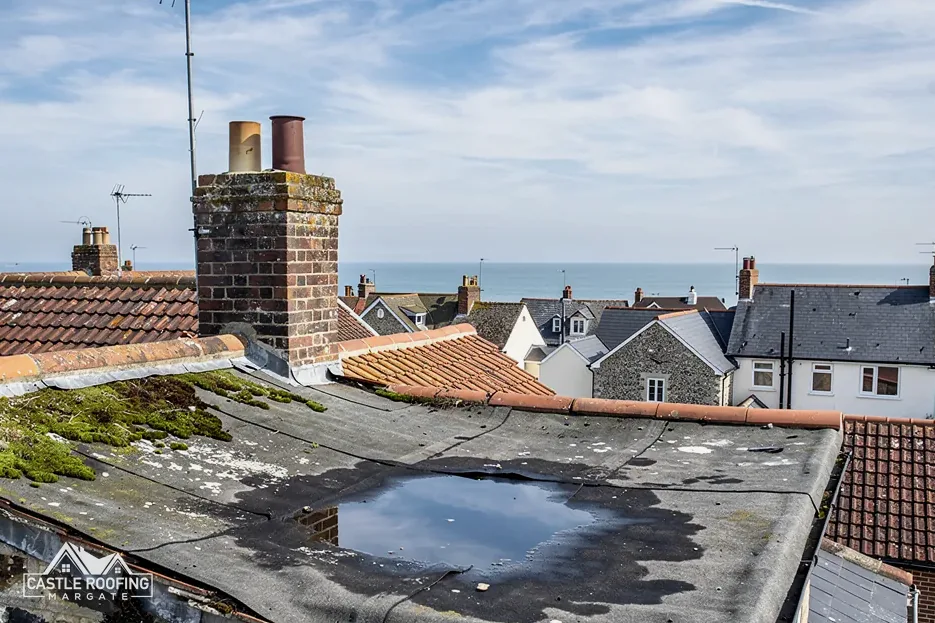
When the fall is too small, or boards sag, water stops running to the outlet and sits in shallow pools. This is ponding. Standing water does not always cause a leak, but it works against every covering over time. The lifespan figures assume a roof that drains, which a ponding roof does not.
You can spot a lack of fall from the ground floor or an upstairs window. Look for a pale ring or silt line left on the membrane after rain has gone, moss and algae in one spot, and a puddle that is still there the next day. A blocked outlet creates the same picture, so clear that first.
If a roof has lost its fall, the fix is not to patch it. The sagging deck answer covers the usual causes. Falls are usually built in with tapered insulation or timber firring pieces, which are strips laid on the joists to create the slope, and they are worked out before the new covering goes on. Both methods add thickness at the high side of the roof, which can affect door thresholds, window cills and the height of the upstand at the wall, so those heights are checked at the start.
What this means when a roof is replaced
On a replacement, the fall is part of the specification you should be told about. Ask what fall the new roof will have, how it is created, and whether the outlet positions suit it. A rear extension built with a very shallow slope might be improved by adding firring, and the surveyor can say whether that is practical given the height of the wall above it and any door thresholds.
Before agreeing a quote, check three things:
- The fall stated in writing, as a ratio such as 1:80 or 1:40, not as the word "slight".
- How water leaves the roof: the outlet, gutter or downpipe, and whether it is large enough for the area it serves.
- That the standard referred to is BS 6229:2025 and not the withdrawn 2018 edition.
Getting water off is the point of the fall, so the outlet sizes and positions are as much a part of the specification as the fall itself. Start from flat roofing if you want yours checked, and the rear extension answer if the roof in question covers an extension.