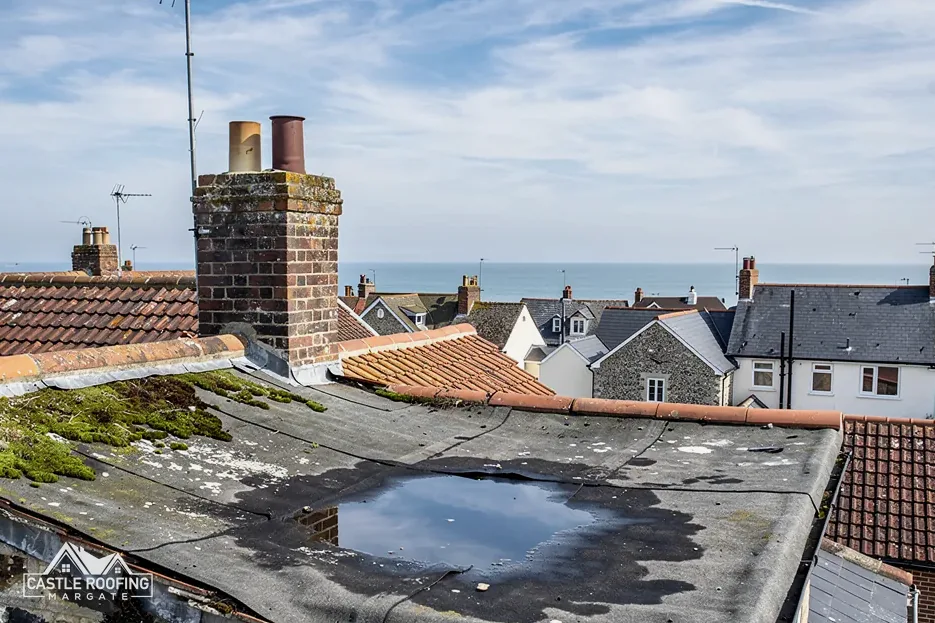
From a clogged outlet to a pond
Whatever its name suggests, a flat roof is built with a slight slope so rain runs to an outlet, a gutter or a scupper (an opening through an upstand that lets water spill out). When the outlet is clear, a shower leaves the roof within minutes. When it is partly blocked, the water drains slowly and a shallow pond forms around it.
That is ponding. A small pond on a sound roof is not an emergency on day one, but it never helps. Water stands against the seams and laps of the covering for hours instead of seconds. Sunlight, frost and dirt then work on the same patches again and again, and the surface wears at those places first.
Leaves, moss, grit shed by the covering, nesting material and the odd fallen toy are the usual culprits. On a roof beside a tree, a single autumn can fill a small outlet. A grille or leaf guard helps, but it needs looking at too, because a guard clogged with silt blocks the flow just the same.
Overflow and leaks at the upstands
A roof outlet is sized for normal rain. If it is blocked, water has two ways out: over the lowest edge, or under something. Both are bad for the building.
Where the roof meets a higher wall, the covering is turned up as an upstand. If the pond deepens enough to climb that upstand, water reaches the top edge, where the flashing and sealant are meant to keep it out. Those details are made for rain running down, not for a standing depth of water leaning on them. The same is true around rooflights, pipe penetrations and the joints in a gutter.
- Water can cross the top of an upstand and run down the inside of the wall.
- A pond can seep through a worn lap or a pinhole that stays dry in light rain.
- Overflow from the edge can soak a fascia, the soffit beneath it and the brickwork below.
The signs inside are stains on the ceiling beneath the outlet or along the wall. If a stain appears after rain, look at the roof's drainage before you look anywhere else. Our page on how a flat roof is sealed against a wall shows how those junctions are built.
Clearing leaves and moss
Many blockages can be cleared by hand from a safe position: lift the grille or guard, remove the debris and pour a little water down the outlet to check it runs. Moss builds more slowly, but a mat of it beside an outlet holds water back and gives leaves something to cling to.
Getting onto a roof to do this is where care is needed. A roof that looks solid may not be, and some surfaces turn slippery with moss or frost. If you cannot reach the outlet from a window or a proper ladder, leave it to a roofer who has the right access.
Where debris keeps returning, ask why. A tree overhead, a gutter that is too small, or an outlet set too high above the finished surface could each be the cause. A roofer can see whether the outlet sits at the lowest point or has been left high and dry.
A clean outlet is also worth checking at the first heavy rain after clearing. Watch the water leave the roof: it should run steadily, not trickle, and no pool should linger near the outlet an hour or so after the rain has stopped. If a pool stays, the fall around the outlet deserves a look next.
Falls that stop a pond forming
Even a clear outlet cannot cope if the roof has no real slope. BS 6229:2025 sets out the code for membrane roofs, and it asks for no less than 1:80 as the finished fall over the general roof. IKO, a single-ply maker, recommends designing for a fall of 1:40, pointing to the code of practice. A fall that looks right with a spirit level on the day can still hold water once the boards have sagged.
Where a roof holds water around the outlet even when it is clear, the cause may be sagging boards, a sunken deck or an outlet that was fitted too high. These show up as a pond that stays a day after the rain stops. See the minimum fall for a flat roof and a sagging flat roof deck for the next step.
If a roofer finds the outlet blocked and the ceiling stained, the question becomes whether the covering is still sound. We study the roof first, then send one written price. The full range of work is under flat roofing.