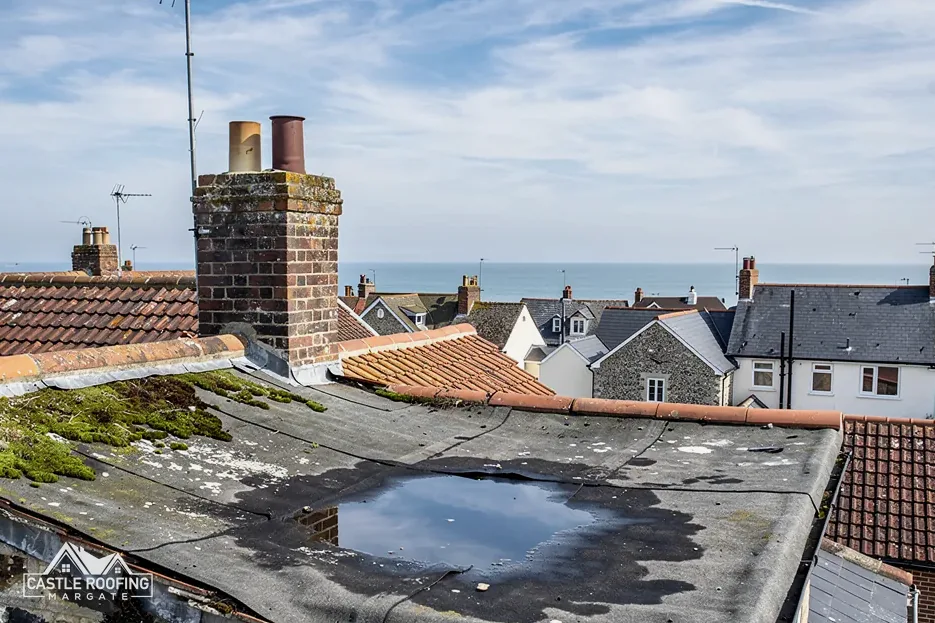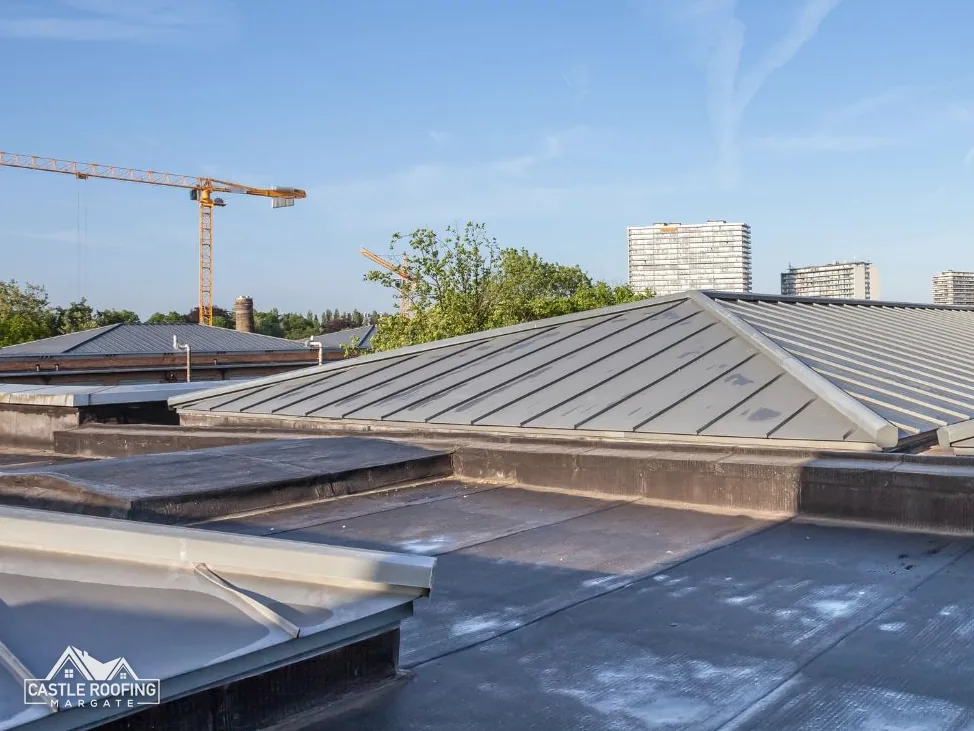
Use this to decide before you call anyone. It sets out what splits, blisters and a soft deck each mean, what a repair can achieve in each case, and which findings point to a full replacement.
A flat roof that leaks puts its owner in a bind. Repair it and the same leak may return in a year; replace it and a perfectly mendable roof has been thrown away. The right answer depends on one thing above all, which is how far the damage spreads and whether the deck beneath the membrane is still sound.
A repair deals with a place. A replacement deals with a roof. A split in a seam, a lifted edge or a failed seal round an outlet is a place, and it can often be fixed in an afternoon. A membrane that is cracking in many spots, blistering across its width or lying over a soft deck is a roof problem, and patching it only moves the leak to the next weak spot.
This guide walks through the common findings and what each one usually means, then looks at published repair prices and the point where mending stops making sense. It sits within our flat roofing work, and the survey is where a roof is judged against it. You are shown photographs of the roof itself, taken at the time.
What splits, blisters and ponds usually mean
Each visible fault points toward a cause, and the cause decides whether a patch will hold. The table sets out the usual reading. It is a guide to what the survey looks for, not a diagnosis from the ground.
| What you see | Usual cause | Often |
|---|---|---|
| Split at a seam or upstand | Movement or a weak joint | Repair |
| Single blister | Trapped air or moisture | Repair |
| Many blisters | Moisture through the layers | Replace |
| Standing water | Poor fall or blocked outlet | Either |
| Spongy underfoot | Wet or rotted deck | Replace |
The last column is a starting point, not a verdict. A blocked outlet that has caused ponding is cleared in minutes, and a split caused by a deck that has moved is a symptom of something larger. That is why the survey looks at the cause before it recommends the cure.
Staining on the ceiling below tells you water is arriving, but not where it enters. Water can run along the deck or between the layers before it drops, so the stain and the hole are often some distance apart. A repair that goes where the stain is can miss the entry point. The survey follows the water back, from the stain through the ceiling, deck and layers to the opening.
Weather adds to this. Manston, on the Met Office 1991 to 2020 averages, sees about 110 days a year with 1 mm or more of rain, so a small fault is tested often. A flat roof with a weak point does not stay quiet for long.
Splits and open seams: when a patch is enough
A split is a break in the membrane. On a single-ply roof such as EPDM it is usually at a seam, an edge or a corner. On felt it tends to be at a lap, where one sheet overlaps the next, or at an upstand, the turned-up edge where the roof turns up against a wall.
A patch is a sound answer when:
- the damage is limited to one spot or a short length
- the membrane around it is flexible and still bonded to the deck
- the deck beneath is dry and firm
- the roof is not near the end of its typical range
On an EPDM roof, a repair means cleaning the area, applying primer and bonding a patch or a strip of splicing tape over the break. A felt roof takes a patch of cap sheet, bonded with heat, or a local application of a liquid coating.
Look at the cause before accepting the patch. A split along an upstand often shows that the membrane has pulled away from the wall as the roof has moved, and a patch on its own may open again. Re-forming the upstand, so the membrane has slack, is the more durable fix. Our page on the signs a flat roof is failing shows what a spread-out problem looks like, so you can tell it from a single split.
For the patch to be worth doing, the job also needs a dry day and a dry surface. Bonding to a damp membrane fails, which is why emergency repairs in winter are often a stopgap that is revisited in spring.
Blisters and what is under them
A blister is a raised bubble in the membrane. It forms when air or moisture is trapped between the covering and the layer beneath, and warm weather expands it. On a felt roof the cause is often moisture that was in the deck or the old layers when the felt was laid.
One or two small blisters on an otherwise sound roof are usually watched rather than cut. If they stay the same size and the felt is not cracked, they may do no harm for years. Cutting a blister open invites water in, so a blister is treated only when it is leaking or when it sits where it will be walked on or flexed.
The warning sign is a spread. Many blisters across a wide area tell you that moisture is moving through the roof, and a repair to each one is chasing a fault that lies underneath. At that point the sound next step is to find out how wet the build-up is. Our guide to blisters on a felt roof covers what to check.
Questions the survey asks about a blister:
- Is it dry inside, or does it hold water?
- Is the felt cracked on its crown?
- Does it sit on a lap, an edge or a joint in the deck?
- Are there others nearby, and are they growing?
The cost of leaving a blister is usually modest, which is why the survey does not rush to cut. The cost of missing a spreading blister problem is a wet deck, and that is expensive.
A wet or soft deck: where repair stops
The deck is the structural layer, usually plywood, boards or concrete, that the waterproofing sits on. When a leak has run for a long time, the deck can take on water and begin to rot. A deck that is spongy underfoot, dips between the joists or shows dark staining from below has stopped being a matter for a patch.
The reason is simple. A membrane can only be as sound as its base. New waterproofing laid over a soft deck is bonded to a surface that is already failing, and the repair moves with it.
The decision from the deck's condition:
- A dry, firm deck: repair or replace the membrane as its condition suggests.
- A damp patch confined to one area: cut out and renew that board, then repair or recover.
- A soft or rotted deck across a wide area: strip back to the structure and re-deck, then lay a new membrane.
A re-deck is the point where a repair turns into a replacement, since the membrane has to come up whatever its condition. Our page on a sagging flat roof deck covers what causes a dip and what a fix involves.
Where there is access, the survey also checks from the loft or the room below, since a deck stained from underneath tells its own story. We record what we find and show you the photos before any decision is made.
Published repair and replacement prices
Published figures give a sense of scale, not a quote. Checkatrade's repair guide, updated in June 2026, gives EPDM rubber repairs at £120 to £170 per square metre, exclusive of VAT, on a basis that applies up to a maximum of 3 m². Treat it as a rate for small patches only, which cannot be stretched into a price for a whole roof. The table sets two MyJobQuote figures beside it.
| Source | What it covers | Figure |
|---|---|---|
| MyJobQuote, October 2026 | Average roof repair | Around £650 |
| MyJobQuote, October 2026 | Flat roof replacement | £1,500 to £6,000 |
The repair average is for roof repairs in general, not for flat roofs alone, and it is an average rather than a floor or a ceiling. These are typical UK figures from third-party guides, not our prices, and Which? and HomeBuilding report dearer work across London and the South East, which takes in Kent.
The comparison to draw is cost against remaining life. A repair that buys a few more years of a roof with plenty of range left is good value. The same fix on a roof close to the end of its range can be money spent on the way out. HomeBuilding gives torch-on felt a typical 10 to 15 years, and EPDM 25 to 30, so the age of the covering matters. The cost guide for flat roof replacement explains why quotes differ.
When a new membrane is the right answer
Replacement is the right answer when repair would be a short-term fix with the same fault waiting behind it. The findings that point that way tend to come together.
Signs that a new membrane is the sensible choice:
- the leak keeps returning after patches, in different places
- blisters, splits or cracking cover much of the surface
- the deck is soft, rotted or has sagged
- the roof is at or past the typical range for its covering
- the roof holds standing water because the fall is wrong
- the insulation beneath is soaked and has to be replaced
- the ceiling below keeps staining, however often the roof is patched
Where several of these apply, the roof is giving out as a whole. A new membrane, laid on a repaired deck and to a proper fall, gives you a roof with its life ahead of it, rather than a series of repairs. If you replace the waterproof layer, check the Building Regulations question with building control first, since renewing the waterproof layer can bring insulation upgrades with it.
Equally, a roof with one local fault, a dry deck and years in hand deserves a repair, and we will say so. The survey ends with a plain recommendation and the reason for it, then one written price, with the photos that support the recommendation so you can weigh it yourself before deciding which way to go.