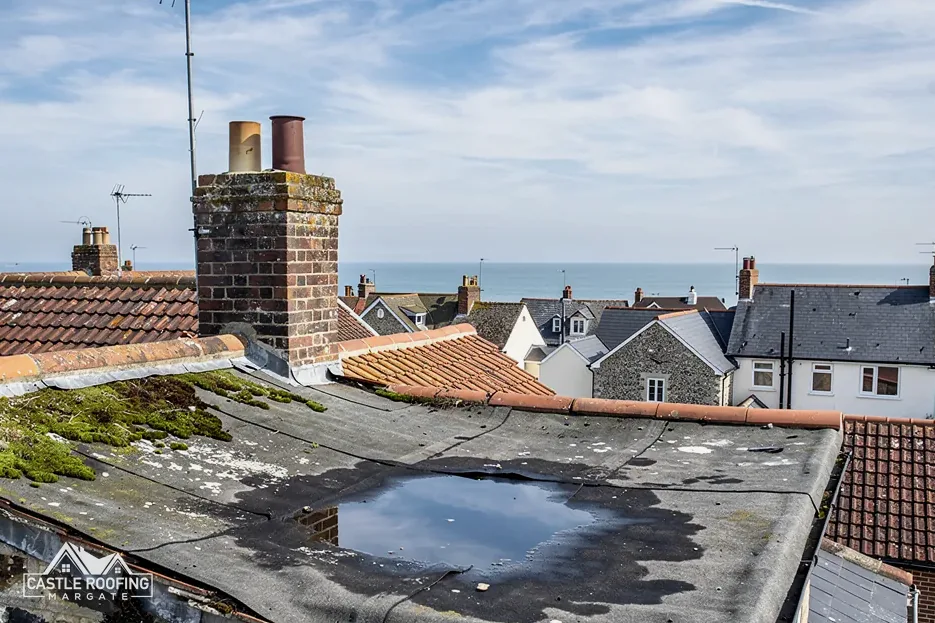
What is going on inside a blister
Modern felt roofs are built in layers of bitumen-coated sheet, joined together by melting the underside with a flame (hence torch-on). The layers should be stuck to each other and to the deck, with no gaps. Where a patch of bond is missing, a pocket can form.
Moisture and air get into that pocket in two main ways. Rain finds a way past a lap, a tear or a worn edge. Damp can also be sealed in at the start, when the deck was not fully dry on the day the felt went down. Then the sun does the work: a dark roof surface gets hot, the trapped pocket expands and the felt lifts. At night it cools and the vapour inside turns back to liquid, and the next morning it happens again.
That daily cycle matters. Each round stretches the felt a little more and weakens the bond around the edge of the blister. A bubble the size of a coin can grow into one the size of a dinner plate, and then the felt over it cracks.
When a cut and a patch is enough
One or two blisters on a roof that is otherwise sound can be repaired. A roofer opens the bubble, checks what is inside, lets the area dry and bonds the felt back down before a patch goes over the top. The patch must lap beyond the opened area so water cannot sneak underneath it.
The roof is a good candidate for a patch when:
- the blisters are few and small,
- the felt around them is firm and well bonded,
- the deck beneath is dry and does not feel soft,
- the roof still has plenty of working life ahead.
HomeBuilding gives felt a typical life of 10 to 15 years, while Less gives 10 to 20 years. Those are published ranges, not promises. Age is a clue, not a verdict, so a roof at the upper end of the range deserves a harder look before anyone spends money on a patch. Patching a roof that is about to fail only puts off the bigger bill.
Do not cut a blister open yourself, least of all on a wet day. The felt may be hiding a wet deck, and an open cut on a cold, damp roof does more harm than good.
When blistering means the roof is done
The picture changes when blisters are many, large or joined together. Patching a roof full of bubbles is like patching a worn jumper: the next hole opens beside the last one, and each patch adds another edge for water to try.
| Pattern | Likely meaning |
|---|---|
| One small blister | A local pocket; a patch may do |
| Blisters near laps and edges | Water getting in at the joins |
| Blisters across the whole surface | Felt close to the end of its working life |
| Soft or spongy underfoot | Wet or rotting deck below |
A soft patch of deck changes the job. Timber that has been wet long enough must be replaced, and a new covering cannot be laid over a bad deck without the trouble coming back. At that point the straight advice is often to replace the covering rather than keep repairing it. Check the ceiling directly below the worst area: a stain there tells you the water has already crossed the felt. Our guide to repair or replace a flat roof goes through how that decision is made.
What to do before anyone gets on the roof
Photograph the blisters from the ground, a window or a safe step ladder. Note the date, because a roofer can read a lot from the pattern across the roof. Repeat the photographs a week later with a tape or coin beside the largest blister, to see whether it is growing. Check inside for stains on the ceiling beneath, since a damp patch in the room often lines up with a blister outside.
Stay off the roof. Walking across a blistered area can burst bubbles and press water into the layers, and an old felt surface is slippery in the wet. A coating brushed over blisters does not remove the cause either. If you are tempted by a quick coat, coating an old felt flat roof explains what it can and cannot do.
For the wider picture of how long felt lasts and what wears it out, see how long a felt flat roof lasts. All our work on these roofs sits under flat roofing. Send us your photos and we tell you whether the patch is worth it or the roof needs more.