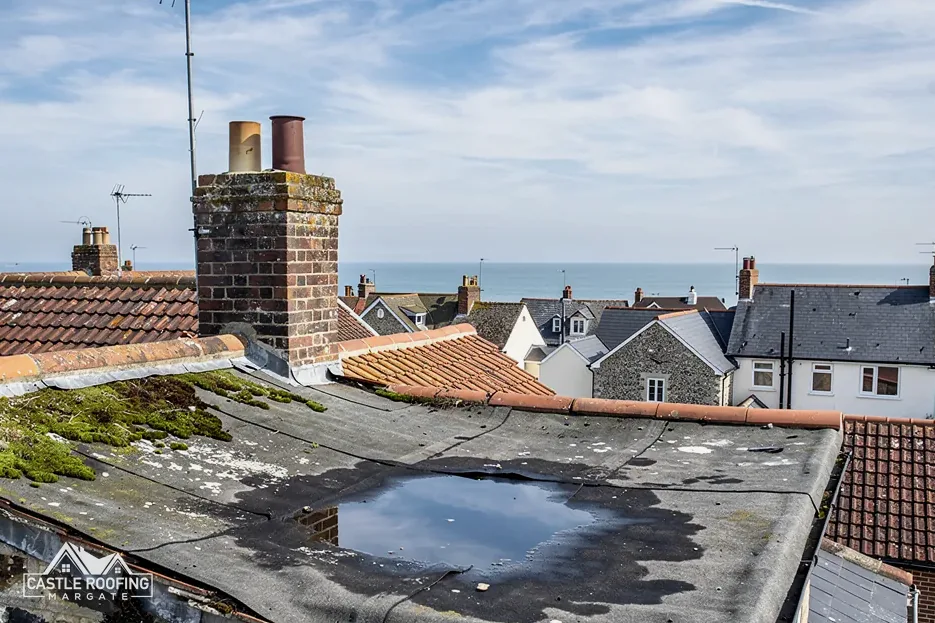
The deck has to be checked first
The old covering is only the top of the roof. Under it sit the deck, which is the boards or sheets that carry the weather layer, and the joists that carry the deck. An overlay means every one of those stays in place, so each has to be fit to stay.
The checks that decide whether an overlay is realistic are these:
- Is the deck dry? Water that has leaked through the old covering for months will have soaked into the boards.
- Is it firm? Walk the roof and feel for soft or springy patches, which suggest rot.
- Is the old covering well bonded? Loose, blistered or badly lapped felt makes a poor base for a new sheet and shows through as ridges.
- Is the fall right? A roof that ponds will pond again if the shape is not changed.
- Is the roof carrying extra weight already? A second covering adds to the load on the joists.
A surveyor often opens a small inspection cut in the old covering to look. Photos alone cannot show what lies below the surface, which is why that cut is worth the effort, and why a quote for an overlay that has been given without a visit deserves a question.
Moisture trapped between the layers
Trapped moisture is the main risk with an overlay. If the old roof held water in the deck or between its own layers, laying a new waterproof sheet on top stops it escaping. The water warms in the sun, turns to vapour, pushes up under the new sheet and forms blisters. In winter it can sit against the boards and encourage rot.
Condensation from inside the building does the same job. Warm, damp air from the house passes through the ceiling, reaches the cold underside of the deck and condenses there. A roof with no vapour control layer or ventilation will keep that moisture trapped under a new covering, as it did under the old. The condensation answer explains the symptoms.
This is why stripping to the deck is the standard approach on many jobs. It lets a roofer see what is below, dry or replace damaged boards, and build the roof up again in the right order. It costs more labour, but it removes the doubt, and the old covering and any wet boards leave site with the waste.
Approved Document L when the membrane changes
Approved Document L covers energy saving under the Building Regulations, and its 2021 edition with the 2023 amendments counts a new waterproof membrane laid on a flat roof as renovation work. In the 2010 regulations, renovating a thermal element means adding a layer or swapping one. An overlay adds a new layer, so it is worth asking your building control team how it treats one.
For existing elements, Table 4.3 sets a roof threshold of 0.35 and an improved U-value of 0.16 W/(m²·K). Paragraph 4.13 allows a smaller upgrade where the better figure is impractical on technical or functional grounds, or where a simple payback of 15 years or less would not be reached.
In practice, a replaced or added layer on a flat roof prompts a conversation about insulation. Whether the work needs a building control application is a separate question. Thanet's council points enquirers at the Planning Portal. The Portal's test is no approval, normally, where less than 25 per cent of the building envelope and less than 50 per cent of the roof is affected, so the share of the building touched decides it, along with any change in the weight of the covering. The next edition, AD L 2026, takes effect on 24 March 2027.
Weight, and when an overlay makes sense
A new covering that adds weight can bring its own rule. The Planning Portal says approval is needed where a new material makes the roof covering 15 per cent or more heavier, and Approved Document A calls a loading increase of more than 15% significant. Two layers of felt on old boards can approach that, and the Planning Portal recommends consulting a structural engineer or surveyor before works begin. The sagging deck answer explains why a tired deck cannot be trusted with extra load.
An overlay makes sense in a narrow set of cases: a dry, firm deck, an old covering still well stuck down, adequate falls, and a build-up that meets the insulation rules. Anything else points to a strip.
For the full picture of a replacement, read the flat roof Building Regulations guide or start from flat roofing. If another roofer has proposed an overlay, ask them to show you what they found in the inspection cut, and how the old and new layers will be vented and drained.