Use this as a checklist when a flat roof over a kitchen, extension or garage is inspected. It names each part, what a sound one looks like, what a failing one looks like, and why a fall of 1:80 matters.
A flat roof rarely fails all at once. It gives notice: a ceiling stain that dries and returns, a puddle that is still there two days after rain, a seam that has lifted at one corner. An inspection exists to read those notices before a leak reaches the room below.
Flat roofs are not flat. They are built with a slight slope so water runs to an outlet, and nearly everything an inspector looks at is about keeping that water moving: the waterproof layer, the places where it turns up a wall, the outlet it drains to and the deck that carries it all. Each of those has its own signs of wear.
This guide goes through them in the order a visit follows. The visit is part of our roof inspections work, and it applies to a rear extension in Margate, a dormer in Ramsgate or a garage in Broadstairs just the same. For the photographs a visit produces, see roof inspection photos.
The membrane: surface, laps and seams
The membrane is the waterproof skin of the roof, whether it is felt, EPDM rubber, GRP fibreglass or lead. It is the first thing looked at because it is the only thing between the weather and everything else. An inspector walks it, or views it from a ladder or an upstairs window if walking would risk damage, and reads the surface for the following.
- blisters, which are raised pockets in felt where moisture or air is trapped
- splits and cracks, especially where they follow the board joints underneath
- surface crazing and a chalky, grey or bare look on a coated roof
- patches laid over patches, a sign of earlier repairs
- moss, silt or leaf debris holding water against the surface
Laps are the next target. A lap is where one sheet overlaps the next, and on a felt roof it is bonded by heat or adhesive. On a single-ply membrane, which is one factory-made sheet such as EPDM, the joints are glued or taped. On GRP the sheet is continuous, so a crack is the thing to find. In each case the question is whether the joint is still closed, because an open lap lets water travel sideways under the surface for some distance before it shows indoors.
Where a roof is felt, the page on blisters on a felt roof explains what a blister can and cannot mean. Lead on a flat roof follows a different code from membrane roofs: BS 6915 via Approved Document C, not BS 6229, so it is judged by different measures.
Upstands, flashings and edges
An upstand is the part of the membrane that turns up a wall, a parapet or a roof light kerb. It is a weak point, because the flat area is simple and the junction is not. The membrane has to rise, be fixed at the top and be covered, so that rain sliding off the masonry is turned away from the gap. A fixing that has pulled loose, or a cover that has slipped, leaves a path straight behind the membrane.
| Detail | Checked for | Sign of trouble |
|---|---|---|
| Wall upstand | Fixing at the top | Gap or lifted edge |
| Flashing | Cover over the upstand | Slipped or cracked lead |
| Edge trim | Drip over the gutter | Water tracking back |
| Roof light kerb | Corner folds | Splits at corners |
| Pipe penetration | Collar and seal | Perished sealant |
A flashing is the strip, often lead, dressed over the top of an upstand. At a wall abutment, the point where the roof butts against the side of the house, it forms the weather barrier above the membrane. The page on the flat roof wall abutment shows how that joint is made.
Edges matter as much. The edge trim carries water off the roof over the gutter. If the trim is too short or has lifted, water runs back under the edge and into the timber behind it, and that damage hides until the fascia or deck gives way. Corners and folds are checked on every upstand, since a membrane that is folded sharply is thinner there.
Outlets, gutters and falls
Water leaving the roof does so through an outlet, which is a drain in the surface or a gutter at the edge. A flat roof with a blocked outlet is a pond waiting to happen, so each is cleared and watched. Leaves, silt and moss gather at outlets first, and the page on a blocked flat roof outlet goes into what to do about it.
The fall decides whether water reaches the outlet at all. BS 6229:2025 is the current standard for membrane roofs laid on a continuously supported deck, and the 2018 edition is withdrawn. It applies to membranes only, and not to lead. Under it, a finished roof keeps at least 1:80 across its open areas and in any internal gutters, which means 1 unit of drop for each 80 units of run.
That figure is a minimum for the finished roof, not a design target. IKO, a membrane maker, advises designing single-ply roofs to 1:40, a steeper figure than the 1:80 finished minimum. Our page on the minimum fall for a flat roof gives the arithmetic.
Signs the falls have gone wrong:
- Water still standing on the surface days after the rain has stopped.
- A tide mark of silt marking where the puddle used to reach.
- Dirt and algae growing in a ring at the low point.
- A deck that dips between joists when it is pressed.
Ponding is not always a leak, but it ages the membrane faster, and it can be a sign that the deck or joists below have moved.
The deck underneath: soft spots
The deck is the board or timber layer under the membrane. It carries the weight of the covering and the people who walk on it, and it has to stay dry. An inspector checks it by feel and by sound: pressing along a line, treading carefully and noting any give. A deck that flexes underfoot has lost its stiffness, and a deck that is soft in one patch has usually been wet for some time.
Evidence that water has got in:
- a spongy patch that returns slowly after pressure
- dark staining or a musty smell at an open edge or outlet
- fungal growth along a board edge visible from the ceiling or soffit
- nails or screws backing out where boards have shrunk or swelled
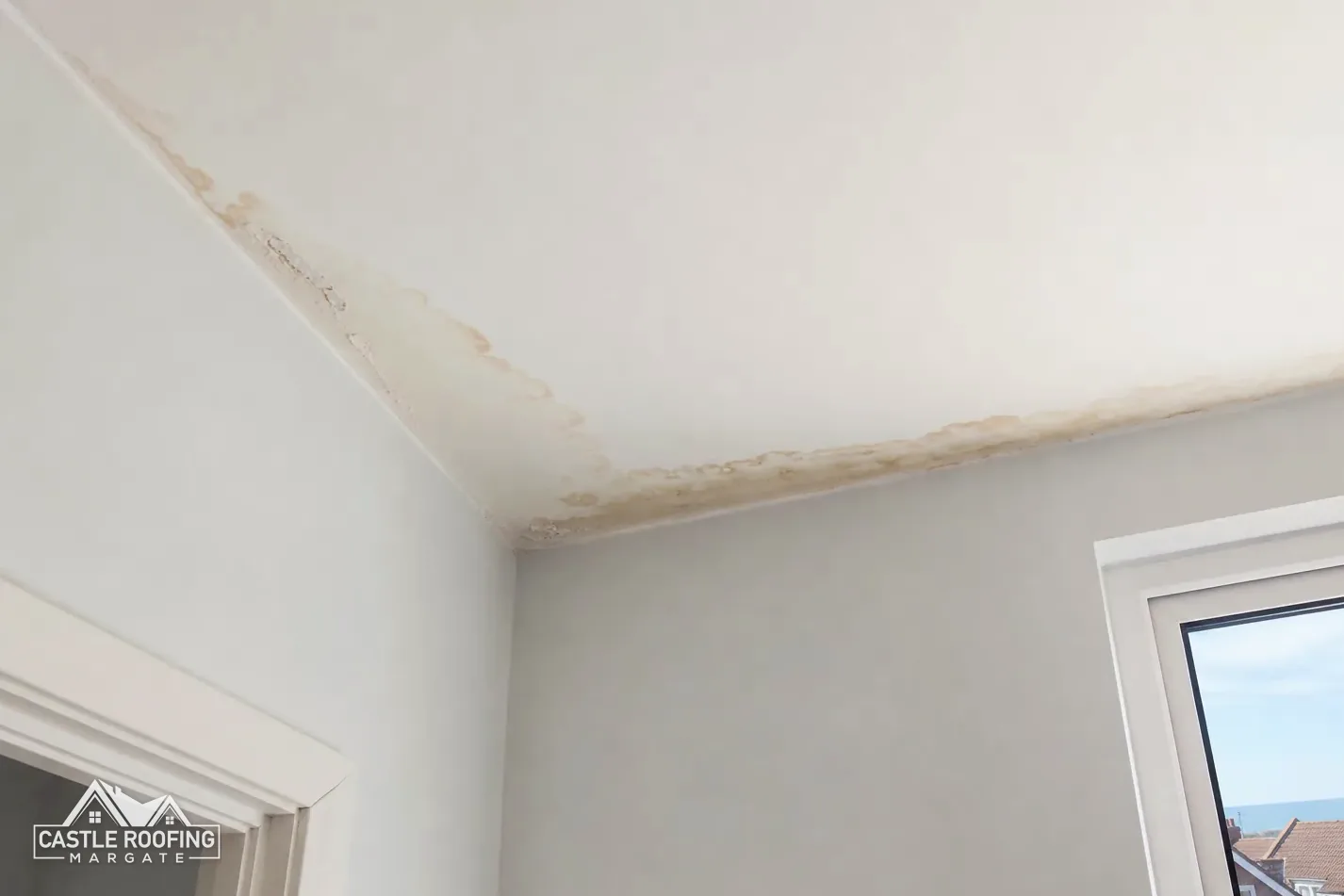
The ceiling below adds clues. A brown ring with a darker edge is a stain that has been wet more than once. A stain that grows only in cold weather can point to condensation rather than a leak, and the page on condensation under a flat roof explains how to tell the two apart.
Where the deck has failed, patching the surface alone does not hold, since a new membrane stuck to rotten boards will lift with them. The inspection report says so, and says how much deck is affected. If the deck needs renewal, replacing the waterproof layer counts as renovation under Approved Document L, with the roof figures in Table 4.3: 0.35 as the threshold and 0.16 as the improved value.
Lifespans as context, not promises
An inspector cannot say exactly how long a roof has left, but the covering's typical life gives context for the findings. The figures below come from two published guides, and they disagree for some materials. They are typical ranges, never promises for a particular roof, and the length of a product warranty is a separate matter from how long a covering lasts.
| Covering | HomeBuilding | Less |
|---|---|---|
| EPDM | 25 to 30 years | 30 to 50 years |
| GRP | 25 to 30 years | 25 to 40 years |
| Felt (torch-on) | 10 to 15 years | 10 to 20 years |
For lead on a flat roof, HomeBuilding gives 60 to 100 years, and MyJobQuote puts lead flashing at over 80 years, a lower bound and no ceiling. Lead sits well beyond the other coverings in the table.
Age shifts how a finding is read. A split in a covering close to the end of its range points towards replacement. The same split in a young one points towards a repair, and perhaps to a fault in the laying, which is worth finding before more money is spent. Our page on flat roof lifespan by material goes through the comparison.
An inspector judges a roof by its condition, whatever the age on paper. Afterwards a written report arrives with pictures taken on your own roof, and a repair, an overlay or a full replacement follows only if the findings call for it.
What the report records and what follows
The visit ends with a written report, and the report is more useful when it is specific. A line that says only "flat roof in poor condition" gives you nothing to act on. A good one names each defect, says where it is and says how serious it looks, so that you can decide between a patch, a repair of a whole section and a new covering.
A usable report records:
- the covering, its apparent age and any earlier repairs
- every defect, with a photo and a position on a simple plan
- the state of the outlets, the edges and every upstand
- the condition of the deck wherever it could be tested
- any water pooling, with a view on whether the falls are the cause
- what the inspector could not reach or see
The last item matters. Frost, a wet surface, a skylight in the way or a roof too fragile to tread all limit what a visit finds. A report that admits the gaps is more trustworthy than one that fills them with guesses.
What follows depends on the findings. A small repair, such as resealing an upstand or clearing an outlet, may be all a sound roof needs. A pattern of failures across a roof near the end of its range usually points to overlaying or replacing it, and our page on how often a roof should be inspected helps you plan the next visit either way.
If access is the worry, the page on inspecting a roof without scaffolding shows what can be read from a ladder, a window or a mobile platform.