What decides the size
A gutter has to carry the water that lands on the roof above it to the nearest downpipe, fast enough that it does not spill over the front. Three things set how hard it has to work:
- The roof area draining into it, taking in the whole width of the slope from ridge to eaves.
- The number of outlets, and how far water must travel to reach one.
- The fall of the run, since a gutter that slopes properly moves water faster.
A long, wide slope with a single outlet at one end works the gutter far harder than a short run with an outlet at each end. That is why two houses of the same size can need different gutters, and why a neighbour's gutter is a poor guide to yours.
Gutters come in several channel sizes and profiles, from small ones for sheds and porches to wide ones for large roofs. The maker's data sheet states what area each size and outlet arrangement serves, so a capacity figure comes from the product and not from a general rule. BS EN 12056-3 covers the layout and calculation of roof drainage.
Roof area and outlets in plain terms
Think of the roof as a funnel. Rain lands on every tile or slate on the slope and runs down to the eaves, and all of it ends up in one place. The wider the slope, the more it delivers.
A hipped roof, a roof with a valley and a roof with a dormer all add water to particular parts of the gutter. A valley on the roof pours its flow into the eaves gutter at a single point, so the run below it takes a concentrated load. A roof with a long, unbroken slope delivers an even sheet of water along the whole run.
Where the outlet sits matters as much as the size. An outlet half-way along a long run serves both halves, while one at the end makes the water travel the full length. Adding a second outlet and downpipe can help more than fitting a bigger channel, though it depends on where a pipe can run. Our page on blocked downpipes shows how a downpipe that is clogged limits the whole run, whatever size the gutter is.
When gutters overflow in heavy rain
Overflow is not always a sizing problem. The first things to check, before anyone talks about bigger gutters, are:
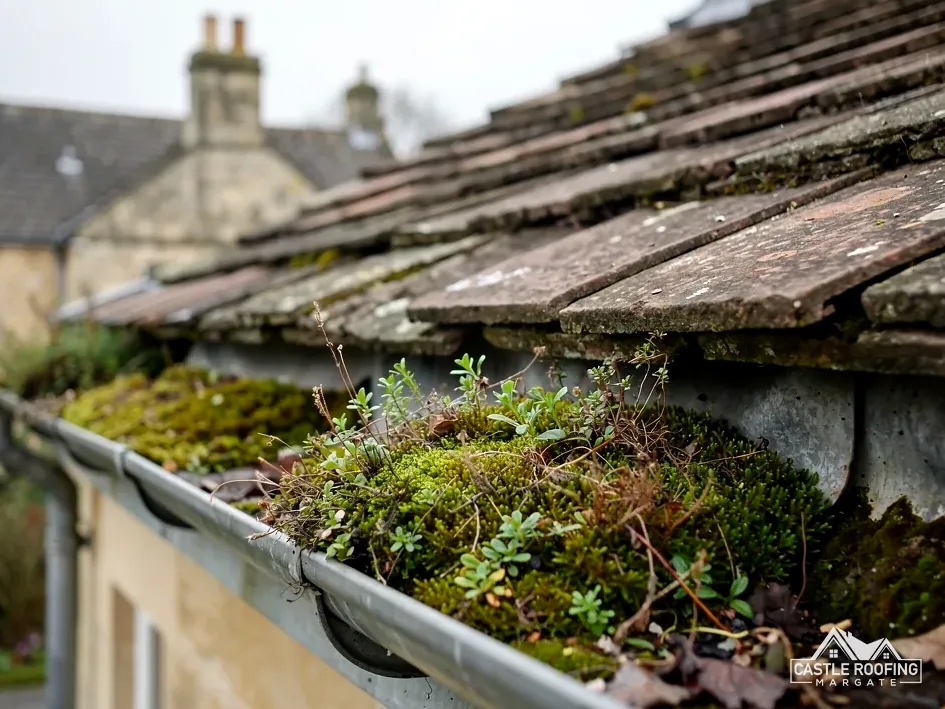
- Is the outlet or downpipe blocked with leaves, moss or roof grit?
- Does the run have the right fall, or does it hold water?
- Have the joints failed, so water leaves through them?
- Are the brackets holding the run in line?
Our guide to the causes of overflowing gutters goes through them in order. Met Office figures for Manston, averaged over 1991 to 2020, give about 613 mm of rain a year and 110.05 days with 1 mm or more. An average says little about a cloudburst, which is what a gutter is tested by.
If the run is clear, sound and at the right fall, and still spills in a downpour, then the channel or the outlets are too small for the roof. That is when upsizing is worth considering, by fitting a wider channel, an extra outlet or both. The roofer should be able to say which of the two the roof needs.
Upsizing when you replace
The best time to change the size is when the gutters are coming off for another reason. A replacement run can be larger than the old one, provided the fascia can carry it and the brackets and downpipes are matched. A larger channel is heavier when full, so the board behind it has to be sound. Downpipes should be matched to the new gutter too, since a wider channel feeding a pinched downpipe only moves the overflow somewhere else. Our page on rotten fascia boards shows what to check.
Profile also affects the choice. If the house has an ogee or a half-round run, the new one should usually match, and ogee and half-round gutters explains why.
For cost, MyJobQuote gave around £1,000 to £1,600 for gutter replacement in October 2026, a typical UK range, which is a guide and not our price. A roofer who sizes by measuring the roof, and not by guessing, should be able to say why the channel and outlets are what they are, and the written price follows from that survey. The wider work is at guttering, soffits and fascias.