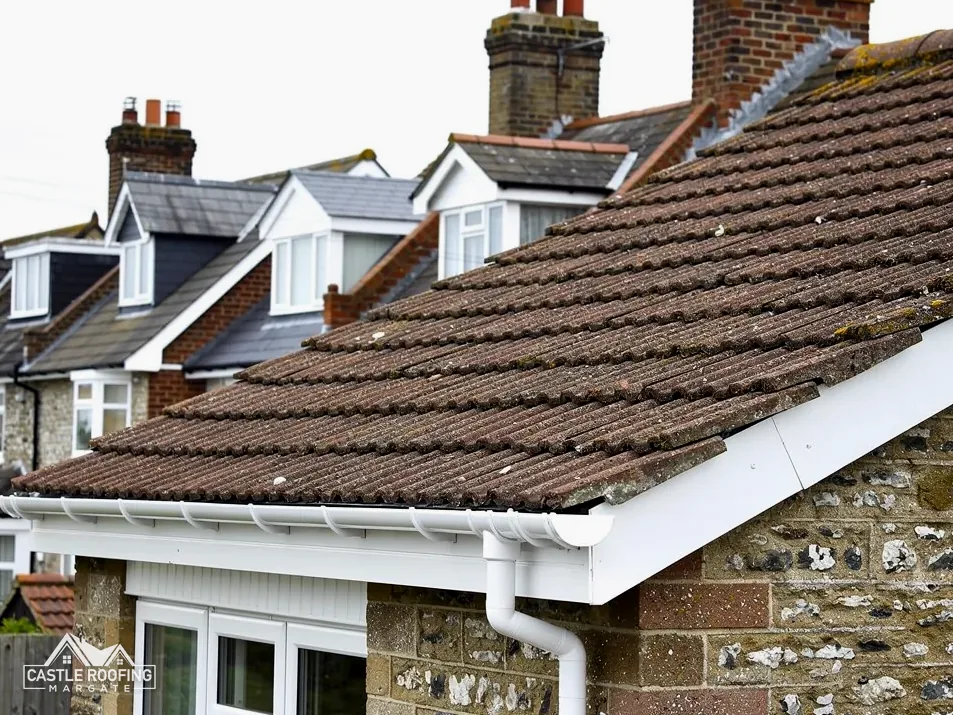
Get a sense of what a gutter clear should cost before you ask for prices. The guide gives the published range, explains why access moves it, and shows what a clear written quote contains.
Gutter cleaning looks like the smallest job on a roofer's list, and next to a re-roof it is. Even so, quotes for the same house can differ by a surprising margin, and the reason is rarely the gutter. It is the ladder, the height of the eaves, the length of the run and what has been growing in it.
This guide starts with a national figure for clearing a whole house, from Which? Trusted Traders. It then works through the parts of a house that decide where within that range, or beyond it, a particular price falls. Compare a terraced house with low eaves and a single back gutter with a three-storey villa that has gutters on every side, and the work involved is not the same at all.
Cleaning is one part of our guttering, soffits and fascias work, along with repairs and replacements. If the clear turns up a failing gutter, you are told and shown pictures of it.
The published range for clearing every gutter
The most useful figure comes from Which? Trusted Traders. Its cost guide, gathered from a survey of 11 Which? Trusted Traders in November 2025, gives £75 to £350 to "Clear out all gutters at front and back of property". Labour and materials are in that figure; VAT is left out. Read it as a typical UK range from a single guide, never as a price list for any one house.
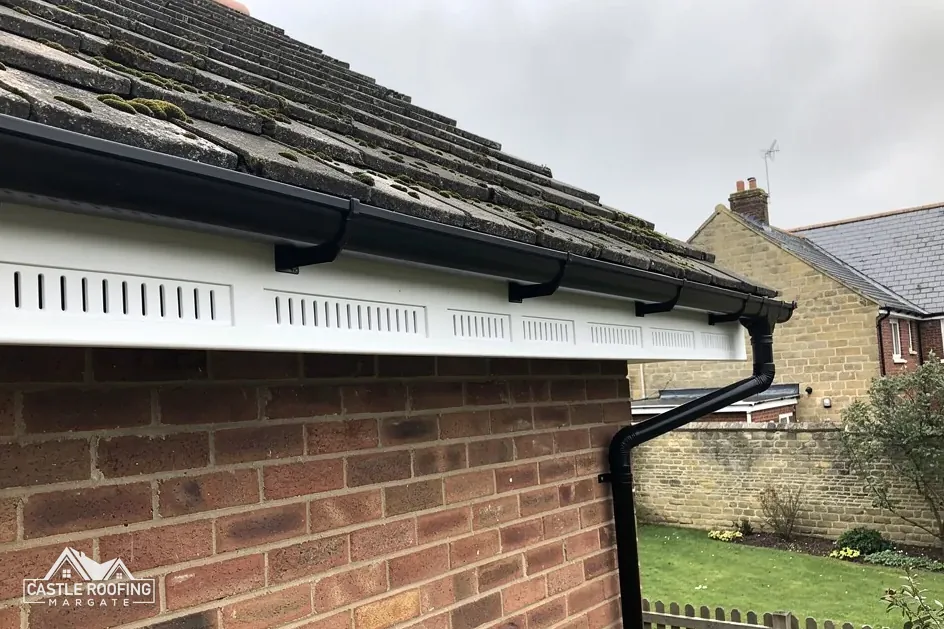
Which? adds a regional warning: householders in London and the South East should expect figures towards the top of its scales. As Kent lies in the South East, a Thanet or Canterbury quote in the upper part of the range, or a little beyond it, would be no surprise.
Three points help when you read the figure:
- it applies to gutters at both the front and the rear, not one elevation alone
- it is a figure without VAT, so a quote you receive should say whether VAT at 20% is in it
- it is a range for clearing gutters, not for mending, replacing or painting them
A figure at the low end suits a small house where the eaves can be reached from a ladder at ground level. The top of the range, and sometimes above it, belongs to larger or taller houses, or to gutters that have been left a long time. A price outside the range is not wrong for that reason alone: it needs a reason that you can see, such as a tall elevation, a long run or a conservatory roof in the way of the ladder.
What a clear should include
A proper clear is more than a scoop of leaves from the front. The aim is to leave rainwater a clear path from the gutter to the drain. That takes in several things:
- Debris is lifted out of the gutter by hand or with a scoop and dropped into a bag, not swept down the downpipe.
- The run is flushed with a hose to show up any dip where water stands, and any joint that weeps.
- Each outlet, the opening where the gutter meets the downpipe, is cleared so water can pass through.
- The downpipe is checked for a blockage, by running water through it and watching the foot at the bottom.
- Moss, silt and plant growth are scraped from the floor of the gutter.
What you should receive afterwards is a short account of what was found. A gutter with a joint that leaks under pressure, a bracket that has pulled away from the fascia, or a run that dips are all visible during a flush, and those are the things you pay to learn.
Flushing is the step that separates a clear from a quick scoop. A gutter can look clean from a ladder and still hold water because of a dip that only shows when the run is full, and the first heavy shower will show it too, from the ground, as water coming over the front edge.
Access decides most of the difference
The gutter is the same wherever it is, but the way to reach it is not. A gutter at the back of a bungalow can be cleared from a stepladder. One above a two-storey bay window may need a tower or a longer ladder with a stabiliser, and a gutter on a third storey may need scaffolding. That is why two houses with identical gutters get different quotes.
| Factor | Why it matters |
|---|---|
| Height of the eaves | Sets the ladder, tower or scaffold needed |
| Length of the runs | More gutter takes more time |
| Condition | Packed moss and silt slow the work |
| Obstacles below | A conservatory roof or bay blocks a ladder |
| Trees nearby | Leaves and seeds refill the run |
Work at height has its own law, the Work at Height Regulations 2005, and regulation 6(3) places a duty on employers to stop people falling wherever that can reasonably be done. A roofer pricing a tall house is therefore pricing the safe means of reaching it as well as the hours spent there. A ladder footed on soft ground, or leaning on the gutter itself, is a bad way to save money, because cast iron and plastic gutters are not designed to take a ladder's load.
Should a tower or scaffold need to sit on the footway, Kent County Council issues the licence, with the scaffolding firm lodging the paperwork. That cost is priced after a survey and sits outside the headline range.
How often gutters need clearing

No single schedule suits every house, and the sensible answer depends on the one in front of you. The deciding factor is what drops into the gutter. A house with a mature tree overhanging the eaves fills its gutters faster than one in the open, and a shaded north side grows moss faster than a sunny south side.
Weather matters as well. The Met Office climate averages for Manston, 1991 to 2020, record 110.05 days a year with 1 mm or more of rain. That is a lot of water to move off a roof, and a partly blocked gutter shows itself on those days. A run that copes in a dry month can overflow in a wet one.
Instead of a fixed interval, look for the signs that a clear is due:
- water spilling over the front lip during moderate rain
- green or black staining on the wall under a gutter
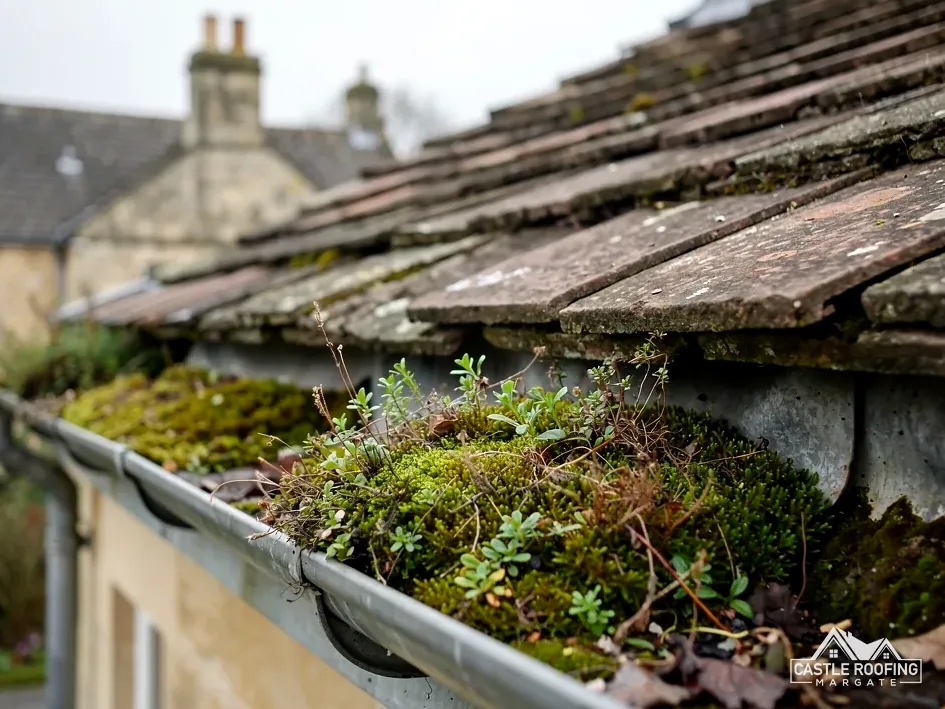
- plants or seedlings growing from the gutter edge
- a downpipe that gurgles, or one that stays dry while the gutter overflows
- a visible build-up when you look from an upstairs window
Autumn is the obvious time to look, once the leaves have come down. After a stormy spell, it also helps to glance up from the ground and note any branches or debris lodged in the run. Our page on how often to clean gutters covers the rhythm for different kinds of house.
Reading a written quote for gutter work
A sensible quote for a clear is a single written total for the whole house, set out plainly. Check that it names the elevations covered, so you know whether the back is included, and states whether VAT is in the figure. If a tower or scaffold is needed, the quote should also say who supplies it. Kent County Council's licence is needed for anything on the footway, and the quote should make clear who handles the application. A short quote on one line, with none of this stated, leaves too much to argue about once the ladders are up.
Citizens Advice suggests collecting written quotes from at least 3 traders before you choose one. For a gutter clear that is easy to arrange, and it shows you the spread for your own house. A figure far under the rest raises the question of what has been dropped, while one far over raises the question of what is being assumed about access.
The questions worth asking before you agree:
- Are the front and the back both included?
- Is the downpipe checked and flushed?
- Is VAT in the price?
- What happens to the waste?
- If a joint or bracket is found to be failing, will you be told before anything else is done?
We look at the house, or at pictures of it, before a price is given, and the price is then written as one total. If a fault turns up while we are on the ladder, you are told and shown a picture, and any repair is quoted separately before it begins.
When cleaning is not enough
A clear fixes a blockage. It does not fix a gutter that is leaking, sagging or rusted, and it is wasted money to clean a failed gutter again and again. A few signs show that the next step is repair, not another clear. Water that stands in the run after a flush, a joint that drips, a stain that comes back within weeks of a clean, or a bracket that has dropped are all in that group.
If the gutter holds water along its length after being flushed, it has lost its fall, the slight slope towards the outlet that keeps water moving. That is usually a bracket problem, where a fixing has pulled out or the timber behind it has softened. If water drips from a joint under pressure, the seal has failed and the joint needs remaking. A cast iron gutter that is rusting through needs more than a scrape, and a plastic one that has cracked in the sun needs replacing.
Gutter guards, the mesh or brush inserts that keep leaves out, are sometimes suggested to cut the number of clears. They suit some houses and not others, and they still need checking from time to time. Our page on whether gutter guards are worth it weighs them up.
If you would rather clear them yourself, read the guide on cleaning gutters yourself safely first. Falls from ladders are the real danger of the job, and a sound reason to hand the job over. Whoever does it, leaving the gutter clean and the water flowing is the point, and a failing gutter should be repaired before it is cleaned again.