What the Wildlife and Countryside Act 1981 says about nests
Section 1(1) of the Wildlife and Countryside Act 1981 is breached when anyone intentionally removes or harms a nest belonging to a wild bird, from the moment building starts until the birds have finished with it. Two things in that wording are worth reading slowly.
The first is the word intentionally. The offence is aimed at someone who intentionally damages or removes a nest, which is why looking before you start work matters. A roofer who sees birds going in and out of a gap and carries on regardless has stopped being able to say they did not know.
The second is the phrase about use. The protection stops when the nest is finished with. It is not a ban on repairing a soffit for ever after a bird has used it once.
GOV.UK's guidance on wild birds says there are no licensing purposes that permit development or construction. In plain terms, construction work gives no ground for taking an active nest away, so the job has to wait. For wider context, guttering, soffits and fascias explains how the roofline fits together.
What to do while the nest is active
You cannot hurry a family of birds, and you should not try. For the time being the job is mostly looking and waiting.
- Do not block, poke or fill the gap, and do not pull out any nesting material you can see.
- Watch from the ground for a few days to confirm birds are still going in and out.
- Tell any roofer or decorator working near the eaves so they leave that section alone.
- Keep the work around it going: gutters elsewhere on the house can usually be cleared and repaired.
How long a nest stays in use depends on the birds rather than the calendar, so no date can be promised. The practical test is whether birds are still visiting. When the activity has stopped for a good while and the gap looks quiet, ask a roofer to check it before anything is closed up.
A droppings stain under the soffit is a hint that birds are using it, though it will not tell you whether a nest is still live. Neither will a noise at dusk, which is why a few days of patient watching from the ground is worth more than any guess made from a ladder.
Closing the gap once the nest is finished
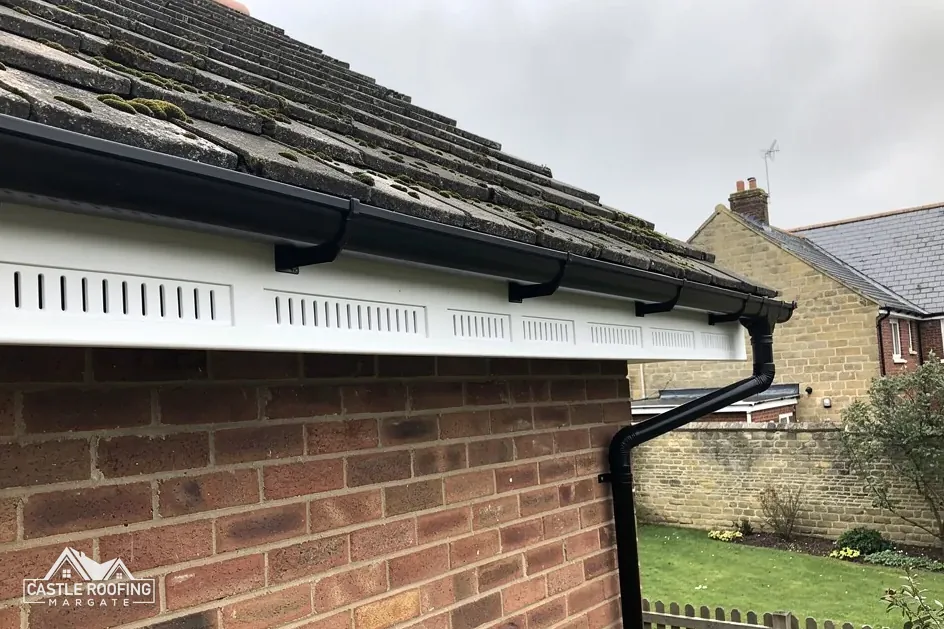
The reason birds get into a soffit is a gap: a board that has shrunk or rotted, a section that has come away from the wall, or a vent that has been pushed out. Stopping them returning means repairing that gap, not just stuffing it.
A sound repair usually involves three steps. The loose or rotten board is cut out or replaced. Any old nesting material is cleared from behind. The soffit is then closed, with any ventilation kept working so the roof space can still breathe. If you want to know how soffit ventilation sits with the rest of the roof, our note on soffit vents covers it.
Where the fascia is also failing, replacing both together saves scaffold and disturbance. Our guide to fascia and soffit replacement sets out how the job is done, with one written total to come after the survey.
Do not rely on a loose-fitting cover or a bit of tape. Birds will test every gap, and a weak patch invites another nest the following year.
When it might not be birds
A scratching or squeaking in the roofline is not always a nest. Droppings under a fascia, or small animals slipping into a gap at dusk, can mean bats instead, and bats are treated differently. Their resting places are protected whether or not an animal is present on the day.
If you are not sure what is using the gap, treat it as the more cautious case. Stop work on that board and read our guide to bats behind fascia boards, which explains why the advice has to come first.
Other signs that the gap is bigger than it looks include a soffit that bows when pressed from below, daylight at the edge of a board, and a gutter that has moved away from the wall because the board behind it is soft. Those are all repair jobs, whatever is living in there, and the roof edge is worth a proper look from a roofer once the nest has gone.
That visit comes before any figure, and the photos it produces are of your own soffits.