Read this before anyone is booked to look at iron guttering on an older house. It explains what can be repaired where it hangs, what a conservation area or a listing asks of you, and when new iron is the right answer.
A cast iron gutter is a run of heavy iron lengths bolted end to end and carried on brackets along the eaves, where the roof slope finishes over the wall. On a Victorian or Edwardian terrace in Margate, Ramsgate or Broadstairs it may be as old as the house and still be doing the job. When one stretch starts to drip, the whole run is rarely worn out.
The trouble is that iron fails in a few predictable places. A joint loses its seal, a bracket works loose, rust eats a thin patch, or paint has been missing for years. Each of those can be put right with the gutter still on the house, and a repair keeps the original profile that gives the frontage its look.
This guide takes those faults in turn, then covers the paperwork for houses in a conservation area or on the statutory list, and the point at which a length is beyond saving. It sits within our guttering, soffits and fascias work, which takes in repairs and replacements alike.
How old iron guttering is put together
Each length of cast iron gutter is poured in a mould, which is why it is thick and heavy compared with plastic. Lengths are joined with a bolt through overlapping flanges, with a jointing compound between the faces so the joint sheds water instead of passing it on. The gutter ends in a stop end, a cast cap, or it drops into an outlet, the opening that feeds the downpipe.
Underneath, brackets carry the weight. Some are fixed to the fascia, the board running along the rafter ends. Others are screwed into the rafters themselves or into the wall. The gutter sits slightly out of level so that water travels towards the outlet; that slope is called the fall.
Iron fails in familiar ways because of how it is made and what it carries:
- the compound in a joint dries, shrinks and lets water through
- a bolt rusts solid, or its head rusts away
- standing water sits in a low spot and rusts the floor of the gutter from inside
- a bracket loosens as the fixing behind it decays
- paint wears off and leaves bare metal to the weather
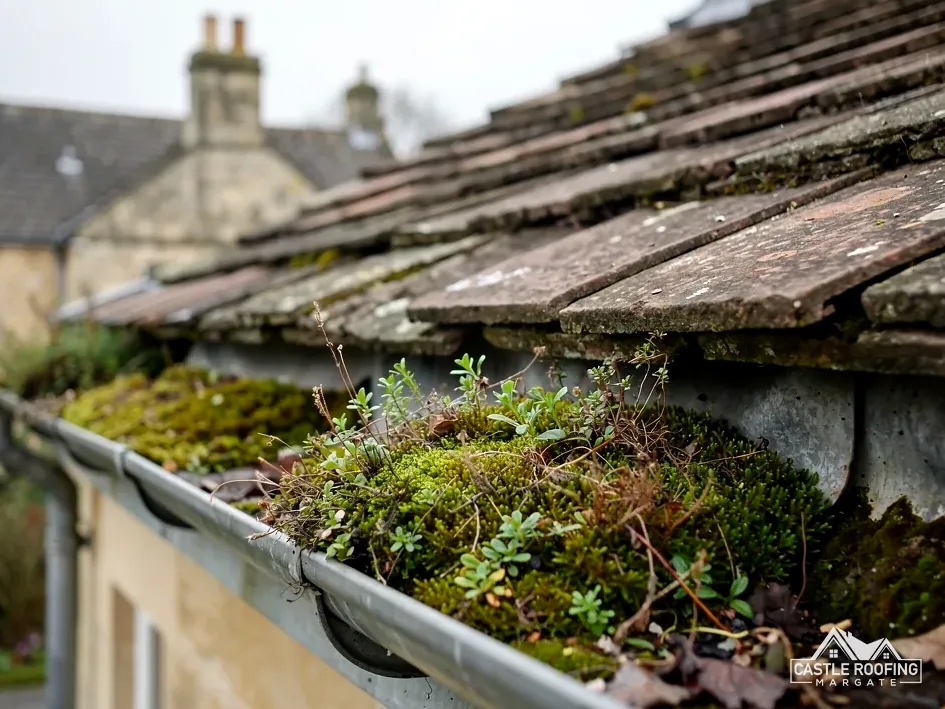
Water does its damage slowly. A drip at one joint keeps one patch of brickwork wet, and a shaded stretch of wall that never dries grows green and starts to hold moisture against the masonry. Over a few winters that can reach the plaster inside.
Knowing which of these you have decides whether the job is a short visit to reseal or a full run of new lengths. A surveyor on a ladder can usually tell from the stains on the wall below and the pattern of rust along the run.
Joints: the first place to look for a leak
Water running down the wall just below a join usually points to the joint rather than the length. The repair takes the joint apart, cleans both faces back to bare metal, and puts it back together on fresh compound with new bolts. If the bolt cannot be turned, it is cut or drilled out rather than forced, because iron cracks before it bends.
The order of work on one joint is short:
- Support the lengths either side so they cannot drop when the bolt comes out.
- Undo or cut the bolt, then separate the faces.
- Scrape old compound and rust from the flanges and wire-brush to clean metal.
- Lay fresh jointing compound along the face and bring the lengths together.
- Fit a new bolt, tighten it evenly and wipe off the squeezed-out compound.
- Check the joint with water from a hose before the paint goes on.
A joint that has been patched from outside with sealant alone usually weeps again, because the water gets in behind the patch. Taking it apart is the repair that lasts. Where a join has been bridged with a clamp or a wrap, that comes off first. Old bolts are replaced as a matter of course, and the ends of the lengths are checked for chips and cracks before they go back together, since a damaged flange will not seal however much compound is used.
Our guide to repairing leaking gutter joints covers the same problem on plastic runs, where the fix differs from iron because a plastic joint carries a rubber seal instead of compound.
Brackets, fall and the timber behind them
Iron weighs far more than any modern gutter, and a length packed with wet leaves and silt weighs more again. A bracket that has pulled slightly away from its fixing lets the gutter dip, and a dip is where water stands. Standing water then rusts the floor and finds its way over the front lip in heavy rain.
So a sagging run is a bracket problem before it is a gutter problem. The check is to sight along the run from one end and look for a belly between supports. If you can see one, the question is what the bracket is fixed to. A fixing into a decayed fascia board, or into a rafter end that has gone soft, will not hold a new bracket for long. Our page on a sagging gutter fix goes into the steps for the dip itself.
Timber found rotten while the gutter is off is dealt with before the iron goes back. That can mean splicing in new wood at the rafter feet, the ends of the rafters that project over the wall, or replacing a length of fascia. Photos of whatever is found go to you before any timber is cut.
Once the timber is sound, the gutter is set back to a steady fall towards the outlet, checked with a level and then with water. Where a bracket is missing or has failed, a new one is fitted to the same pattern so the run still looks as it did. Where the original pattern is known, matching lengths and brackets can be sourced to suit.
Repainting cast iron, and what to check first
Paint is the only barrier between iron and the weather, so a gutter with bare patches rusts quickly. Met Office climate averages for Manston, 1991 to 2020, record 110.05 days a year with 1 mm or more of rain, and 612.64 mm in all. An east Kent gutter is wet on a large number of days, which is why the coating matters.
Good repainting is mostly preparation. Loose rust and flaking paint come off with a scraper and wire brush, bare metal gets a rust-inhibiting primer, and then the finish coats go on. The inside of the gutter is painted as well as the outside, because the inside is where rust starts. Painting needs a dry gutter and dry weather.
Check what the metal is telling you before the brush comes out. The inside of the floor is the part to look at hardest, because rust there is out of sight from the ground. A screwdriver tip pressed gently into a blistered patch shows quickly whether sound metal lies underneath or a flake that crumbles. Photos of each suspect patch go with the quote, so the decision to repaint or replace is one you can see for yourself.
| What you see | What it means | Outcome |
|---|---|---|
| Flaking paint, sound metal | Coating has worn | Prepare and repaint |
| Rust bubbles on the floor | Water has stood there | Clean, treat, repaint |
| Hole or soft edge | Metal lost to rust | Replace that length |
| Hairline crack | Impact or frost split | Replace that length |
Conservation areas and listed houses: like for like
A repair that leaves the gutter looking as it did is the safest route on an older house. Section 55(2)(a) of the 1990 Town and Country Planning Act keeps a job that leaves a building's outward look materially unchanged outside the meaning of development. Thanet District Council's own conservation area page makes a related point about like for like work, which it says makes a planning application less likely. Less likely is not the same as never, so a short call to the planning team settles the matter before the ladders go up.
A listed house is different. Under section 7 of the Listed Buildings Act 1990, a listed house needs consent before anyone alters it in a way that changes its character, and Canterbury City Council says the same for its own district. Swapping iron for plastic on a listed frontage can alter that character, while mending the iron in place is a very different proposal. Raise it with the conservation officer at the start, because the answer sits with the council and not with the contractor.
Check whether an Article 4 direction applies with your council before work starts. Such a direction removes named permitted development rights across a set area. Thanet District Council's own list places directions in three conservation areas, and its planning team can say which classes apply to a given address.
The practical sequence on a period house is simple: decide what the repair is, call the council's planning team with a photo and a description, and keep the reply with the job papers. Our guide to gutters in a conservation area sets out the questions to ask.
When replacement in cast iron is needed
Repair stops making sense when the metal itself has gone. A hole through the floor of a length, a split along the back, or a section whose walls have rusted thin cannot be patched in a way that lasts. A run with several of those along its length is better renewed than chased from one leak to the next, because each patch moves the weight and the water onto the next weak point. Before a run is condemned, the surveyor checks the downpipes and the outlets as well, since a blocked outlet can make a sound gutter look as if it has failed. The cause is dealt with first.
The signs that point to replacement rather than repair:
- cracks that run through the metal and open when the gutter is lightly knocked
- rust holes that break through the floor or the back of a length
- flanges so corroded that a joint cannot be made tight
- lengths missing altogether, or replaced years ago in a different profile
- brackets that have rusted through and cannot be copied from a spare
Where replacement is needed on a period house, new cast iron in the same profile is the nearest match to what the frontage had. Modern gutters in other materials come in ogee and half-round shapes too, though on a house under a listing or a direction the council decides what is acceptable.
After the survey you receive a single written price for the whole job, along with the photos that explain why a particular length is being renewed rather than mended.