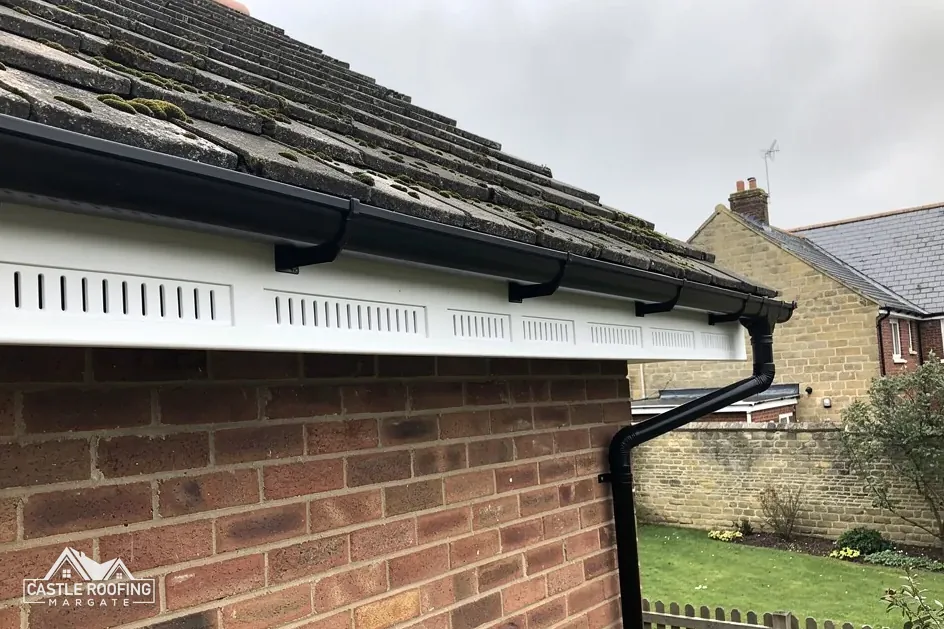
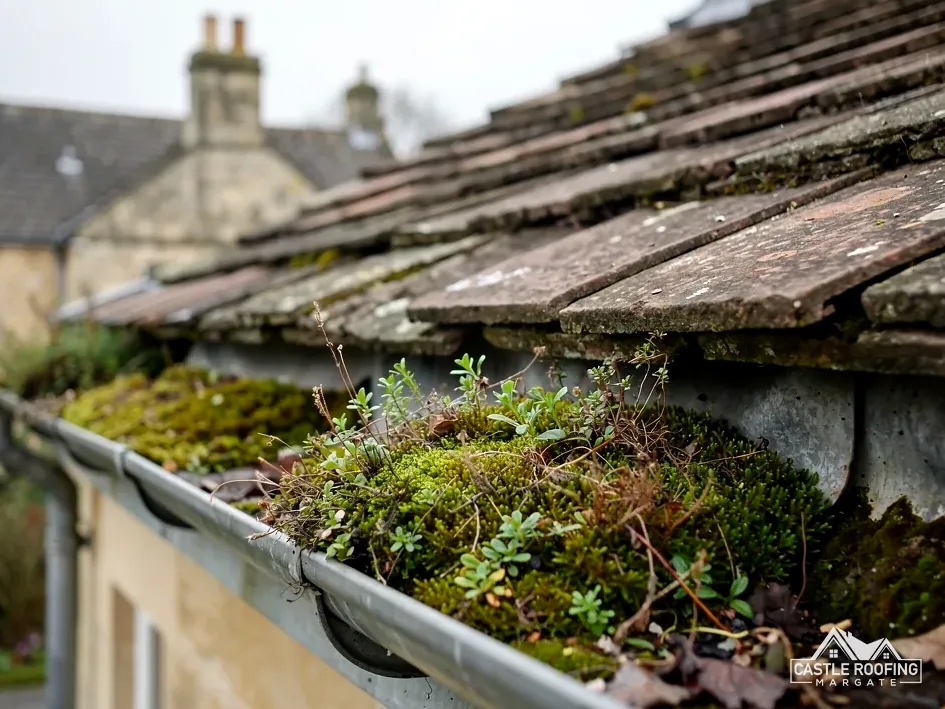
Read this if water is spilling from a gutter joint or hopper, or a wall is going green or damp below the eaves. You will see the signs, the usual causes, the choice between clearing and replacing, and where the pipe should discharge.
A downpipe is the vertical pipe that carries water from the gutter to the drain. It looks like the simplest part of a house, and it is out of mind until the day it stops working. Then the gutter above it fills, spills over the front edge and runs down the brickwork, and by the time anyone looks up, a patch of wall has been wet for weeks.
The pipe has several places where it can choke. At the top there is often a hopper, a funnel-shaped box that collects water from one or more gutters and feeds it into the pipe. At the bottom there is a shoe or a connection to a gully, which is the grated drain at ground level. In between are bends and joints where debris can lodge, and every one of these can fail on its own.
This guide takes the problem in the order you meet it: the signs, the causes, whether to clear or replace, and where the water ends up. It belongs to our guttering, soffits and fascias work, and it sits beside the pages on gutter overflows and wall damp that go into the symptoms in more detail.
How a downpipe works and where it chokes
Rain falls on the roof and runs to the gutter, which is fixed on a slight fall towards the outlet. Brett Martin's guidance gives that fall as 1mm for every 600mm, which is barely visible but enough to move water along. At the outlet the water drops into the downpipe, travels to the ground and leaves through a gully or a drain.
A blockage can sit at four points. Each has its own cause and its own clue.
- The outlet or hopper at the top, where leaves, moss and silt gather first
- A bend in the pipe, where a joint or an offset slows the flow and traps solids
- The shoe at the foot, where the pipe turns out over the gully
- The gully or drain below, which may be blocked even though the pipe is clear
A pipe that is full only at the top tends to be a debris problem. A pipe that fills from the bottom up, with water backing up the whole length, points to the drain. The two need different fixes, and clearing the top will do nothing if the drain below is the problem.
The Met Office's Manston record shows a 1991 to 2020 average of about 613 mm of rain a year, falling across 110.05 days with 1 mm or more. A downpipe in Thanet is working on more than a hundred days a year, so a partial blockage is put to the test on many wet days through the year.
Signs of a blocked downpipe
The first sign is usually water in the wrong place. When the pipe cannot take what the roof sends, the gutter overflows at the lowest point, and that is generally next to the hopper or the outlet.
Watch for these during or just after rain:
- water spilling over the front of the gutter above the pipe, or pouring from a joint
- the hopper full to the brim, or overflowing at its top edge
- a stream running down the wall beside the pipe instead of inside it
- a gurgling or a hollow, knocking sound from the pipe
- a pool of water around the foot of the pipe that does not drain away
The slower signs show up on the wall. Green algae in a streak below the hopper, a brown or dark tide line on the brick, flaking paint, and damp patches inside the room on the other side of the wall all tell you that water has been running down the face for a long time.
A downpipe that is frozen can be mistaken for a blockage. Manston also averages 21.43 air-frost days across the year, so ice in a pipe is a real winter possibility. It clears when the weather warms, but a pipe that splits from ice then leaks at the crack, and the damage shows up afterwards as a wet wall.
Our page on overflowing gutters sets out how to tell an overflow caused by a blocked pipe from one caused by a gutter that has dropped.
What blocks them
A blockage that starts at the top gets worse in stages. A little debris collects at the outlet, narrows the opening and catches more, until the opening is shut. The reasons differ from house to house.
| Cause | Where | Clue |
|---|---|---|
| Leaves and moss | Hopper, outlet | Overflow at the top |
| Roof grit and silt | Bends, shoe | Slow drain after rain |
| Tennis balls, nests | Outlet, pipe | Sudden total blockage |
| Collapsed pipe | Any joint | Water leaving a crack |
| Blocked drain | Gully, below ground | Backing up from below |
Roof grit is worth a note here. As tiles and slates weather, small particles wash into the gutter and then into the pipe. Over the years they settle at the lowest bend as a thick sludge, and a pipe can lose a good part of its bore without anyone seeing it. The same sludge forms in the gully, so a pipe that has been cleared once and left for years will often be partly shut again by the time it overflows.
A house with trees close to the roof will clog faster than one with an open outlook, and a house with no gutter guards or a poorly sited outlet will clog faster again. Birds sometimes build in the top of an open hopper, and an active nest is left in peace, because section 1 of the Wildlife and Countryside Act 1981 makes it an offence to intentionally damage or destroy a nest while it is in use or being built. How often to clear is a separate question that our page on how often to clean gutters deals with.
Clearing a blocked downpipe or replacing it
Clearing is the right answer when the pipe is sound and something is simply stuck in it. Debris of that kind is what a clear is for. The work is quick and needs little equipment, it costs far less than new pipework and it leaves the existing system in place.
Replacing is the right answer when the pipe itself has failed. The signs are a split along the seam, a joint that has pulled apart, a bend that has cracked, a pipe that has sagged away from the wall because its brackets have rusted, or old cast iron that is rusting through from the inside.
How to tell the two apart:
- if water runs freely once the blockage is out, clear and move on
- if the pipe blocks again within a few weeks, something inside is catching and needs checking
- if the pipe leaks from a crack or joint, repair or replace that length
- if the pipe is cast iron and has flaking rust, a section may be worth replacing
For rough costs, the Which? Trusted Traders guide of November 2025 gives £75 to £350, excluding VAT, for clearing the gutters on both the front and rear of a house, and it says South East prices tend to be at the upper end. MyJobQuote gives £1,000 to £1,600 for replacing the guttering, in a guide updated on 20 October 2026. These are typical UK ranges for whole systems, never a price for your downpipe, and the written price follows a look at your pipe.
Clearing a downpipe in the right order
The job is simple to describe and awkward to do safely, because the hopper is usually at the first-floor eaves. Working at height is where the real risk sits, so the access is planned before anything else.
The sequence is the same whoever does it:
- Look at the gutter and hopper from a safe position and note where the water is spilling.
- Clear the hopper and the first stretch of gutter by hand, bagging the debris rather than dropping it.
- Run water down the pipe from the top and watch the foot to see if it flows or backs up.
- If it backs up, rod or flush the pipe from below, or open a joint to reach the blockage.
- Check the gully at the base and clear it, because grit often ends up there.
- Run water again until the flow is steady, then check every joint for weeping.
Never try to clear a downpipe by poking from the top with a rigid pole while leaning off a ladder. Hooks, extending poles and ground-based tools suit low pipes, and anything at first-floor height or above needs a proper tower, a platform or a scaffold.
Where a scaffold on the pavement is needed, it takes a Kent County Council licence, which the scaffolding company applies for. That is rarely worth it for downpipe clearing alone, so we combine it with other roofline work where we can. Our page on gutters leaking down the wall covers what to check when the wall has already been wetted.
Where a downpipe should discharge
A downpipe that clears perfectly can still cause damp if it empties in the wrong place. The water has to reach a drain, and it has to arrive there without splashing back against the wall.
Common arrangements, and what to check for each:
- into a gully with a grating, where the pipe ends just above or below the grating level, not touching the grating
- into a below-ground rainwater drain, with a collar sealed around the pipe
- into a combined drain shared with a neighbour, where a blockage may sit outside your boundary
- into a water butt with an overflow, where the overflow must also reach a drain
A pipe that stops short and drops water onto the paving lets it bounce back onto the wall, wetting the lower courses and the damp-proof course. A pipe that ends in a gully full of leaves is no better, since the gully fills and the water backs up the pipe.
Where a terrace shares a drain or a gutter, a blockage may start with a neighbour. A frank conversation is better than a dispute, and our page on the shared gutter on a terrace goes into who looks after which part.
If a downpipe was rerouted before you bought the house and you doubt where it now goes, we trace it during the survey. We note what we find at the pipe's foot, show you photos, and tell you whether the drain or the pipe needs attention first.