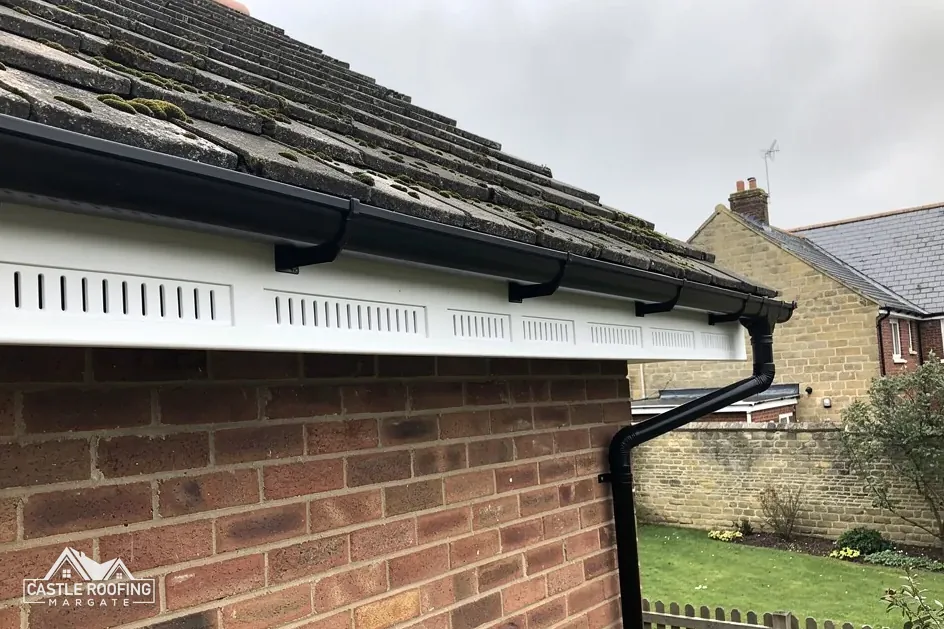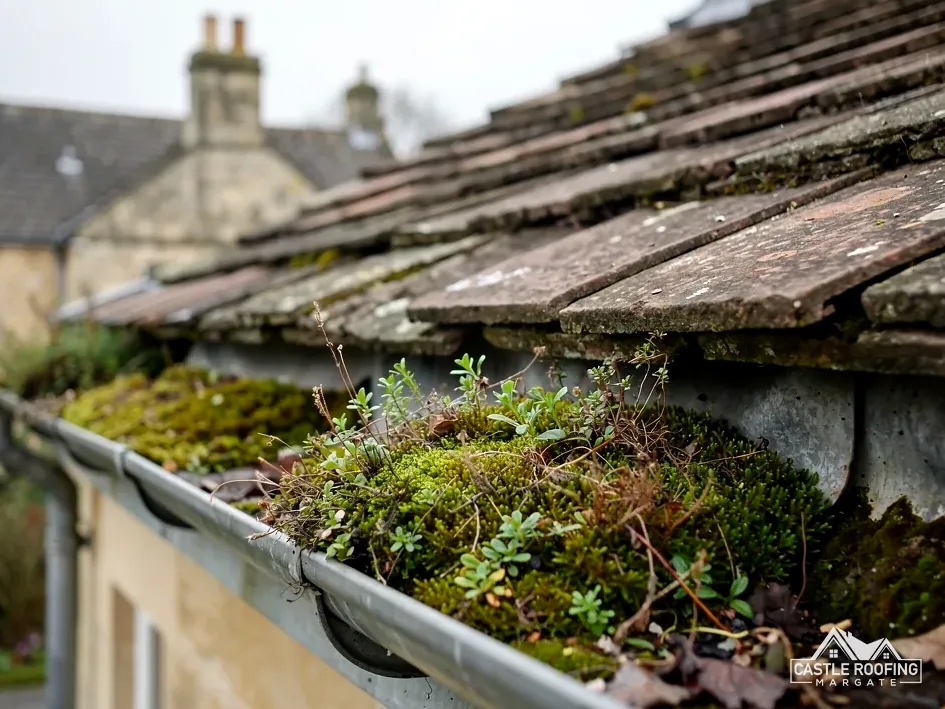
If a gutter overflows in light rain or holds a puddle after a shower, its fall is the first thing to look at. You will learn what the manufacturer's figure is, where the slope is set or lost, and when to call someone.
A gutter looks level from the ground, and for most of its length the eye can find nothing wrong. Yet a gutter that really is level is a gutter that holds water. Rain needs somewhere to go, and the only thing that moves it along the run is a slope so gentle you could miss it with a spirit level in your hand.
That slope is called the fall. Too little and the water stands, collects silt, rusts iron or stains plastic, and spills over the front lip in a downpour. Too much and the gutter looks wrong against the line of the roof edge, and fast water can shoot past the outlet instead of dropping into it.
The figure for a plastic system comes from the maker, and this guide gives it. It then looks at the parts that set the slope: the brackets, the outlets and the running outlets, and how a gutter can lose its fall years after it went up. It forms part of our guttering, soffits and fascias work, and resetting a lost fall belongs to it.
What fall means, and how little of it there is
Fall is how far the gutter's high end sits above the outlet, the opening where water leaves for the downpipe. It is measured against the length of the run. You do not see it as a slope; you see it as water that finds its way along the channel and out, instead of lying still.
Brett Martin, a gutter manufacturer, tells installers to set a fall of 1mm for every 600mm of gutter. Put another way, the far end of a 600mm length of gutter sits just a millimetre lower than the near end. That is a very small angle, and it is why the job is done with a line or a laser and not by eye.
A gutter with correct fall does several things at once:
- carries water to the outlet instead of letting it stand in the run
- helps silt, seeds and leaf fragments wash along and out
- keeps weight from pooling in the middle of a long run
- lets a joint stay dry between showers
- reduces the chance of overflow at a bend or stop end
None of this makes the gutter look sloped from the pavement. The fascia, the board the brackets are fixed to, often does not run level either, and a gutter set to a fall can look perfectly in line with the roof edge while following its own gentle line underneath it.
Working out the drop on a real run
The published ratio is easy to turn into a drop for any length of gutter. This is simple arithmetic on the manufacturer's figure, not a separate published rule, so treat the numbers as a guide for setting out and not as a standard.
| Length of run | Total drop |
|---|---|
| 3 metres | 5 mm |
| 6 metres | 10 mm |
| 9 metres | 15 mm |
| 12 metres | 20 mm |
On a 6 metre run, the high bracket would sit 10 mm higher than the bracket at the outlet. The thickness of a finger is about that much. On a long terrace the drops add up, which is why long runs are often split with an outlet in the middle so that each half falls a shorter distance.
BS EN 12056-3 is the current British Standard for roof drainage layout and calculation, and it is the reference behind sizing a gutter system. The fall quoted here is the installer's setting-out figure from the manufacturer, and a page on what size gutter a roof needs deals with the calculation side separately.
A fall that is only a few millimetres out over a long run is very hard to see from the ground. It shows up on a wet day, when the gutter is full, which is when the lowest point holds a puddle and the water that should be leaving passes the outlet.
Why a gutter overflows when the fall is lost
When the slope is gone, water stops moving at the rate the roof sends it down. It collects at the lowest point, which may be a dip in the middle of the run and not the outlet end. A gutter is shallow, so a small standing depth leaves little room for a sudden downpour, and the next burst of rain spills over the front lip.
The Met Office climate averages for Manston, 1991 to 2020, record 110.05 days a year with 1 mm or more of rain, so a gutter with a dip has plenty of wet days on which to spill. Water that goes over the front lip soaks the wall below it. Water that runs off at a joint stains the brickwork and works into the mortar.
Standing water also does harm of its own. Silt settles and holds moisture against the floor of a cast iron gutter, which rusts. In a plastic gutter, the weight of silt and water pulls the run lower still, so a small dip becomes a bigger one.
The usual causes of lost fall:
- A bracket has loosened or dropped and the gutter hangs lower at that point.
- A bracket was fixed to rotten timber and has sunk.
- The gutter was never set to a fall, or was set the wrong way.
- A joint has moved, putting a kink in the line.
Our guide to overflowing gutters separates a fall problem from a blockage or an undersized run.
Brackets: where the slope is set, and lost
The gutter takes its fall from its brackets. Each bracket is fixed at a height, and the gutter simply follows the line the brackets make. So the first bracket at the high end is fixed, the last bracket near the outlet is fixed lower by the amount the run requires, and a string line pulled tight between them marks every bracket in between.
That is why a sagging gutter is a bracket question first. One bracket that has dropped by a few millimetres drags the gutter down with it and removes the fall around that point. Water then stands just upstream of the dip. A gutter that has sagged along its whole length has usually lost its supports one after another, often because the fascia timber behind them has softened.
Spacing matters as well. Brackets that are too far apart let the gutter bow between them when it is full of water, and a bow between two brackets is a dip in the fall. The maker's instructions give spacings for each profile, and the installer follows them.
If the fascia is rotten, a new bracket in the same soft timber will not hold the line for long. The board is repaired or renewed first, as our guide to fixing a sagging gutter sets out. Once the timber is sound, the brackets are reset to the line and the fall is checked by running water through the gutter, not just by looking.
Outlets and running outlets
The outlet is where the fall ends. A stop end closes the high end of the gutter, and at the low end the outlet drops into the downpipe. The gutter must be set so the outlet is its lowest point, and the outlet must be above the downpipe's mouth, or water has nowhere to go.
A running outlet is the fitting used when the downpipe is not at the end of the run. It sits in the middle of a gutter and lets water drain away through it while the gutter on both sides slopes towards it. On a long front gutter or a roof with a short drop, running outlets split the run into two shorter falls instead of one long one.
The choice between an end outlet and a running outlet is made when the gutter is set out:
- an end outlet suits a short run with a downpipe at the corner
- a running outlet suits a longer run where the downpipe sits in the middle
- two outlets suit a very long run, each serving its own length
- a hopper, the funnel-shaped head fitted to a downpipe, takes a branch from another roof
Where the existing downpipe position cannot move, as on a terrace where the pipe sits against a party wall, the fall is set to suit the outlet and the gutter is cut or adjusted to match. A blocked outlet mimics a loss of fall, and the cure is a clear-out. Our page on a blocked downpipe deals with that.
Checking a gutter's fall without special tools
You do not need levels to find out whether a gutter is draining. A hose, or a bucket of water, does the job, and so does a wet day. Stand back and watch. Water tells you more than a ruler, because it shows not just where the gutter is low but how much of the flow it holds back.
Here is a simple way to check, carried out from a safe position and never from a ladder on your own:
- Run water into the high end of the gutter, using a hose at ground level if you can reach, or ask a roofer to do it.
- Watch the water travel along the run. It should move steadily towards the outlet.
- Look for a place where it slows, stops or pools.
- Check that water leaves the outlet and runs down the downpipe to the drain.
- Take a note of any joint where water drips or any bracket that has dropped.
If water is standing after the flow has stopped, that point has lost its fall. The gap between the standing water and the next bracket along tells you where to look first.
A roofer who sets or resets a fall works from the high end and the outlet with a taut line, then checks with water. The result is a gutter that empties on its own, with water left standing nowhere along the run. If you are quoted for a reset or for new gutters, ask to see how the fall will be set and checked. You get one written price after the survey, with the photos of what was found.