Read this before anyone drills, scrapes or pulls down an old soffit. It explains what the HSE says about where asbestos turns up, how to find out for sure, and which kind of work needs a specialist firm.
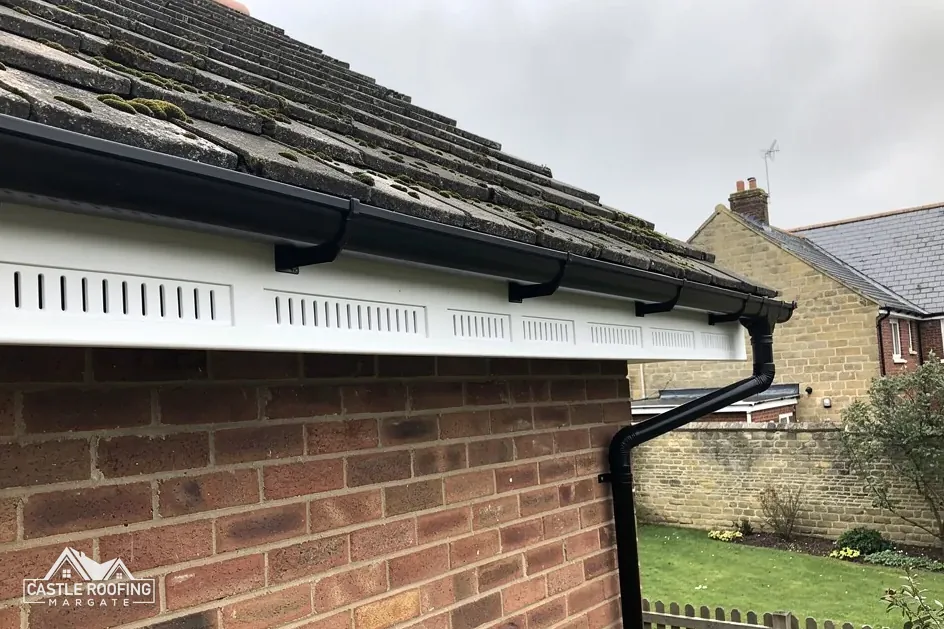
A soffit is the flat board that closes the gap under the overhang of a roof, between the wall and the back of the fascia, which is the board the gutter hangs from. From the ground it looks like a strip of painted board, and in a house of a certain age that is all anyone sees. The material can still matter a great deal when the board has to come down.
The HSE says asbestos insulating board, usually shortened to AIB, is found in external soffits. Some of that board is still in place on older rooflines. A job that looked like a simple fascia and soffit swap can turn into a job with legal duties attached, so the question has to be settled before the first fixing is touched.
This guide is for owners of older houses across Thanet, Canterbury and the east of the county who are planning gutter or fascia work and want to know where they stand. It belongs with our guttering, soffits and fascias work, and it should leave you able to put the right questions to any firm that quotes.
Where a soffit sits and why it gets disturbed
The soffit runs along the underside of the eaves and, on a gable, up the verge. It keeps birds and weather out of the roof space, and on many houses it carries a vent so the loft can breathe. It is fixed to the wall plate and to the back of the fascia, usually with small pins or screws every few hundred millimetres.
That fixing pattern is the problem. Whenever a fascia is replaced, a gutter is changed or a vent is cut in, the soffit gets drilled, pinned, broken or pulled away. If the board is a type that releases fibres when it is broken, each of those actions is a way of exposing people.
Common reasons a soffit is touched:
- a rotten fascia whose replacement means unpinning the soffit behind it
- new gutters or a new roofline that need fresh fixings
- adding soffit vents to a house that has condensation in the loft
- repairs after birds or damp have damaged the board
- painting, where flaking paint tempts someone to scrape it
None of these is dramatic, which is exactly why the risk gets missed. A job that takes an hour on a modern house can be a very different job on an older one, and the board is often painted over so many times that it looks like any other. The guide to what a soffit is covers the board's job in the roofline, and this page deals with what to do when its material is in doubt.
What the HSE says about soffits
The Health and Safety Executive lists AIB among the materials found in buildings, and gives "external soffits" as one of the places it turns up. Its advice on whether asbestos is present is short: a house that was built, or had major work done, before 2000 should be presumed to contain some.
That is a rule about the building as a whole, so it is the starting point and never the end of the inquiry. It does not say every older soffit contains asbestos, and it does not say a newer house is free of it. It says you should treat the possibility as real until someone has shown otherwise.
Soffit boards are not all one material. Some older boards are AIB. Others may be asbestos cement, which is a different product with a different place in the rules, and plenty are timber, plywood, a modern cement board or uPVC. Nobody should assume that a soffit containing asbestos must be the cement kind, because the two sit in different categories of work, as the sections below explain.
A refurbished house counts too. The HSE advice covers a building built or refurbished before 2000, so any roofline work done before that year counts as well as the year in which the house itself was built.
How to find out what your soffit is made of
You cannot settle this by looking from the ground. Only a survey or a laboratory test shows what a board is made of. The safe order is: stop, assume, then test.
- Hold off on any work that touches the soffit, including drilling and cleaning with a brush.
- Note the age of the house and any past roofline work, including the date of any refurbishment you know of.
- Ask a specialist surveyor to sample the board or inspect it. The sample is taken by a trained person and analysed in a laboratory.
- Act on the result: a clean result lets the job go ahead as normal, a positive result sets the route.
MyJobQuote, in a guide updated on 9 September 2026, gives £325 as what a survey for asbestos typically costs. That is a national figure, and testing one soffit can come in above or below it. Set against a stopped job or a contaminated drive, it is a modest first step, and it gives you a result you can show a buyer or a surveyor later.
We can tell you what a roofline looks like and where the fixings are, and we will say plainly when a soffit needs testing before a price can be fixed. A written price for the work follows only after the material is known, because the answer changes the method.
A soffit that is intact and left alone is not the risk. The risk begins when it is drilled, broken or pulled apart.
What you should leave alone in the meantime
If you think your soffit is AIB, the safest course is to leave it as it is. A sound, painted board that nobody touches does not release fibres. Damage and disturbance are what create the problem.
The list below is general good practice for any suspect board:
- do not drill, screw, nail or saw into it
- do not scrape, sand or wire-brush the paint
- do not power-wash it or spray it with a pressure hose
- do not break it up to get it off, or drop it from a ladder
- keep children and pets away from any pieces that have fallen
Never put a damaged piece into a household bin or an open skip. Cover it, keep it damp if it has crumbled, and ask for advice before moving it. The HSE's guidance on waste, which we come to below, makes the handling rules clear.
If a section of soffit has already fallen or cracked, treat it as a breakage. Keep the area clear, and get it looked at by a specialist before anything else is done. Anyone who has been scraping or sanding a board and is worried should speak to their GP about it, and it is worth keeping a note of the date.
A broken soffit does not need to be an emergency, but it does need the right person. Once the material is known, the page on fascia and soffit replacement then walks through the new boards going up.
Licensed, notifiable or non-licensed work
The HSE divides asbestos work into three groups. Which one applies depends on the material and on how much disturbance the job involves, and it is a decision made on a risk assessment, never a guess.
| Group | Covers | Who does it |
|---|---|---|
| Licensed | Work on AIB that is not of short duration | A licensed firm |
| Notifiable non-licensed | Brief AIB removal in a refurbishment, or broken-up AC | Trained firm, with notification |
| Non-licensed | Careful removal of AC without breaking it | Trained firm |
On the HSE pages, the licensable category is work on AIB where the risk assessment finds that the job will drag on. Short-duration work to take out AIB during a refurbishment is notifiable non-licensed work instead. The non-licensed group covers asbestos cement products that are carefully removed without being broken up, and the HSE adds that weathered cement is still in that group provided it is not otherwise substantially damaged.
Notifiable means the work is reported to the enforcing authority before it starts, and the contractor keeps health records for those who did it, which the HSE says must be held for 40 years. None of that paperwork falls on the homeowner, but it does explain why this kind of job takes planning and cannot be fitted in on a free afternoon.
For a soffit, this matters. A whole roofline of AIB on a terrace is not a short job. Where the work is licensable, we arrange for a licensed firm to take that part on. Once the board is out and the area is cleared, we carry on with the new soffit, fascia and gutters, and you hear about each stage before it starts.
Waste, disposal and what happens next
Asbestos waste is controlled from the moment it comes down, and the rules cover how it is sealed, stored and moved. The HSE's guidance, EM9, says to "Double-wrap and label asbestos waste". For larger quantities, its A14 guidance calls for a lockable skip, and an open skip is never the answer.
Householders have one route of their own. Kent County Council accepts asbestos at its household waste recycling centres apart from Sheerness, wrapped twice in strong plastic and taped, by booking, with no more than 5 sacks a month free, and you are asked to declare it comes from your own home. That route is for a householder's own small amount, and a large roofline of board will not fit within it. Where a lot of material is involved, Kent County Council points people to the Asbestos Removal Contractors Association to find a company.
Waste produced by a firm doing the work is trade waste, which moves on a consignment note, carried by a firm registered in the upper tier. The government's guidance says the household exemption is for domestic hazardous waste other than asbestos waste, so a householder should not assume a consignment note is unnecessary.
What happens in order once a soffit is confirmed or suspected:
- The material is identified by sample or survey.
- The right group of work is decided on the risk assessment.
- A licensed or trained contractor removes the board.
- The waste is double-wrapped, labelled and taken away on the correct paperwork.
- The new soffit goes up, with vents if the loft needs them, and you see photos of the finished roofline. Our page on soffit vents covers those.