Read this before anyone steps onto an old sheeted roof. It sets out the three kinds of asbestos work as the HSE describes them, how sheets come off, and what happens to them after.
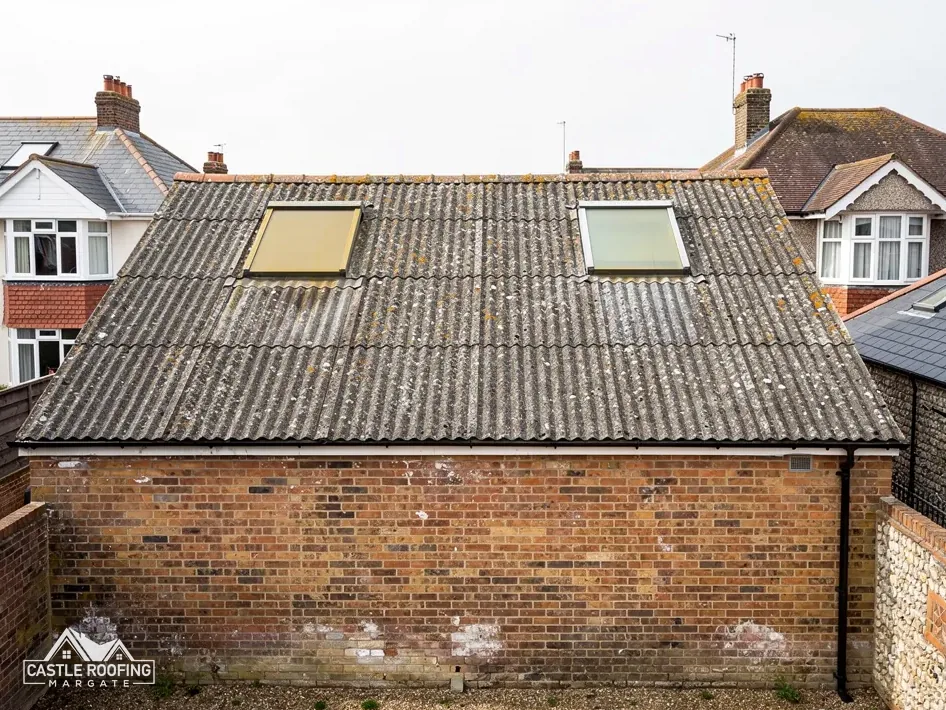
Corrugated sheeting on a unit, a workshop, a farm shed or a church hall roof may be asbestos cement. Many such roofs went up long ago and nobody wrote down what the sheets were made of. The HSE's starting point is simple: a building put up or altered before 2000 should be assumed to hold asbestos until a test shows otherwise.
While asbestos cement is whole and sound, the fibres stay locked into the cement. The danger comes when sheets are broken, drilled, scrubbed or dropped. That is why the rules for this material turn on one question: will the sheets be taken off in one piece, or will they break up?
This guide covers the three kinds of asbestos work, how sheets are lifted off a commercial roof, why the surface is treated as fragile whether or not it looks tired, and the waste route afterwards. It sits with our wider commercial roofing work, which takes in sheeted roofs on industrial estates and farms across East Kent.
Nothing here replaces a survey. It tells you what to ask for and what a sensible job looks like.
Is the roof asbestos cement at all?
You cannot tell by looking. Cement sheets of different ages look alike from the ground, and a later overcladding layer can hide the original. A roof of unknown age falls under the HSE advice to treat a building put up, or refurbished, before 2000 as holding asbestos, so the working assumption on an older unit is that the sheets contain it.
The way to settle it is an asbestos survey, with a sample of the sheeting analysed by a laboratory. MyJobQuote gives a typical cost of £325 for an asbestos survey, a UK figure from its page of 9 September 2026 and not a price for any particular building. A larger or more complicated site is priced after a look at the roof.
What the survey and the roof visit record:
- the age of the building and any refurbishment history you hold
- the profile and fixing of the sheets, and whether any are cracked or slipped
- sheets that have been patched, painted or coated at some point in the past
- rooflights set in the run, and the gutters and flashings that may also carry asbestos products
- external soffits, where asbestos insulating board is sometimes found
Until the result is back, treat the sheets as asbestos and keep people off the roof, including your own staff. Our guide to the asbestos survey before roof work explains the sampling step in more detail, and the same survey tells a roofer which method to price.
Why these roofs are always fragile
The HSE's guidance on sheeted roofs, A14, says plainly that an asbestos cement roof counts as fragile every time. Age does not come into it. A sheet that looks sound from the yard can still give way under a person's weight, because the cement is brittle and each sheet is held only at its fixings.
Weathered sheets are worse in one respect. Moss, lichen and a crazed surface hide hairline cracks, and a fixing that has rusted loose lets a sheet lift in a gust and fall back onto its purlin with a bang. The risk of a fall is therefore joined to an asbestos risk on the same roof, and a person who goes through a sheet takes broken cement down with them.
Three things follow for anyone who manages such a building:
- Nobody walks on the sheets, including a maintenance person after a blocked gutter or a lost ball.
- Any contractor you instruct is told in writing that the roof is asbestos cement and fragile.
- Roof access points are kept locked, and the rooflights in the run are treated as fragile too.
The wider picture of work on fragile surfaces, including the Work at Height Regulations, is in our guide to fragile roof safety. For asbestos cement the short rule is that platforms and edge protection come before the first sheet is touched, and that nobody relies on the sheets to carry their weight at any point in the job.
Three kinds of asbestos work
The HSE sorts asbestos work into three groups, and the group decides who may do it and what has to be reported. For a cement roof the deciding question is how much damage the sheets will suffer on the way off.
| Group | When it applies | Roof example |
|---|---|---|
| Non-licensed | Carefully handled and removed without breaking up | Lifting whole weathered sheets off the purlins |
| Notifiable non-licensed | Cement sheets badly damaged or broken up | A roof where many sheets crack on removal |
| Licensed | Asbestos insulating board, unless short duration | A long job on a board soffit or lining |
On the first group, the HSE words it this way: cement roof sheeting and rainwater goods count as non-licensed provided the material is carefully handled and removed without breaking up, and this includes cement which is weathered but not otherwise substantially damaged.
The second group is notifiable. Where the HSE's test of substantial damage or breaking up is met, the work is notifiable non-licensed work, and the employer keeps a register of the work, as health records, for 40 years.
The third group covers asbestos insulating board, which turns up in external soffits. Work on it is licensable unless it is of short duration, and a long job on a soffit board needs the HSE's licence. Anything in that group goes to a firm that holds one, and we pass it on without taking any part in it ourselves.
How whole sheets are taken off
Careful removal means the sheets are undone at their fixings and lowered whole, never broken to make them easier to carry. It is slower than stripping a tiled roof, and the order matters because each step protects the one after it.
On a sound, whole-sheet job, the sequence runs as follows:
- The area below is cleared or closed off, and the survey result is checked against what is actually on the roof.
- Edge protection and a working platform spread the load across the purlins before anyone goes up.
- Fixings are released one by one, and each sheet is lifted clear without being flexed or dropped.
- Sheets are lowered by hoist or on a controlled path to the ground, never thrown or slid down the slope.
- Each sheet is stacked flat, double-wrapped and labelled as asbestos waste.
Double-wrapping and labelling come from the HSE's guidance on asbestos waste, EM9. The instruction not to break or cut the material runs through the HSE's advice, and Kent County Council repeats it in its own rules for householders at its recycling centres.
If a sheet cracks during removal, the job does not carry on as before. Work is stopped and reassessed, because broken sheets can move it into the notifiable group. A roof where the sheets are likely to break may be better overclad than stripped, and our guide to overcladding industrial asbestos sheets covers when that route suits a building.
Where the waste goes
Asbestos waste never goes into an open skip. The HSE's guidance asks for a lockable skip for larger quantities, with the sheets double-wrapped and labelled before they go in.
The route differs for a business and for a householder, and the difference matters on a commercial roof:
- Kent County Council's recycling centres for household waste accept asbestos from a householder's own home, at every site apart from Sheerness, double-wrapped, by booking, with no more than 5 sacks a month free.
- A commercial building produces trade waste. That waste moves on a consignment note, and the carrier needs upper-tier registration.
- A business cannot use the household route, so the carrier and the disposal site are settled before the roof is touched.
Government guidance exempts domestic hazardous waste from a consignment note, but asbestos waste is carved out of that exemption. Asbestos therefore always needs a note once it travels as business waste.
Ask to see the carrier's registration and the consignment paperwork on any roof job, ours or anybody else's. A tidy site and the waste taken away is the minimum, and with asbestos the paperwork is part of tidy. If the waste route is vague at the quote stage, it will be vague on the day. Keep the survey and sample results with the waste paperwork, because together they show what came off the roof and where it went after that.
What sets the price and the next step
A per-square-metre price for asbestos cement roofing cannot be given from a distance. The job is priced after a survey, and the written price that follows is one total for the whole job.
The things that move it are:
- the area of the roof and the profile of the sheets
- whether the sheets are whole and sound or already cracked
- access: a tight yard, a road frontage or a roof over live production
- whether scaffold stands on the highway, which needs a Kent County Council licence that the scaffolding company applies for with 5 working days' notice
- the replacement covering, and whether an overcladding layer or new insulated sheets go on
On an occupied building the work also has to fit round the business, with staff and visitors kept out of the area below and noisy stages timed sensibly. Some owners prefer to move stock first; others want the roof done in sections so the unit never closes. Either way, the plan is set down on paper before any access equipment arrives.
Two questions are worth putting to every roofer who quotes: who will lift the sheets, and where will they go afterwards? A vague answer to either is a reason to ask again. The written price should name the disposal route, so that you can see the waste leaves the site in a lockable container and is not left in the yard overnight.
The first step is the survey. Our first visit is to the roof and its sheeting, you receive photos of your own roof, and the asbestos question is settled before anything is priced. If the survey finds licensable material on a soffit or lining, that part is handed to a firm that does that work, and the written price says so plainly.