Why the year 2000 matters on a commercial roof
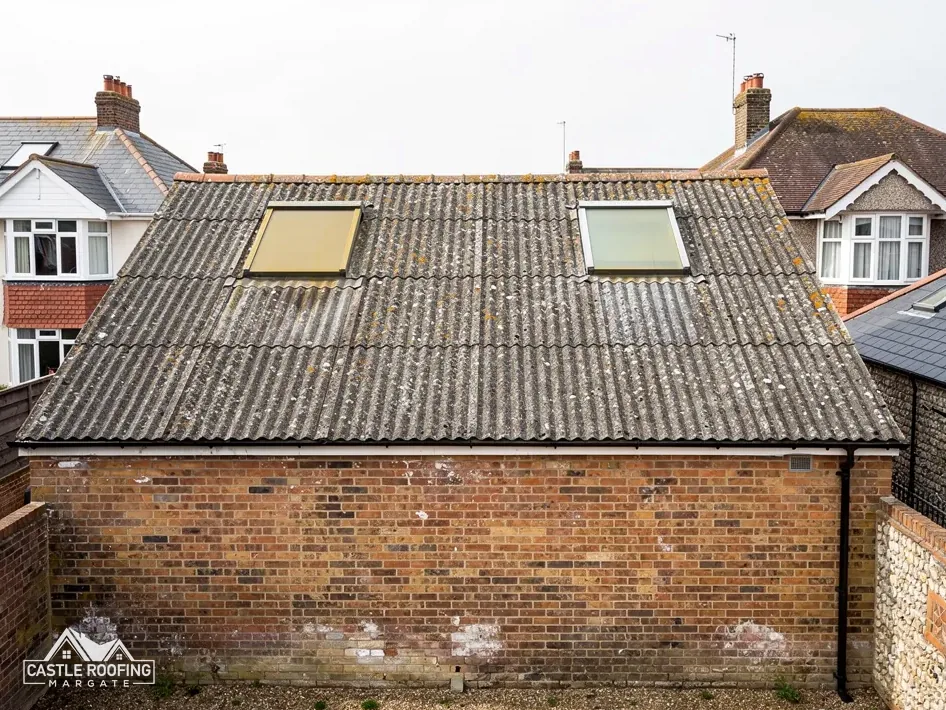
HSE's guidance on whether asbestos is present sets the year 2000 as the line. A building put up before it, or refurbished before it, is treated as containing the material until a survey shows otherwise. A 1960s workshop is caught by its age alone, and a later unit that was refitted in 1995 is caught by the refit.
Roofs are among the places it turns up. HSE names asbestos cement products, roof sheeting and rainwater goods among them. Soffit boards can also contain AIB, asbestos insulating board, which HSE lists under external soffits. Both sit at the edge of a roof job, exactly where a roofer works.
HSE's fragile-roof guidance (A14) adds a second point: every asbestos cement roof counts as fragile. A survey therefore tells you two things together. It names the material, and it says whether anyone should be stepping on the roof at all.
That makes it more than a formality before the quote. It is the first piece of paper for any commercial roofing job on a building of this age, ahead of the scaffold booking and ahead of the figure.
What the report settles for the roof job
Once a surveyor has sampled and identified the materials, the roof work can be set up around the result. Four things hang on it:
- The material itself: asbestos cement, insulating board or something else, because the HSE rules differ for each.
- The category of work: non-licensed, notifiable non-licensed, or work that must go to a licensed firm.
- The access method. A fragile surface rules out walking on it and changes the scaffold, nets and platforms.
- The waste route: how it is wrapped, stored and taken away.
HSE treats careful removal of asbestos cement as non-licensed work, so long as the sheets come away unbroken. Sheets that crack or crumble during removal push the job into the notifiable non-licensed category. AIB in a soffit is different again: HSE makes it licensable except for short-duration jobs.
Any licensed element is handed to a licensed firm, and the survey result tells us in good time whether one is needed. Until the survey is back, nobody can say which of these routes applies, and a figure given before it is a guess about what is up there.
Cost, timing and the written price
A typical asbestos survey costs £325, according to MyJobQuote, whose guide on taking an asbestos roof off (September 2026) also gives around £2,750 for the removal itself. Those are national guide figures for a typical job, not a quote for your building, and a large commercial roof with several elevations will sit well away from them.
Book the survey first, because the result can change what the job is. A leak that looked like a patching job on a sheeted roof can become a question of overcladding or full replacement once the sheets are identified. The sibling answers on asbestos cement roof sheets and overcladding industrial asbestos sheets cover those routes.
Get the report as a document and file it with the building's records, along with the plan marking where samples were taken. It is useful again at the next repair, at a sale, when a tenant asks, and whenever another contractor needs to know what is on the roof.
We read the report before we look at the roof, then send one written price that reflects what was found.
Waste and where it goes
HSE's waste guidance wants asbestos waste sealed in two layers with a label on the outside, and sheet material needs a skip that locks. Open skips are ruled out. That applies on a Margate industrial estate exactly as it does anywhere else.
Kent County Council's household waste recycling centres accept householders' own asbestos in limited amounts, by booking, except at Sheerness. That route is not meant for a business. Waste from a commercial roof counts as trade waste, which travels under a consignment note and must be carried by a waste carrier holding the right registration.
If the poles will sit on the footway, the scaffold company applies to Kent County Council for the licence, five working days ahead. Plan the survey, the scaffold notice and the waste carrier together so the job is not held up at the gate with the sheets already off and the building open to the weather.
For roof access while the survey result is awaited, see fragile roof safety. Until the sample result is in, nobody walks on sheeting of this age.