

Roofers in Littlebourne
14.8 road miles from Margate. Careful roofing in Littlebourne: repairs, re-roofs, chimneys and lead on village houses, barns and shops, priced as one total after the survey.
- Planning: CanterburyPlanning rests with Canterbury City Council.
- Three protected areasThree conservation areas within 0.75 km of Littlebourne.
- STG, RochesterSTG Building Control in Rochester takes applications.

Three listings from one January day and fifteen Article 4 areas
One January
St Vincent's church, the Court barn and the Bow Window Restaurant were all first listed on 30 January 1967.
Article 4 streets
Canterbury's data names Nargate Street, The Hill, the High Street and Bekesbourne Lane, so ask the council before changing a visible roof.
Neighbouring areas
The Ickham-Wickhambreaux-Seaton and Lee Priory & Garrington areas also reach within about 0.75 km, so the boundary map is read first.
Littlebourne, 1,597 residents
Littlebourne's listings, boundaries and streets on one page
| Council | Canterbury City Council |
|---|---|
| Building control | STG Building Control Partnership |
| Scaffold and skip licences | Kent County Council |
| Conservation area | Ickham-Wickhambreaux-Seaton; Littlebourne; Lee Priory & Garrington (Ickham & Well) |
| Population, 2021 | 1,597 (Littlebourne parish) |
| From Margate | 14.8 road miles, about 22 min |
| Usual residents, 2021 Census | 1,597, Littlebourne parish |
| Grade I, first listed 1967 | St Vincent's, Court barn |
| Grade II, first listed 1967 | The Bow Window Restaurant |
| Article 4 areas touching the village | 15, Canterbury data |
Littlebourne is planned by Canterbury City Council and inspected through STG, and 46 listed entries lie within 500 metres of its centre, so a listing check is a routine first step before any roof here is priced.
Sources: ONS Census 2021, Canterbury City Council, Kent County Council, OSRM road routing.
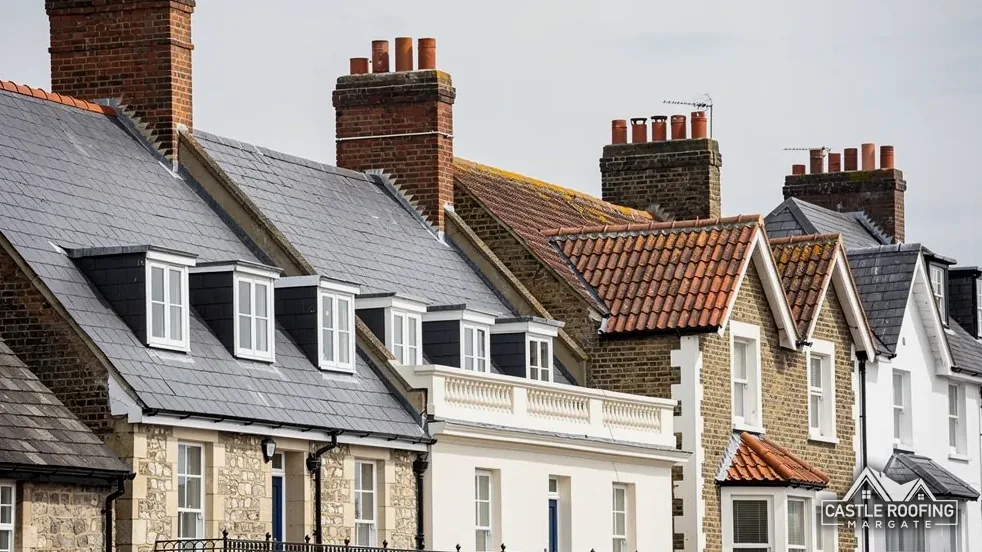
Littlebourne, church to High Street
Littlebourne roofs, from the Grade I church and Court barn to the High Street's Article 4 entries
Three chapters on the listed church, barn and restaurant, the three conservation areas and the Article 4 streets, and the scaffold licence, skip permit and Manston weather behind a re-roof.

Chapter 01 of 03
St Vincent's, the Court barn and the 1967 entries
Littlebourne had 1,597 usual residents at the 2021 Census, and Historic England shows 46 listed entries within 500 metres of the village centre point. Three that stand out share a date. The Church of St Vincent and the Barn at Littlebourne Court are both Grade I, and The Bow Window Restaurant is Grade II. All three were first listed on 30 January 1967. A village with that many entries close together is one where the roof question starts with the list, before it reaches slates or tiles.
St Vincent's is in Church of England use, which places it among the exempt denominations, so its works go through the faculty system rather than through listed building consent. We would work to the faculty as granted. The exemption covers only the faiths the law names and only while the building is in use for worship. Meeting houses of Quakers or Unitarians, and churches vested in the Churches Conservation Trust, take the ordinary listed building consent route.
The Court barn is different again. No exemption applies to a barn. A barn roof is a broad plane of covering carried on rafters, with the covering hung from battens, so a repair that lifts it reaches the timbers beneath. Section 7 of the Planning (Listed Buildings and Conservation Areas) Act 1990 governs it, and Canterbury City Council decides applications. A Grade II building used as a restaurant is no different on principle: use does not alter the listing, and a roof on a listed shop, restaurant or office needs the same consent as one on a house. Our commercial roofing page covers the non-domestic side of that work.
For all three kinds, the order is the same. The entry is read first, the roof is surveyed from the road and then from close range, and you receive photos of each slope, valley and stack, so the description of the job is built on what is really there. Repairs are specified to match the existing covering, with changes only where consent allows them. If you are unsure which category your building falls into, message us the address and we will say which route to ask the council about before a visit is booked.
| Entry | Grade | First listed |
|---|---|---|
| Church of St Vincent | I | 30 January 1967 |
| Barn at Littlebourne Court | I | 30 January 1967 |
| The Bow Window Restaurant | II | 30 January 1967 |
Source: Historic England, National Heritage List for England
Chapter 02 of 03
Three conservation areas and fifteen Article 4 areas
Three conservation areas reach within about 0.75 km of the centre of Littlebourne on the national planning dataset: Ickham-Wickhambreaux-Seaton, Littlebourne itself, and a third centred on Lee Priory and Garrington. Canterbury City Council counts 97 conservation areas across its district, so a survey begins by plotting your address on the right map. Inside any of them the land is article 2(3) land, which removes dormer rights, and the same is true inside the Canterbury World Heritage Site, which was inscribed in 1988 and consists of three parts in the city, all linked by a buffer zone. That is a planning matter, not only a heritage one. Dormer and roof-window conditions are laid out in our roof window planning guide.
Article 4 sits on top. Canterbury's published data lists 15 Article 4 areas touching the village, and the entries name streets: Nargate Street, The Hill, the High Street and Bekesbourne Lane, among them Pear Tree Cottages, Old Oast Cottages and Malvern Cottages. A direction takes named permitted development rights away in a set area. Exactly which rights, and for which houses, is for Canterbury City Council to say, so on those streets we ask for the council's answer before any visible roof change is priced.
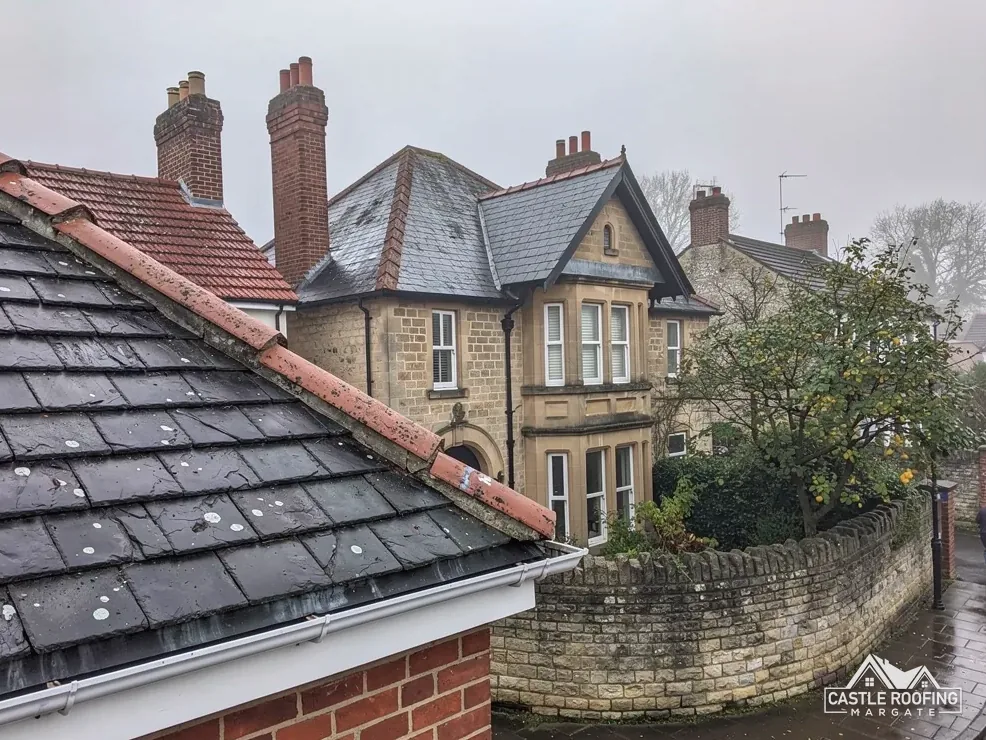
An ordinary repair is a different matter again. Section 55 of the Town and Country Planning Act 1990 draws its line at material change: works leaving the exterior looking essentially as it did are not development at all, so re-bedding a ridge or replacing a few slipped tiles normally sits outside planning. A converted house is the exception to watch: Canterbury City Council gives flats and maisonettes no permitted development rights at all, which sends any outside change to planning. The question that matters is whether the covering, the ridge line or the stack looks different from the street afterwards.
Building control is its own test. Canterbury City Council directs applicants to its building control partner, STG, on 01634 331133. The Planning Portal's benchmark is under 25 per cent of the building envelope and under 50 per cent of the roof for a job to avoid an application, with a covering 15 per cent or more heavier needing approval. See roof replacement for what a full re-cover involves.

Chapter 03 of 03
A licence, a skip and the Manston record
Scaffolding that stands on a Littlebourne street or pavement comes under section 169 of the Highways Act 1980, and the licence is Kent County Council's to issue. Kent County Council's guidance leaves the application to whoever puts the scaffold up. The 2026 to 2027 charge is £52 per week, the application goes in 5 working days ahead of the intended start, public liability insurance of £5 million or more is a condition, and an inspection can add £78 where the council judges one necessary. A scaffold has to be kept 1.2 metre or more from the carriageway, so on a village street the position is agreed with the scaffolder in advance.
A skip has its own permit under section 139 of the same Act. It costs £45 per week for 2026 to 2027, takes 5 working days to apply for, and may be no more than 5 metres by 2 metres. Kent County Council also wants notice of 3 days for a renewal, and a skip placed on the footway needs express permission, with 1.5 metres kept free as a pedestrian walkway. A skip with no permit costs £120 for inspection plus a £45 retrospective fee. The waste from a Littlebourne re-roof is planned around those dates: old tiles and battens are loaded to the skip and the street is swept before we leave each day.
The Met Office's Manston station gives 1991 to 2020 averages of about 613 mm of rain a year, 110.05 days with 1 mm or more of rain, 21.43 days of air frost, 1846.03 hours of sunshine and a mean wind at 10 metres of 9.86 knots. These are Manston figures. They are not readings from Littlebourne, so they are offered as a rough guide to what a roof faces over a year. Under BS 5534, fixings are specified from how exposed each particular building is.
The four steps below put these pieces in the order a Littlebourne job takes, from the first survey to the last load, and each one is agreed with you before the next begins. If a step turns up something unexpected, such as a rotten batten or a failed flashing, you are shown it in a photo before the price changes.
From first look to last load at Littlebourne
Entry, survey, photos
The list entry is read, the roof surveyed, and photos of each slope sent to you.
Boundary and Article 4
Canterbury City Council is asked about your address where it sits on a named street.
Licence and permit
The scaffolder applies to Kent County Council; any skip has its own permit.
Work and sweep
Daily updates, a swept street each evening, and the waste taken away.
10-Year workmanship guarantee. In writing
Around Littlebourne
Littlebourne among its Canterbury district villages
Littlebourne belongs to the same chain as Sturry and Fordwich: Canterbury City Council decides planning, STG handles building control applications, and Kent County Council is the highway authority behind every scaffold and skip.
Littlebourne church, barn and Article 4 streets
How are roof repairs on St Vincent's Church or the Court barn handled in Littlebourne?
They follow different routes. Worship at St Vincent's is Anglican, so its roof work is authorised by faculty. The Court barn has no such exemption, so listed building consent applies, decided by Canterbury City Council. In both cases the roof is surveyed first and repairs are specified to match the covering already there.
Which of the three conservation areas around Littlebourne covers my house?
That depends on the address. Three areas, Ickham-Wickhambreaux-Seaton, Littlebourne and one around Lee Priory and Garrington, reach within 0.75 km of the village centre, and each boundary is mapped by Canterbury City Council. Inside one, dormer rights go as article 2(3) land, while a plain repair that changes nothing material stays outside development under section 55.
What does an Article 4 entry on the High Street or Nargate Street mean for my roof?
Canterbury's data lists 15 Article 4 areas touching the village, and some entries name addresses on those streets. An Article 4 direction takes named permitted development rights away in a set area, but which rights are removed is for Canterbury City Council to confirm for your house. We ask before pricing any change you can see from the road.
My Littlebourne shop is listed. Does its roof need consent separate from a house's?
No, the same listed building consent applies, because the Planning (Listed Buildings and Conservation Areas) Act 1990 looks at the building's character and not at what it is used for. The Bow Window Restaurant, Grade II since 30 January 1967, is an example. Canterbury City Council decides, and our commercial roofing work follows the consent.
How far ahead must scaffolding be arranged for a Littlebourne house?
The fee for 2026 to 2027 is £52 per week, and the application reaches Kent County Council 5 working days ahead of the start. Kent County Council expects the scaffold company to make it. For queries ahead of applying, Kent County Council highways take calls on 03000 41 81 81, and any skip needs a permit applied for on its own.
Your Littlebourne roof, surveyed before pricing
Tell us what the roof is doing and send a picture if you have one; a visit follows, then a single written total.