

Roofers in Bridge
17.9 road miles from Margate. Roof work for Bridge cottages, High Street fronts and village houses, with a photographed survey first and one written total afterwards.
- City planningPlanning in Bridge: Canterbury City Council.
- Five conservation areas5 conservation areas within 0.75 km of the centre.
- STG inspectsSTG Building Control Partnership, Rochester.
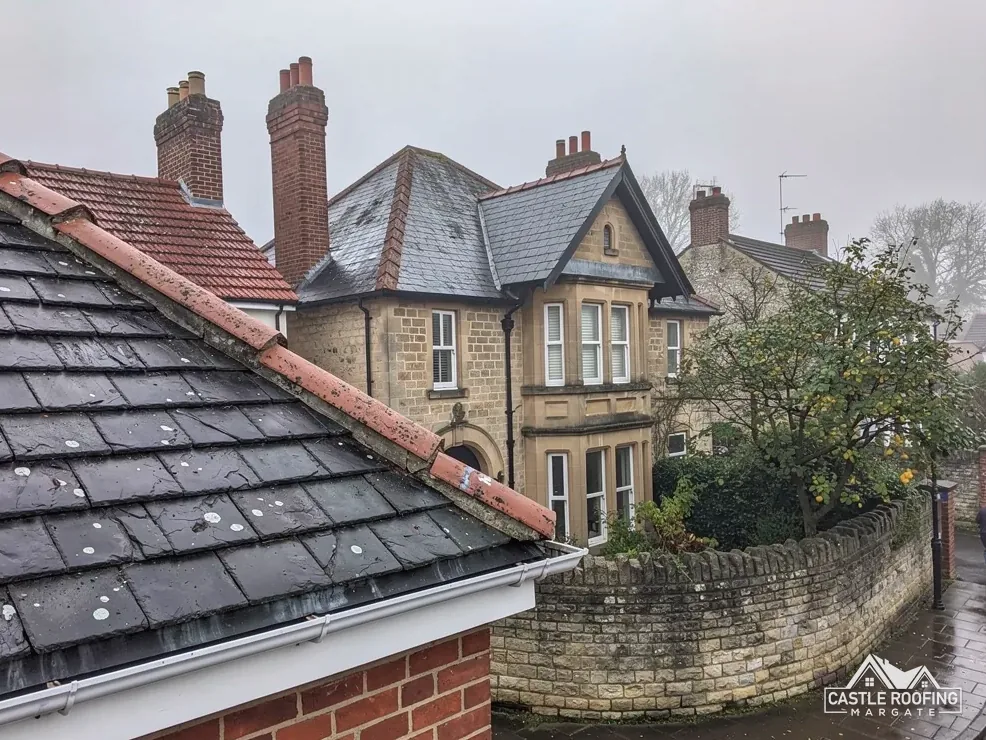
Grade II* walls, downland rules and ten High Street directions
Faculty ground
As a parish church, St Peter's has roof works handled through the Church of England's faculty system, not the council.
Named areas
Bifrons Park, Patrixbourne and Bourne Park are among the conservation areas near the village, and each gets checked against your address.
Ten directions
Canterbury's Article 4 list carries ten Bridge entries, all High Street addresses, so that street gets one extra question before a quote.
Parish of Bridge
A High Street village inside the Kent Downs
| Council | Canterbury City Council |
|---|---|
| Building control | STG Building Control Partnership |
| Scaffold and skip licences | Kent County Council |
| Conservation area | Renville Farm and Bridge Railway Station (Bridge); Bridge; Bifrons Park (Bekesbourne with Patrixbourne/Bridge); Patrixbourne; Bourne Park (Bishopsbourne/Bridge) |
| Population, 2021 | 1,566 (Bridge parish) |
| From Margate | 17.9 road miles, about 28 min |
| Residents, 2021 Census | 1,566, Bridge parish |
| Listed entries within 500 m | 40, National Heritage List |
| Landscape designation | Kent Downs National Landscape |
Bridge has 1,566 residents, a parish church and a house both listed Grade II*, and a place inside the Kent Downs National Landscape, which is why every survey here begins with the paperwork before the ladder, and why the photographs we send show every slope and stack.
Sources: ONS Census 2021, Canterbury City Council, Kent County Council, OSRM road routing.

Bridge, church to carriageway
Bridge roofs, from the Grade II* church to the scaffold on the High Street
Three chapters on the listed buildings, the conservation areas and the downland designation, and the licences and weather that shape a roof job in a Canterbury village.
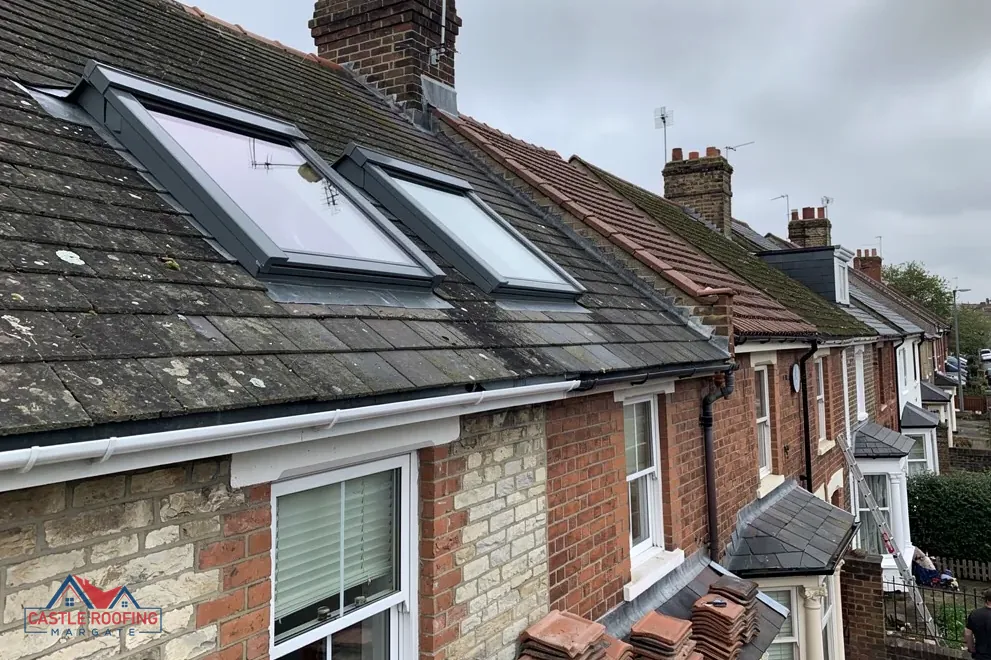
Chapter 01 of 03
St Peter's, Bridge Place and a village of listed roofs
Bridge had 1,566 usual residents at the 2021 Census, and the village centre holds the buildings that decide how a roof job begins. The Church of St Peter is listed Grade II*, first listed on 30 January 1967. Bridge Place is also Grade II*, first listed on 29 September 1952, and Riverdale House is Grade II, first listed on 14 March 1980. Historic England's list shows 40 listed entries within 500 metres of the centre, so on many streets here the opening question about a roof is whether the building is on the National Heritage List at all.
Listing covers the whole building, roof included. Under section 7 of the 1990 Planning (Listed Buildings and Conservation Areas) Act, altering a listed building in a way that affects its character needs authorisation first, and Canterbury City Council puts the same idea to owners: any change touching the building's character means listed building consent. A different slate, a re-pitched ridge (the capped line along the summit of the roof), a stack cut down to the roofline, or a flashing (the lead or zinc strip dressed where roof meets masonry) replaced by a bead of mastic can each count as a change.
St Peter's takes another road. A parish church of the Church of England that is still used for worship sits outside listed building consent through the ecclesiastical exemption, and its works go through the faculty system instead. Our part is to describe the roof accurately and price what the faculty allows. Other congregations are not treated alike. Methodist, Baptist, Roman Catholic and United Reformed buildings run their own schemes, whereas Quaker, Unitarian and Churches Conservation Trust buildings are handled as ordinary listed buildings needing listed building consent, and a scheduled monument needs scheduled monument consent.
A listed house is the more usual case on a village street. The order we follow is consent first, quote second, scaffold third, and the application should describe the same slates, battens (the thin timbers that carry the covering) and flashings that will go on the roof, so the drawing and the job match. Our lead roofing page explains how lead detailing is specified, and our roof replacement page covers what a full re-cover involves, from stripping to the last ridge.

Chapter 02 of 03
Named areas, a national landscape and a High Street list
The national planning dataset at planning.data.gov.uk places 5 conservation areas within about 0.75 km of the village centre: Renville Farm and Bridge Railway Station, Bridge, Bifrons Park, Patrixbourne and Bourne Park. Each has its own boundary, so a Bridge house may fall in one of them and not in the Bridge area itself. Canterbury City Council states that its district has 97 conservation areas, so the first job on a Bridge survey is working out which one your street belongs to, if any. The council holds the boundary maps and the designation dates, and a house near a boundary line deserves a direct question to the council.
The village also sits inside the Kent Downs National Landscape, formerly the Kent Downs Area of Outstanding Natural Beauty. Both a conservation area and an area of outstanding natural beauty count as article 2(3) land under the General Permitted Development Order. That status removes permitted development for roof dormers, though it leaves the re-covering of a house alone. Dormer and roof window conditions sit in our roof window planning guide, so we leave them there.
| Designation | Status |
|---|---|
| Conservation areas near the centre | 5 within about 0.75 km |
| Conservation areas in the district | 97, Canterbury City Council |
| Landscape designation | Kent Downs National Landscape |
| Article 4 entries in Bridge | 10, all on the High Street |
| Building control | STG Building Control Partnership |
Source: planning.data.gov.uk; Canterbury City Council
Canterbury's published Article 4 list carries 10 entries for Bridge, and every one is a High Street address: numbers 5, 7, 9 and 11, numbers 26, 27, 29 and 31, Maudsley House at 47, number 50, and Lynton Cottage at 79 and 81. A direction under Article 4 strips selected permitted development rights from a mapped area. The effect of each of these ten is a question for Canterbury City Council, and we put that question to the council before a High Street survey is booked.
Flats and the building envelope
Canterbury says a flat has no permitted development rights of its own, so altering its outside appearance means a planning application. Building Regulations ask a separate question, and the STG Building Control Partnership, which also serves Gravesham, Medway and Swale, delivers Canterbury's building control on 01634 331133. Canterbury publishes no re-roofing percentage of its own, which leaves the Planning Portal's test to apply: under 25 per cent of the total building envelope and under 50 per cent of the roof affected, with approval needed whenever a new covering adds 15 per cent or more to the weight.

Chapter 03 of 03
Licences, party walls and the weather on a village roof
Putting a scaffold on a Bridge street or verge needs a licence under section 169 of the Highways Act 1980, and the licence is granted by Kent County Council, the highway authority. According to Kent County Council, the company erecting the scaffold submits the application, so the scaffolder applies and we settle dates with that firm after the survey has defined the work. Kent County Council charges £52 per week for 2026 to 2027, wants the application 5 working days before the licence starts, sets a £5 million minimum of public liability insurance on the scaffold applicant and may add a £78 site inspection. Before applying, its highways line is 03000 41 81 81.
A skip is a separate permit from Kent County Council: £45 per week for 2026 to 2027, applied for 5 working days ahead, and no longer than 5 metres or wider than 2 metres. On a narrow High Street the pavement matters. Kent County Council's scaffold conditions hold the scaffold a clear 1.2 metres off the carriageway, and a skip placed on the pavement needs the council's express say-so plus a 1.5 metre pedestrian walkway.
Neighbouring homes in a village row often share a chimney. Removing a chimney breast is always a Building Regulations approval matter, since it is part of the building's structure, and when it stands on a party wall the Party Wall etc. Act 1996 requires two months' notice before the work starts. Questions about the neighbour's side go to a party wall surveyor, never to building control, which we flag during the survey, before a quote is written.
The weather figures here are the Met Office's 1991 to 2020 averages for Manston: about 613 mm of rain a year, a mean wind of 9.86 knots at 10 metres (11.21 knots in January), 110.05 days with 1 mm or more of rain, and 21.43 days of air frost. Manston is a separate station elsewhere in East Kent, so these are averages for it, not for Bridge. Cupa, the slate maker, grades buildings on slopes and hills, and tall buildings, with higher exposure, so under BS 5534 the fixings on a Bridge roof are calculated for that house on its own plot.
Myth
The city council issues the scaffold licence when a Bridge house is re-roofed.FactKent County Council issues scaffold licences as highway authority, and the scaffolding company is the one that applies.
Myth
A Grade II* church needs listed building consent for a new roof, like any listed house.FactA Church of England building still used for worship is exempt from listed building consent and goes through the faculty system instead.
Source: Kent County Council; LBCA 1990 s60
10-Year workmanship guarantee. In writing
Around Bridge
Past Bridge to Bekesbourne, Barham and the city
Bekesbourne, Barham, Littlebourne and Canterbury all answer to Canterbury City Council and to STG for building control, so a roof in any of them starts with the same checks: listing, conservation area, scaffold licence.
Bridge High Street, listing and licence questions
Can I re-cover a roof on Bridge High Street without asking Canterbury City Council?
It depends on the building. Ten Article 4 entries in Canterbury's list are High Street addresses, and a listed house needs separate consent before anything touching its character is altered. Where neither applies, the Planning Portal test settles whether Building Regulations approval is needed. We ask Canterbury City Council about your address before the survey is priced.
Which conservation area is my Bridge house in?
The national dataset names Renville Farm and Bridge Railway Station, Bridge, Bifrons Park, Patrixbourne and Bourne Park within about 0.75 km of the centre. Canterbury City Council holds the boundary maps and dates, and a street can sit on the edge of one. We check your address against the council's map and report the result before we quote.
Who applies for the scaffold licence on a house in Bridge?
Kent County Council issues licences under section 169 of the Highways Act 1980, on application by the scaffolding firm. Its notice period is 5 working days, its fee is £52 per week for 2026 to 2027, and it sets a £5 million public liability minimum for scaffolders. The district council plays no part in the licence, and dates are agreed with the scaffolder after the survey.
Does a Grade II* house in Bridge need more than planning permission?
Yes, listed building consent is a separate step. Canterbury City Council says changes that affect a building's character need it, and a roof is part of that character. Bridge Place and the Church of St Peter are both Grade II*. A church in use follows the faculty system instead, and we describe the roof so the application matches the work.
Who inspects a re-roof in Bridge, the city council or someone else?
Canterbury City Council's building control is delivered by the STG Building Control Partnership, which can be reached on 01634 331133 at its Rochester office. A re-roof touching under 25 per cent of the building envelope and under 50 per cent of the roof rarely needs approval, though a covering 15 per cent or more heavier always does.
Bridge roofs start with photographs
Call 01843 305243 or message us about your Bridge roof; after the survey, one written total follows.