
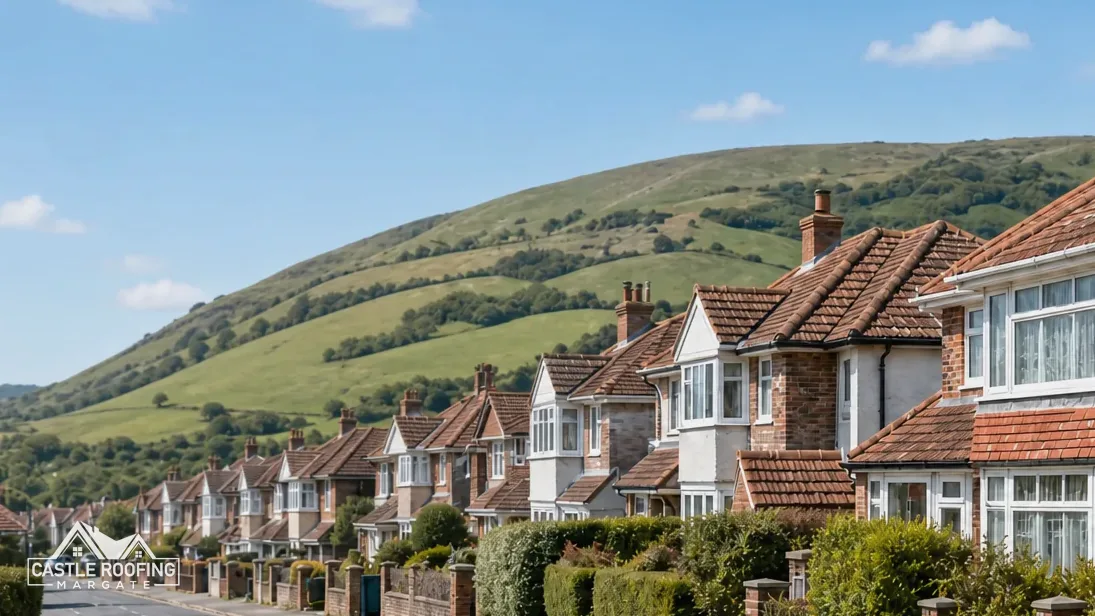
Roofers in Canterbury
18.4 road miles from Margate. Repairs, re-covers and lead and chimney work for Canterbury houses, with the heritage checks done before a price and one written total after the survey.
- Planning: CanterburyPlanning authority: Canterbury City Council.
- Nine conservation areasNine conservation areas within 0.75 km of the centre.
- STG, RochesterBuilding control through the STG partnership.
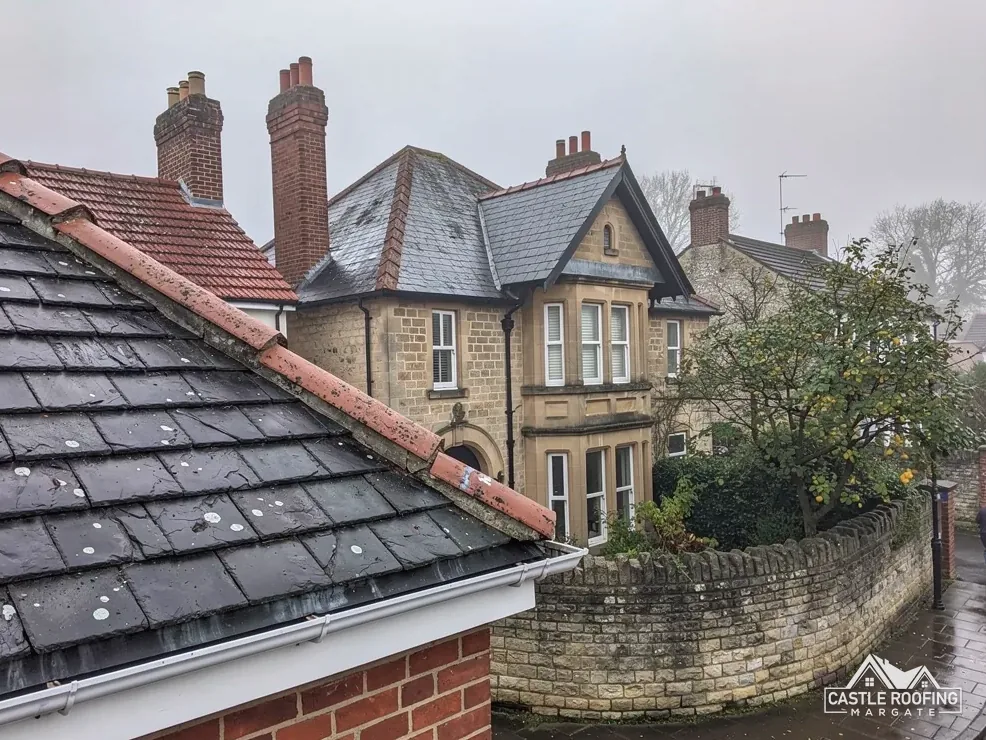
Grade I buildings, a World Heritage Site and a long Article 4 list
Grade I
The Cathedral, Christchurch Gateway and the Archbishop's Palace are all Grade I, and the Guildhall is a scheduled monument.
Nine areas
Nine conservation areas lie within about 0.75 km of the centre, from Nunnery Fields to the West Station area.
Inscribed 1988
Three linked sites carry the World Heritage inscription, and inside their boundary dormer rights do not apply.
Canterbury city centre
A cathedral city with 824 listed entries close by
| Council | Canterbury City Council |
|---|---|
| Building control | STG Building Control Partnership |
| Scaffold and skip licences | Kent County Council |
| Conservation area | Nunnery Fields (Canterbury Conservation Area); Old Dover Road, Oaten Hill and St. Lawrence; Canterbury (Alma, Clyde and Notley Street); Canterbury (Whitstable Road); Canterbury (St Martin's); Martyrs Field (Canterbury Conservation Area); Canterbury (West Station) (Canterbury Conservation Area); New Dover Road and St. Augustine's Road; Canterbury City (Canterbury Conservation Area) |
| From Margate | 18.4 road miles, about 30 min |
| Grade I, first listed 3 December 1949 | Cathedral; Christchurch Gateway |
| Grade I, first listed 3 May 1967 | The Archbishop's Palace |
| Scheduled monument within 500 m | The Guildhall |
| World Heritage Site inscribed | 1988 |
Canterbury puts a World Heritage Site, 824 listed entries and nine conservation areas within a short walk of the same roof, so here the checks come before the quote, never after it, and the photographs show the detail.
Sources: ONS Census 2021, Canterbury City Council, Kent County Council, OSRM road routing.
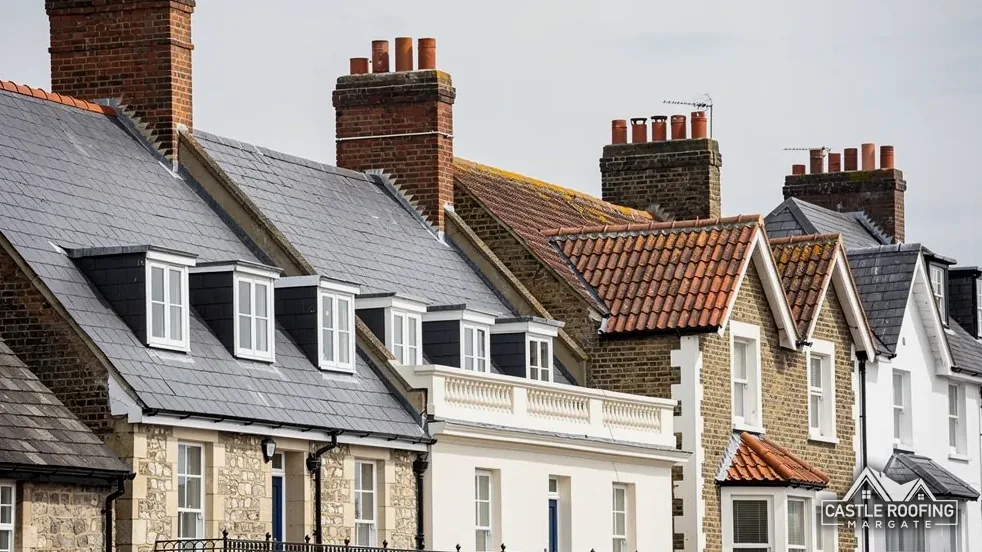
Canterbury, precinct to pavement
Canterbury roofs, from the Cathedral precinct to the licence on the pavement
Three chapters on the listed and scheduled buildings, the World Heritage Site and the conservation areas, and the permits and building control a city re-roof depends on.
Chapter 01 of 03
The Cathedral precinct, the Guildhall and 824 listed entries
Protected roofs crowd the centre of Canterbury. Historic England's National Heritage List holds 824 entries within 900 metres of the city centre. At the top of the scale, Christchurch Cathedral is Grade I, first listed on 3 December 1949, and Christchurch Gateway was given Grade I on that date too. The Archbishop's Palace, also called the Old Palace, is Grade I as well, first listed on 3 May 1967. The Guildhall sits in a different category: it is a scheduled monument within about 500 metres of the centre, and a scheduled monument is protected by a consent of its own.
The Cathedral and the churches around it follow procedures that a house does not. The Cathedral precincts are mostly under the Care of Cathedrals Measure 1990, as amended in 2005, and the Cathedral itself has a matching exemption from listed building consent. Where a Church of England parish church is in regular worship use, the faculty system applies. Roman Catholic and Baptist congregations, Methodists and the United Reformed Church each keep a denominational route. Quaker meeting houses, Unitarian chapels and Churches Conservation Trust churches need listed building consent from the council. Works to a scheduled monument are an offence unless authorised, so scheduled monument consent comes before anyone lifts a tile.
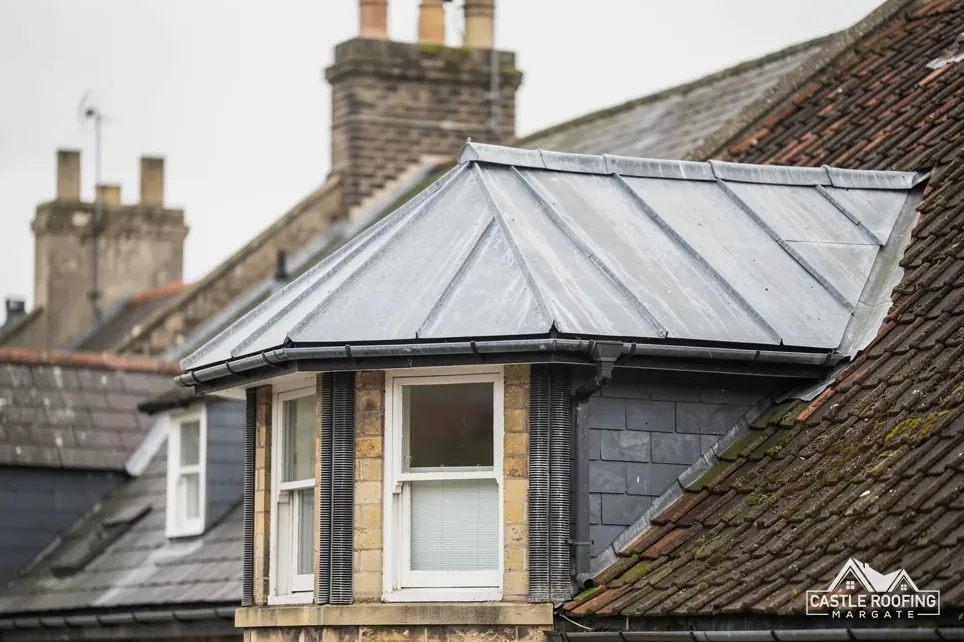
Houses are the usual job. Listing adds a consent layer on top of whatever planning allows, and the order we follow is simple: read the list entry, note its grade and first listing date, photograph the roof slope by slope, then describe the existing covering, the ridge (the tiled or slated crest), the stack and the lead in the application, so the paperwork and the job say the same thing. A flashing is a thin metal strip sealing the junction between roof and wall or chimney, and on a listed building it is part of what was listed.
Where the covering is slate, matching the size, thickness and fixing method matters as much as the colour, and our slate roofing page goes into the options. Where the roof meets a stack, our lead roofing page explains how the detail is built. Neither page replaces the list entry: the entry comes first, and the materials follow from it.

Chapter 02 of 03
The World Heritage Site and nine named conservation areas
The Canterbury World Heritage Site was inscribed in 1988. It takes in the Abbey of St Augustine, the Church of St Martin and the Cathedral, three parts linked by a buffer zone. It is more than a label. The General Permitted Development Order lists a World Heritage Site among article 2(3) land, so permitted development for roof dormers does not apply inside its boundary, though the re-covering of a house is a different kind of work and is not caught by that exclusion. The buffer zone is not named in the order. Canterbury's Local Plan policies protect the site's setting, and the conservation area appraisal covers views of the Cathedral.
The national planning dataset places 9 conservation areas within about 0.75 km of the centre: Nunnery Fields; Old Dover Road, Oaten Hill and St Lawrence; Canterbury (Alma, Clyde and Notley Street); Canterbury (Whitstable Road); Canterbury (St Martin's); Martyrs Field; Canterbury (West Station); New Dover Road and St Augustine's Road; and Canterbury City. Canterbury City Council says its district has 97. Each is article 2(3) land too, and our roof window planning guide sets out the dormer and roof window conditions in one place. A boundary can run through a street, so the council's map matters more than the street name.
Myth
The World Heritage Site is a heritage matter only and never a planning rule.FactA World Heritage Site is article 2(3) land, so dormer rights do not apply inside it.
Myth
The buffer zone around the three sites carries the same planning status as the site.FactThe buffer zone links the three parts of the property, but the Order does not name it as article 2(3) land.
Source: GPDO 2015 Sch 1 Pt 1; UNESCO, list 496
The council's own Article 4 dataset names a long run of addresses close to the centre. In alphabetical order they start with Abbots Place, Adelaide Place and Albert Road through Albion Place to All Saints Lane. A direction of this kind withdraws chosen permitted development rights inside a mapped area, and what each of these removes is something only Canterbury City Council can answer. We put the address to the council before a survey is priced, because a street name alone settles nothing.
Converted houses and flats
Canterbury's guidance is that a flat has no permitted development rights of its own, so changing the outside of one means a planning application. Where a city building has been divided into flats, our first questions on a converted house are who owns the roof, whether a management company is involved, and what the lease says about repairs, since all three decide who signs for the work.

Chapter 03 of 03
Narrow streets, scaffold licences and building control in the city
Where a pavement is narrow, the licence conditions decide the layout. Scaffolding on a Canterbury street needs a licence under section 169 of the Highways Act 1980. Kent County Council grants it, as the highway authority, on an application made by the scaffolding firm. Kent County Council charges £52 per week for 2026 to 2027, wants the application lodged 5 working days ahead of the start and may add a £78 site inspection. Its conditions hold the scaffold at least 1.2 metres away from the carriageway, call for the uprights to be painted white for 2.5 metres up from pavement level, and make the scaffold show lights overnight whenever it stands in, or within 45 centimetres of, the road.
A skip on the road is a separate permit from the same council at £45 per week for 2026 to 2027, applied for 5 working days ahead. It should be no longer than 5 metres or wider than 2 metres, and one left without a permit attracts an inspection fee of £120 plus a retrospective permit fee of £45. A skip on the pavement itself needs express permission and a pedestrian walkway 1.5 metres wide. In a city street those details settle where the waste can stand, so we agree them with the scaffolder before work is booked.
Building control is delivered by the STG Building Control Partnership, which also serves Gravesham, Medway and Swale, from its Rochester office on 01634 331133. No Kent district publishes a re-roofing percentage, so the Planning Portal test is used: under 25 per cent of the total building envelope and under 50 per cent of the roof affected. A chimney breast shared with a neighbour calls for a party wall notice two months ahead, and our chimney repairs page explains the sequence of the work.
For weather, the Met Office station at Manston, a separate site in East Kent, holds the long-run averages. The Met Office's Manston averages for 1991 to 2020 are about 613 mm of rain in a year, a mean wind speed of 9.86 knots at 10 metres, 110.05 days with at least 1 mm of rain and 21.43 days of air frost. They describe Manston, not the city, and what that means for a Canterbury roof is that each house gets fixings worked out for its own exposure.
A Canterbury scaffold, in order
Survey and photographs
We look at the roof and send you photographs of every slope and stack.
Heritage checks
Listing, conservation area and Article 4 questions answered for your address.
Permits in place
The scaffolder applies to Kent County Council; any skip gets its own permit.
Work, then clear
Daily updates, the road and pavement left clear, and the waste taken away.
10-Year workmanship guarantee. In writing
Around Canterbury
Around Canterbury: Harbledown, Sturry, Chartham and Bridge
Harbledown, Sturry, Chartham, Bridge and Fordwich share the city's council and its STG building control, but each has its own conservation areas and listings, so the checks are repeated for every village.
Canterbury heritage, consents and permits
Can I add a roof window to a Canterbury house inside the World Heritage Site boundary?
The boundary is article 2(3) land, so dormer rights do not apply, and a conservation area or listing may add its own limits. Roof windows have their own conditions, which our planning guide sets out. We check your address against the site boundary and the council's maps, then say what is realistic before any price.
Which conservation area covers Old Dover Road in Canterbury?
The national dataset names one area Old Dover Road, Oaten Hill and St Lawrence, one of 9 within about 0.75 km of the centre. Canterbury City Council says its district has 97 conservation areas, so boundaries differ street by street. We check your house against the council's map and tell you what we find.
Who decides roof works on a Canterbury church or the Cathedral?
Not the city council's planners. Most of the Cathedral precincts come under the Care of Cathedrals Measure, while a Church of England parish church in worship use goes through the faculty system. Chapels of the Catholic, Methodist, URC and Baptist churches have procedures of their own; Quaker and Unitarian buildings, like Churches Conservation Trust churches, need listed building consent; a scheduled monument needs scheduled monument consent. We price what that body allows.
Does an Article 4 entry near the centre of Canterbury cover my roof?
Canterbury's own dataset names a long list of Article 4 addresses close to the centre, beginning with Abbots Place, Albert Road and All Saints Lane. Whether yours is among them, and what the direction removes, is for Canterbury City Council to say. We take your address to the council first, so the quote reflects what it tells us.
Who applies for a scaffold on a narrow Canterbury street?
The scaffolding firm applies to Kent County Council, with 5 working days' notice. Kent County Council's fee is £52 per week for 2026 to 2027 and the space from scaffold to road must never fall below 1.2 metres. The district council is not the licensing body. Dates are fixed with the firm after the survey has been done.
Your Canterbury roof, checked before priced
Message or call 01843 305243 about your Canterbury roof; we check the heritage list, survey the roof, then write one total.