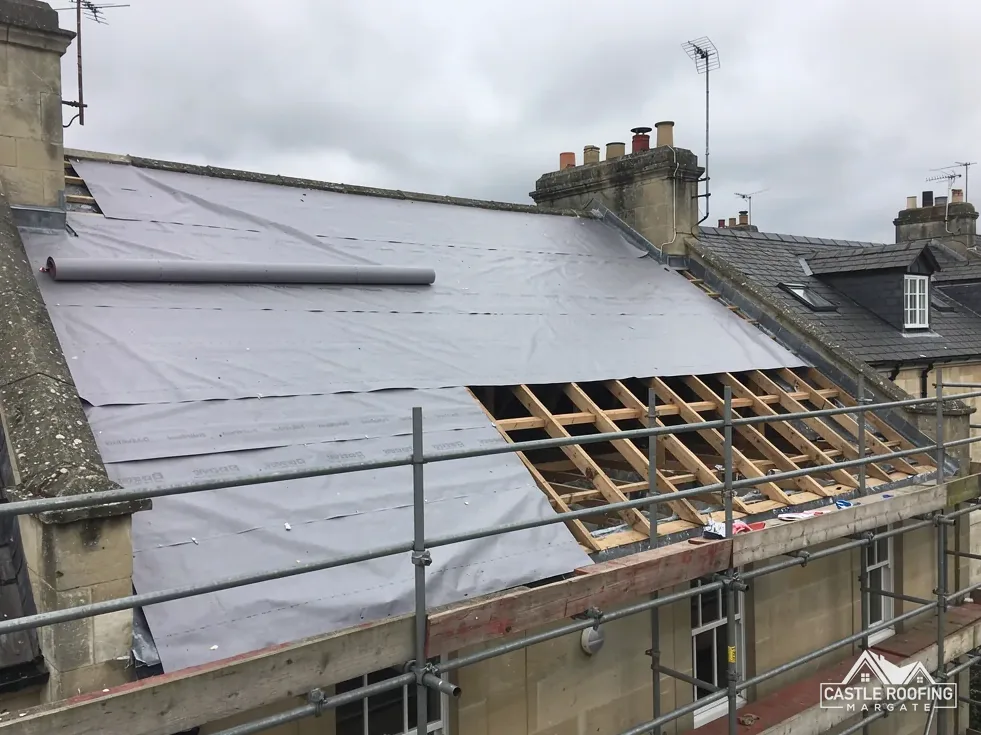
Why a house re-roof is normally permitted
Planning law begins with what counts as development. Under section 55 of the Town and Country Planning Act 1990, works that leave the outside of a building looking much as before are not development, and a plain re-cover in matching material can sit in that group. Where the look does change, Class C of the General Permitted Development Order 2015 steps in. Its subject is roof alterations to a house that fall outside the other classes, and that is wide enough to take in a new roof covering.
Permission under Class C comes with conditions, and the conditions are what a homeowner should check before changing a roof. The covering itself is not normally what sends you to the council. It is something that arrives with it: a taller roof, a new chimney, a changed flue or a lifted ridge.
Building Regulations are another matter altogether. A roof can need approval under them while needing no planning permission, as the heavier roof covering approval answer explains for a re-roof in more detail.
The Class C limits worth knowing
Class C stops applying when an alteration breaks one of its limits. Four matter to a re-roof:
- Protrusion: new work cannot project beyond the original slope by more than 0.15 metres, measured square to its outer face (C.1(b)).
- Height: no part of the alteration may rise above the highest part of the original roof (C.1(c)).
- Chimneys, flues and soil and vent pipes: work that installs, alters or replaces one is outside Class C (C.1(d)).
- Solar equipment: installing, altering or replacing solar photovoltaics or solar thermal equipment is excluded by the same paragraph.
The height limit is the one that catches an ordinary re-roof. Thicker insulation, a deeper batten or a thicker tile can lift the line of the covering, and the limit is written around the highest part, not an average, so a small rise at the ridge still counts. Measure the old ridge before work begins and ask your roofer to confirm the finished height in writing. If the finished roof will sit above the old ridge anywhere, ask the council before you order.
Flats, listed houses and protected areas
Four situations need more care than a plain house on an ordinary street.
Flats
In the Order, a dwellinghouse excludes a building made up of flats, and a single flat within one. Permitted development rights therefore stop at the front door of a block. Canterbury City Council states it directly: flats and maisonettes have none, which means an outside change to a flat needs an application.
Listed houses
Class B and Class C both still apply to a listed house, but section 7 of the Planning (Listed Buildings and Conservation Areas) Act 1990 requires listed building consent for work that affects the building's character. A different covering can well do that.
Article 4 directions and article 2(3) land
An Article 4 direction removes named rights across a set area. Swale's Faversham direction reaches front roof coverings, Dover's can reach roof work on frontages to roads, waterways and public open space. In Thanet the council's own list puts directions on Pegwell and on Ramsgate, including the Marina extension, so ask Thanet which classes apply there. On article 2(3) land, which includes conservation areas, the Kent Downs National Landscape and the Canterbury World Heritage Site, Class B dormer rights go, but Class C stays.
A short route to a clear answer
Run through these in order before a covering is chosen, and write down each answer:
- Is the building a house, or a flat or maisonette? A flat means asking the council about planning permission.
- Is it listed? Then speak to the council's conservation officer about listed building consent before anything is ordered, because a covering bought first is hard to return.
- Is it in a conservation area, or inside an Article 4 area? Ask whether any direction reaches roof coverings at your address.
- Will the new roof stand higher than the old one at any point, or stick out more than 0.15 metres from the old slope? Your roofer can check both from the survey.
If every answer is no, the new roof covering on your house is normally permitted. A window in the roof follows different rules. Roof windows have their own conditions on side slopes and glazing, set out in the roof window planning guide. The wider job sits under roof replacement, and the conservation area re-roofing guide covers the places where extra consent is likely to come up.