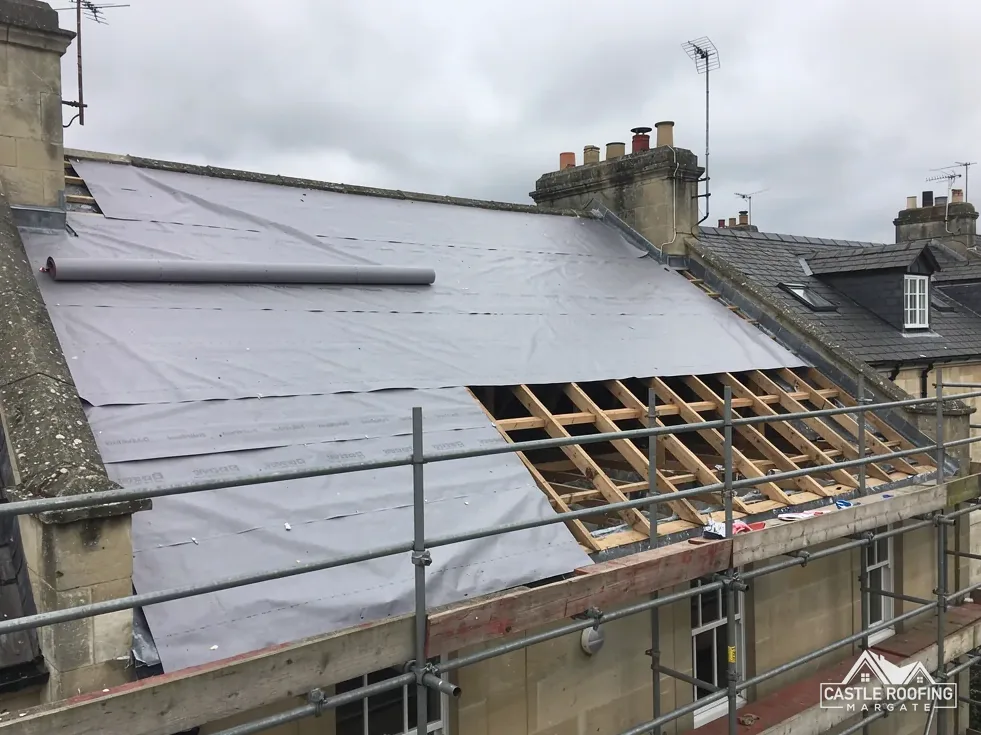
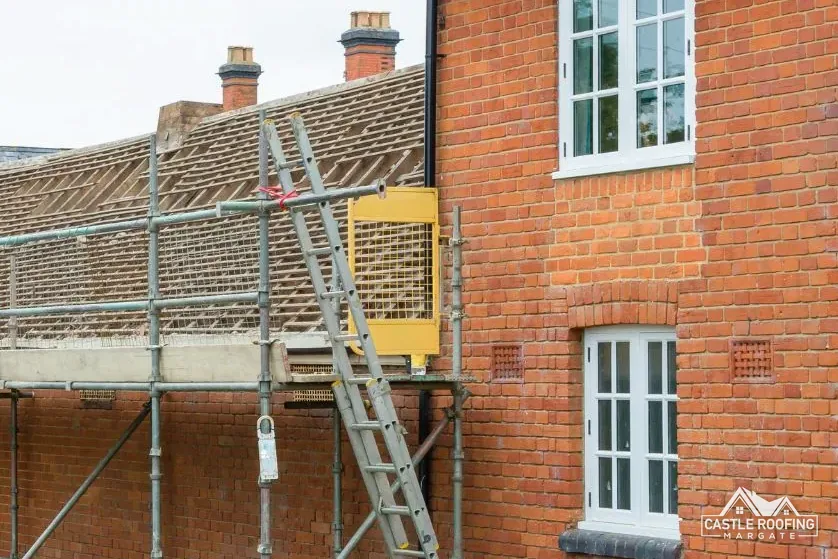
What a strip and re-cover actually removes
A strip takes off the covering, the old felt and the battens down to the rafters. At that point the whole structure is in view, which is why this is the moment to check rafter feet, wall plates and the state of the timber near the eaves and valleys. A sound re-cover is built from the rafters up: underlay, battens, then covering.
Felt is the old word for the layer under the covering. Older roofs often carry a bitumen felt or, on the oldest, no underlay at all. Modern underlay is a plastic-based sheet or fabric, laid over the rafters in horizontal runs with overlaps, and held by the battens above. Its job is to catch what the covering lets through, such as wind-blown rain and snow, and shed it to the gutter.
Battens are the timber laths the covering hangs from. They are set at a spacing, the gauge, that depends on the covering and the pitch. You can read more about the process in our strip and re-cover guide. A re-cover over an existing covering is a separate case, covered in re-roofing over existing tiles.
Choosing the underlay and keeping the roof ventilated
Underlay is not one product. Some are breathable, letting moisture rising from the rooms below escape, and some are not. A non-breathable type, such as Marley's HR underlay, has to be used with ventilation at the eaves. For a cold roof of that kind, Marley gives an eaves vent along the full length of the eaves of 25mm for pitches of 15° or less and 10mm for pitches of more than 15°.
BS 5250:2021 covers condensation and damp in buildings generally, and it is the reference when deciding how much air a roof space needs. Ventilation has to follow a pattern suited to the underlay chosen. Block the eaves with insulation or stuff them with old felt and condensation collects on the underside of the underlay, then drips onto timber and ceilings.
So the choice of underlay, the eaves vents and the loft insulation have to be settled together. That is a decision for the survey, before the quote, because a change of underlay often means a change of ventilation.
Battens graded and fixed for the new covering
New battens are graded timber, treated and cut to a section that suits the rafter spacing and the covering. Reused battens may be split, rotten at the nail line or spaced for a different tile. A new covering is a poor investment when it sits on tired timber, because every nail hole in a weak batten is a loose fixing. The cost of new battens is small beside the cost of putting a scaffold back up to fix a slipped course.
The standard for the work is BS 5534:2014+A2:2018, and its 2018 amendment brought normal re-roofing work into scope. How many nails or clips each tile or slate needs, and how the battens are tied to the rafters, follows from the exposure of the site. In Approved Document C, paragraph 6.8 wants the covering fixed in an appropriate manner, and a loose batten undermines that however good the tile.
Ask for the batten size, the gauge and the fixing pattern, and ask whether the battens are new. A roofer who can answer without looking it up has specified the roof rather than assumed it.
When the old felt and battens can stay
Sometimes parts of the old layers are fit to keep. A recently renewed run of battens, or a roof stripped one section at a time, may hold sound timber worth leaving in place. The test is whether the battens are dry, straight and the right gauge for the new covering, and whether the rafters beneath have been looked at too. Rafters are rarely visible until the old layers come off, so allow for that discovery when you plan the order of work.
Ask these questions before agreeing to keep anything:
- Are the existing battens sound along their full length, including at the nail lines?
- Is the gauge right for the covering that is going on?
- Is the old underlay intact, correctly lapped and the right type for the ventilation planned?
If any answer is no, the layer is replaced. A roof renewed to the rafters costs more than a patch job, and the written price for it follows the survey. The roof replacement page sets out the whole sequence, from survey to final check.