What a second layer does to the roof
Think of a pitched roof as layers: rafters first, then underlay, then battens, then the tiles or slates fixed to those battens. The tiles turn away the bulk of the rain, yet it is the underlay and battens that drain what slips through and hold the covering on. Laying new tiles over old ones leaves the worn layers in place and piles another on top.
Three practical problems follow. The old tiles stand proud, so the new ones sit proud at the ridge, along the eaves and at the verge, and every junction with a chimney or a wall has to be rebuilt to suit. The new tiles need fixing into sound battens, and the battens under the old covering cannot be seen. And the whole assembly carries twice the covering it was designed for.
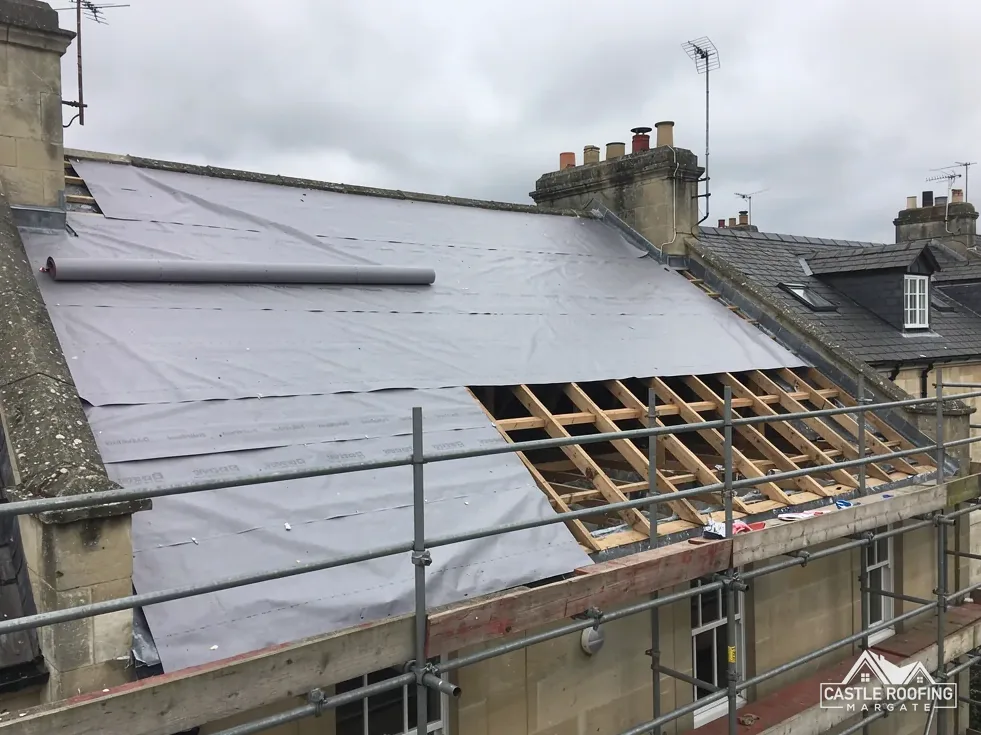
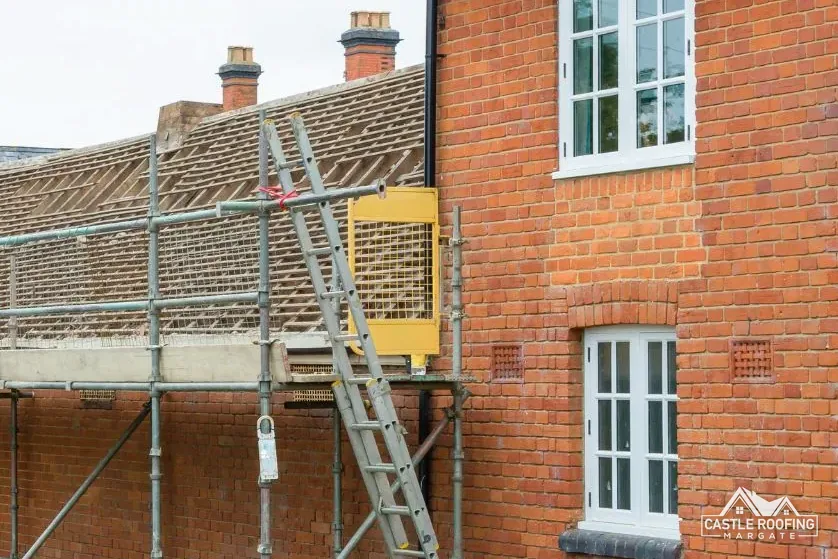
That is why, on a pitched roof of tiles or slates, taking the old covering off is where the work properly starts. The stripped roof can be looked at, measured and rebuilt square, with every junction dealt with while it is open and within reach.
The weight rule in the building regulations
The Planning Portal's re-roofing page treats a new covering as needing approval when it weighs at least 15 per cent more than the old one, or would behave very differently in a fire. Where weight changes, its advice is to take a structural engineer's or a surveyor's view before starting. Approved Document A phrases the same idea a little differently:
| Source | Wording |
|---|---|
| Planning Portal | 15 per cent or more |
| Approved Document A | more than 15% |
A second layer of tiles is not a close call against that line. It adds the weight of an entire covering, so the building control team for the district would have to approve it, and a structural check on the rafters would come first. A strip and re-cover in a covering of similar weight does not raise the same question, because the old layer leaves as the new one arrives. Dover words its own guidance more strictly, counting even a re-cover that matches the old one as work needing approval, and that applies to Dover addresses only.
Faults the old covering hides
Even when weight is not the issue, a roof whose covering is spent has usually aged underneath as well. Putting new tiles over the top paints over those faults. Once the old covering is off, a roofer can see and deal with:
- Battens gone soft or split around old nail holes, so new fixings would have nothing sound to bite into.
- Underlay that has perished or torn, where water has been running behind the tiles for years.
- Rafter feet and wall plates at the eaves that have stayed damp.
- Lead flashings and valley linings that have worn out at the same time as the tiles.
- Gaps round pipes and chimneys that were never properly sealed, often hidden behind old mortar or tired sealant.
Each of these is found by looking, in daylight, on the open roof, and each affects the price. It is far better to see them while the tiles are in a pile on the ground than after a second covering has gone over them and the faults are sealed in for another generation.
Questions to ask a roofer who suggests overlaying
Some roofers will offer to go over the top to save time. If that is suggested, ask for the reasoning in writing, covering these points:
- How much heavier the roof will be, and whether anyone has checked the rafters.
- Which building control team has approved it.
- How the new battens are being fixed through the old covering.
- What happens at the ridge, verges and eaves, where the extra height shows.
- What the scaffold and the days on site look like if the old covering stays.
BS 5534 is the slating and tiling code. Marley confirms that no law demands compliance with it, and its 2018 amendment extended it to ordinary re-roofing. Fixing specifications take account of how exposed the site is, which assumes sound battens underneath. If the old covering turns out to be sound and only a few tiles have failed, a repair beats both options, and the survey photos will show which tiles those are. Set the answers beside the plain alternative described in strip and re-cover, and read about approval for a heavier covering. The whole job sits under roof replacement.