Why flats sit outside the house rules
Planning law treats a house and a flat as different things. The General Permitted Development Order defines a dwellinghouse in a way that leaves out buildings containing flats, along with the flats themselves. Class C, the right that normally lets a house owner re-roof without an application, is written for dwellinghouses. A converted villa with four front doors therefore does not qualify, however grand the original house was.
Canterbury City Council's planning page makes the same point in everyday words: flats and maisonettes hold no permitted development rights, and an owner who wants to alter a flat's exterior must apply for planning permission first.
The trigger is the outside. Under section 55 of the Town and Country Planning Act 1990, work that leaves a building's exterior looking materially the same falls outside the definition of development. Where the new covering cannot be told from the old, the council may not be involved at all. A different tile, new roof windows or a row of solar panels change the look, so take it to the council's planning team for the area before anything is ordered. A listed building or a conservation area adds further layers, so mention them when you ask.
Getting the owners to agree before work is booked
On a house, the person paying is the person deciding. Once a house is converted, its roof tends to become a shared asset, and who may instruct work, who pays and in what proportions depends on the leases or on the freehold arrangement. A roofer cannot read those documents for you. They sit with the owners, the freeholder or the managing agent.
Settle these questions in writing first:
- Who owns the roof, and who is allowed to instruct work on it.
- Whether every flat contributes, and how the share is worked out.
- Who speaks to the roofer, so instructions do not arrive from five directions.
- How the top-floor owner will give access, because the loft hatch and the stairs often run through that flat.
- Who tells the other residents about scaffold dates, noise and blocked doorways.
A roofer can describe the job and answer questions at a meeting of owners. The agreement itself, and any consultation the lease requires, belongs to the owners. Starting on the word of one flat owner is how a roof job ends in a dispute halfway up the scaffold.
Building control, as for any re-roof
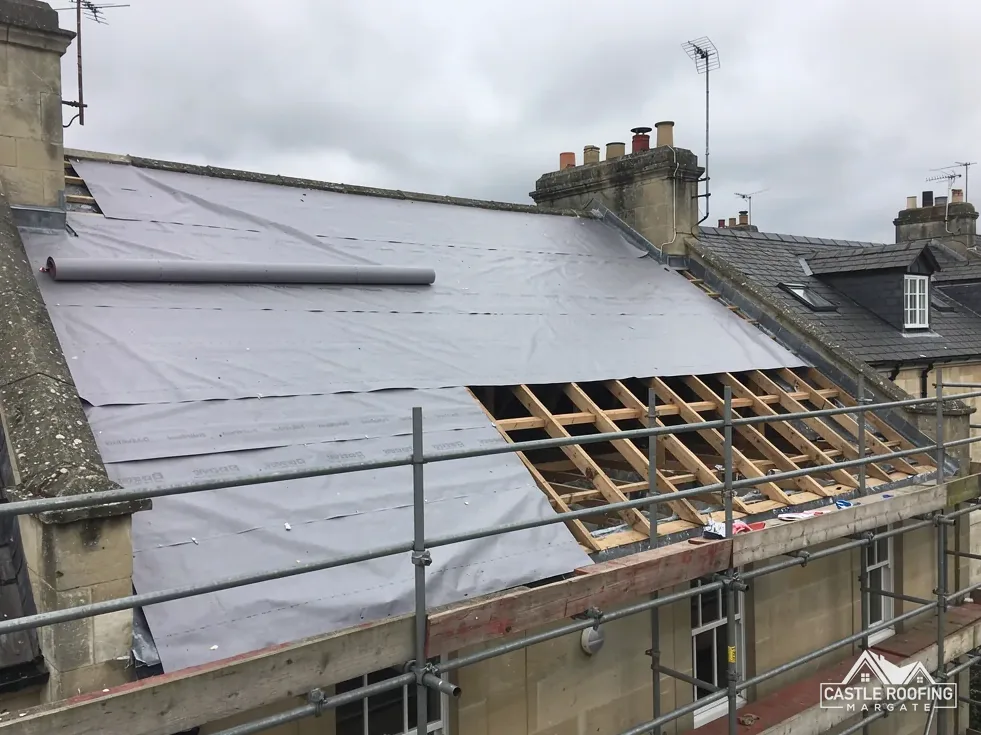
The Planning Portal sets the national yardstick for re-roofing. Stay under 25 per cent of the building envelope and under 50 per cent of the roof and, normally, no application is needed. Nothing in that wording carves out flats. Approval is also needed where a new covering outweighs the old by 15 per cent or more, or would perform significantly differently in a fire, and who lives underneath makes no difference.
Which team deals with it depends on the council area:
- Thanet keeps building control in house; the number is 01843 577522.
- Folkestone & Hythe also keeps it in house, on 01303 853538.
- Dover has its own service too, and its building control page is the place to start.
- A block at an Ashford address goes to Ashford Borough Council's building control.
Canterbury and Swale addresses go to STG Building Control on 01634 331133.
Dover's guidance goes further than the national test, by listing a like-for-like re-cover among the work needing approval. That belongs to Dover and applies to Dover addresses only. Elsewhere, ask the team for your area what it wants to see for a block.
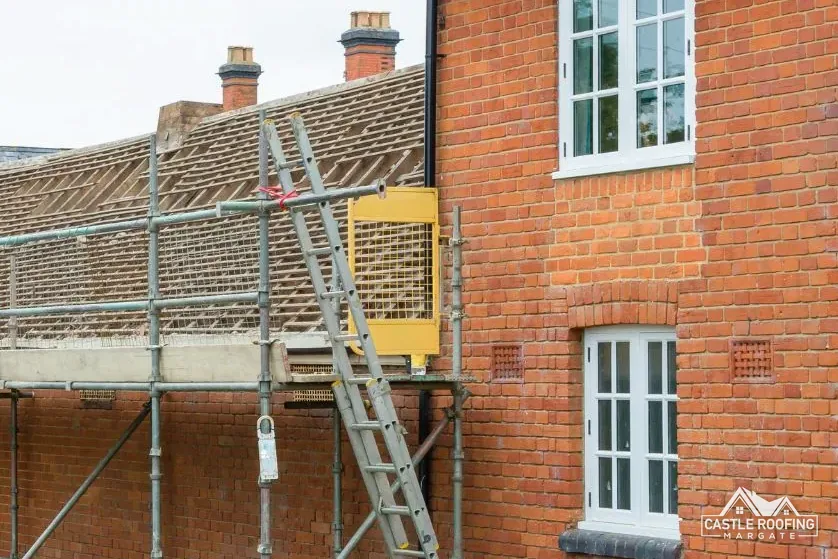
Scaffold, access and telling the residents
Where a block fronts a pavement, the scaffold may stand on the highway. The licence then comes from Kent County Council, and the scaffolders send their application to Kent County Council with no less than 5 working days' notice. The fee for 2026 to 2027 is £52 per week, so a long job on a large roof runs up weeks. Ask the roofer who applies and when the licence starts.
With several households under one roof, day-to-day information matters as much as the work. Residents want to know which days the scaffold goes up, when the front door is blocked, where the skip will stand and when the noise is heaviest. A roofer who tells every flat each day, keeps the stairs clear and takes the waste away leaves fewer complaints than a quicker one who does not.
What the roof is doing above the communal entrance, and where the lead or the chimneys need attention, is found at the survey. The owners can then divide the cost as their leases require. For the wider job, see roof replacement, the building control question and the terraced house version.