The order a re-roof follows from the first scaffold board to the last, Kent County Council's notice period for the scaffold licence, and the things that stretch a job: rain, wind, rotten timber, asbestos and protected wildlife.
The obvious question about a new roof is how many days the work will take. The plain answer is that nobody can see the whole job until the old covering is off. A small hipped roof in dry weather and a long terrace with a failing valley are different jobs, and the same firm will take different lengths of time over them.
What can be set out is the order. A re-roof is a chain of stages, and each one has to finish before the next can start. The time goes where the chain is slowest: the paperwork before the scaffold, the weather during the strip, and anything the strip uncovers.
This guide follows the chain from the survey to the scaffold coming down, with the notice periods that are published and the delays that are known. It is part of our roof replacement service, and you will find no promised duration in it, because a promise made before the roof is open is only a guess.
Why nobody can quote days in advance
Four things set the length of a re-roof, and three of them are unknown until work starts.
- How big the roof is and how many hips, valleys, dormers, chimneys and rooflights it carries, since each one adds cutting and flashing work.
- The weather on each day, since an open roof is never left unprotected overnight.
- The condition of what lies under the covering, such as battens, rafters and wall plates.
- The access: a tight street, a long carry from the skip or a roof beside a neighbour's wall.
The survey tells you the first and the last, and it tells you them in photographs. It cannot tell you the second, and it can only guess at the third from the loft side, which is why a survey that promises a fixed length is selling comfort.
What you can ask for is an order of work and a daily update. At the start of each day the person leading the job should tell you what is being done that day, what has been found and whether anything has changed. If it has, the change and its effect on the written price are explained before the work goes on, not at the end.
A realistic plan allows for the whole range: a start date that moves if the licence is late, a middle that moves with the weather, and an end that moves with whatever the strip exposes. Plan around a range of dates, with some slack on either side for rain, and treat any firm promise from someone who has not been on the roof as a warning sign.
Before the scaffold: the paperwork that has its own clock
Some of the waiting happens before anyone climbs a ladder. The two notice periods that matter are public.
Section 169 of the Highways Act 1980 stops anyone leaving a scaffold where it obstructs the highway unless a licence covers it. All six districts in this area, Ashford among them, sit in Kent County Council's highway area, and the scaffolding company, not you, puts in the application. Its published notice is 5 working days before the date the licence should begin, so the start date cannot be fixed until the application is in.
The costs and conditions come with it:
- the permit is £52 per week for 2026 to 2027, each week being 7 calendar days
- Kent County Council can charge a site inspection fee, £78, if it decides one is necessary
- £5 million of public liability insurance is a condition of applying
- where people walk round the scaffold, it must stand at least 1.2 metres from the carriageway
Skips on the highway are permitted separately, again with 5 working days' notice, at £45 per week for 2026 to 2027.
Because the licence runs by the week, a job that overruns needs the permit renewed for the next one. That is the practical link between duration and cost, and why delays are better understood early. Our guide to who notifies building control covers the other piece of advance paperwork, if your re-roof needs it.
The order of work, from scaffold up to scaffold down
The sequence below holds for a pitched re-roof whatever the covering. The stages are dependent, so an hour lost early shifts everything after it.
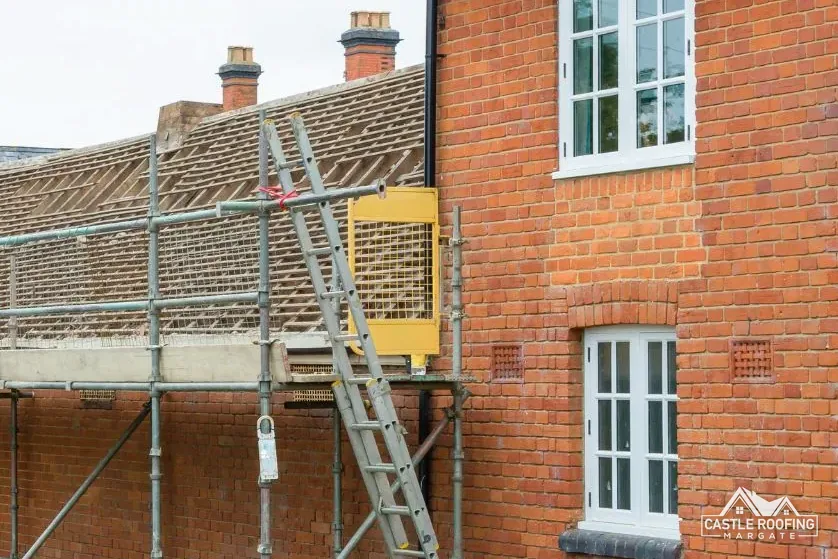
- Scaffold erected, with edge protection fitted and the licence conditions for pedestrians met.
- Skip delivered and positioned, so the old covering has somewhere to go.
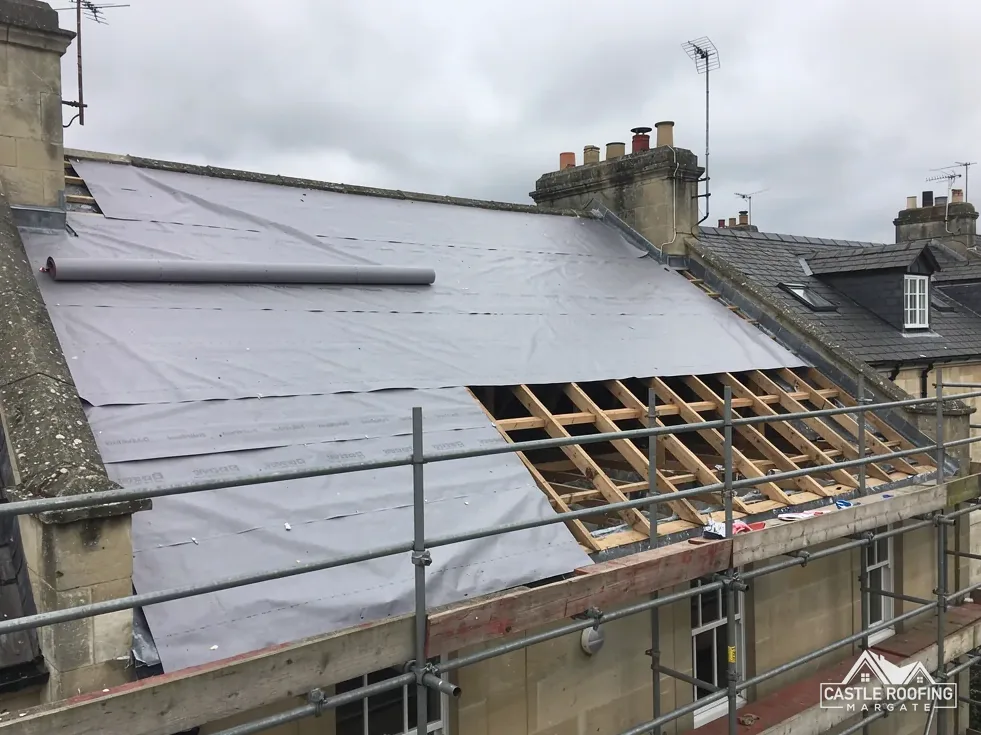
- Old covering stripped from one slope at a time, so that a section is never left open overnight.
- Timbers inspected: rafters, battens and wall plates, which is the moment the true condition of the roof appears.
- New underlay and battens fixed, with eaves and ventilation details put right.
- New covering laid, working up the slope and fixing to the BS 5534 specification for the site.
- Ridge, hips and verges finished, with dry-fix parts to BS 8612 where they are specified.
- Lead and flashings dressed at chimneys, walls and valleys.
- Gutters cleared, the roof swept, the skip collected and the scaffold struck.
Working one slope at a time keeps the house weathertight. It also means that rain stops one stage and not the whole project, because the underlay on a finished slope sheds water while the next slope waits.
The slowest stages are the ones in the middle. Laying a covering is steady work, and fixing the details around chimneys, valleys and dormers is slow work. A roof with many of those takes longer than a plain one of the same area, which is why area alone predicts so little.
What slows a job once it has started
Delays come from a short list, and each has a different remedy.
| Cause | What it does | What follows |
|---|---|---|
| Rain or high wind | Stops stripping or laying | Work waits for safe conditions |
| Rotten timber | Needs new battens or rafters | You are told, and the price is agreed in writing |
| Asbestos | Stops work until it is dealt with | Work that needs a licence passes to a firm that holds one |
| Bats or nests | Limits what can be disturbed | Advice is taken before work continues |
On weather, the Met Office climate station at Manston gives averages for 1991 to 2020: about 613 mm of rain a year, 110.05 days with 1 mm or more, and 21.43 days of air frost. Those are long-run means, not forecasts, yet they show a place where a dry week cannot be assumed.
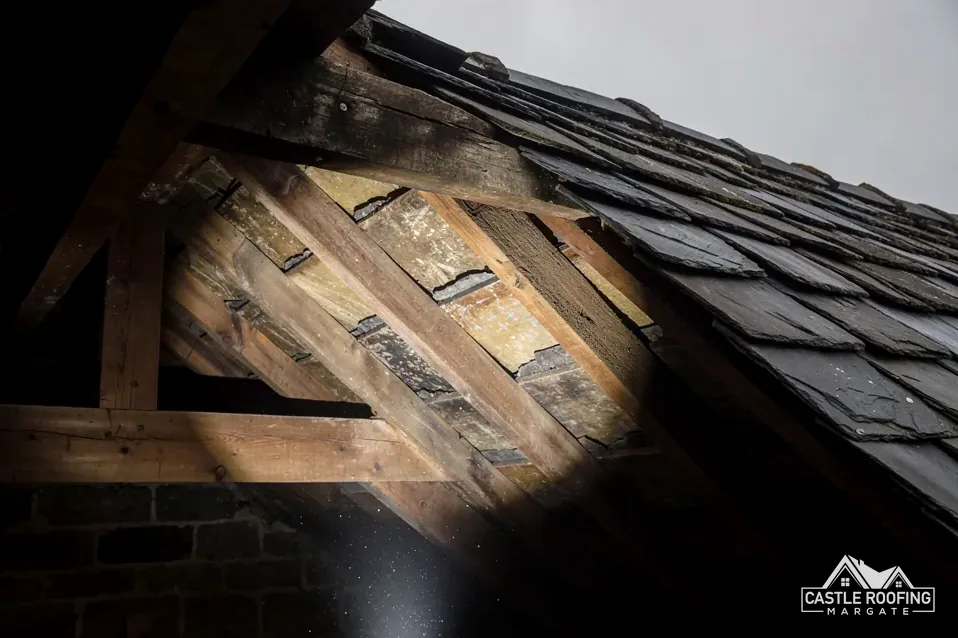
Rotten timber can be a local patch: a run of battens along a leaking valley, or the rafter feet behind a blocked gutter. The fix is to cut out and replace the damaged section, and its extent is known only once the covering is off.
Asbestos matters on older buildings. HSE guidance classes asbestos cement sheeting as fragile in every case, and tells you to assume asbestos is in a building that was built or refurbished before 2000. Bats are different: a bat roost is fully protected by law, and GOV.UK names repairing or replacing a roof as work that can affect bats. A bird's nest in use is protected too, where the damage is intentional.
Approvals that sit alongside the building work
Not every re-roof needs a council decision, but the ones that do should have it settled before the strip. The Planning Portal's yardstick is that normally nobody applies while less than 25 per cent of the building envelope and less than 50 per cent of the roof is involved. A new covering that adds 15 per cent or more to the weight, or would burn differently from the old, needs approval whatever the area.
Councils differ in what they publish:
- in Dover District, the council's page names replacement of pitched roof coverings, with like-for-like re-covering included, as work needing approval, and nobody outside Dover should assume the same
- Folkestone & Hythe District Council lists replacement roof coverings under changes that may need its approval
- Thanet District Council sends owners to the Planning Portal's interactive house for the test
- none of the Kent districts here gives a percentage figure of its own
Listed status adds listed building consent for any work that changes the house's character, and that runs separately from any Building Regulations approval. A house in a conservation area may sit under an Article 4 direction, which a council can use to take away chosen permitted development rights.
These checks cost time at the front of a job, not the middle, and an answer in hand before the scaffold goes up is worth more than one chased while the roof is open. Ask the council early, and ask your roofer which route applies to your address.
Living in the house while it happens
A re-roof is noisy for a stretch of the working day, and the house vibrates when old tiles are stripped or when battens are nailed. Plan for it. Move anything fragile off walls and shelves under the roof slopes, cover items in the loft, and expect dust to drift down through ceilings.
Working from home is possible but hard. Stripping and nailing are loud, so book calls for the quieter hours and tell the team about shift work or a baby who sleeps in the day. Some practical points make the days easier:
- keep access clear for a skip lorry and for deliveries of the new covering
- agree where the team can park and where materials can be stored
- tell neighbours the dates in advance, since the scaffold and the skip will be visible and audible
- keep pets indoors and children away from the working side
When the job is finished, the gutters should be cleared of dropped debris, the garden and drive swept, the skip taken away and the waste gone with it. Ask for photographs of the finished roof, and for the paperwork a building control route needed.
Our guide to living at home during a re-roof goes into the household side in more depth. The straight answer to how long is a range, with the order of work and the daily update to tell you where you are in it.