Four things get settled before a single slate is lifted: whether building control is involved, whether planning applies, who arranges the scaffold licence, and the order the work runs in once the roof is open.
Before a roof is stripped, three offices can have a say: building control, the planning team and the county council that licenses scaffold on a public road. None of them is difficult to deal with, but each asks a different question, and asking them in the wrong order costs days on site.
Thanet District Council runs its own building control team and points owners to the Planning Portal's test for roof work. Planning is usually the simpler of the two, because swapping one covering for another on an ordinary house normally sits within permitted development (a national grant of planning permission, so no application is made). Flats, listed homes and conservation areas change that. Where scaffold stands on the public footway, Kent County Council issues a licence, and the scaffolders apply for it.
This piece sets out each decision in turn, gives the numbers to ring, and then walks through the order a pitched re-roof follows once the paperwork is settled. It is written for Margate, Cliftonville, Broadstairs, Ramsgate and the villages around them. For the wider job, from coverings to the survey, see our roof replacement page.
The Planning Portal test Thanet points to
Thanet's own building control pages hand owners over to the Planning Portal, through its online Interactive House, for the answer on whether consent is required. That makes the Planning Portal's yardstick the one to use. As a rule, re-roofing needs no application while both of these conditions are met:
- under 25 per cent of the building envelope is affected, counting the roof, walls, floor, doors and windows together with any roof windows and rooflights; and
- under 50 per cent of the roof itself is affected.
The two limits sit side by side and both must hold. Stripping an entire roof is far past the second one on its own, so a full re-roof is a job to raise with building control before it starts, whatever the envelope sum comes to. A handful of replaced tiles or a repaired valley is another matter and normally sits well inside both.
Weight is a separate trigger. The Planning Portal lists two more: a new covering at least 15 per cent heavier than the existing one, and a covering that would behave differently in a fire. Approved Document A, the structural part of the Regulations, talks of a significant change in loading and defines it as an increase of more than 15%. The figures differ slightly between the two documents, so name whichever one you are leaning on. Where weight is in doubt, the Planning Portal advises getting a surveyor or structural engineer to look before any work begins, since extra weight can mean strengthening the timbers beneath.
Planning permission is a separate matter, decided by a different office on a different test. Our pages on the fifty per cent roof rule and on who notifies building control take each question further.
Who runs building control across East Kent
The provider depends on the district the house stands in. It is worth knowing which, because the same roof job can start with a different phone call a few miles down the road.
| District | Provider |
|---|---|
| Thanet | The council's own team. |
| Canterbury and Swale | STG Building Control. |
| Dover | The council's own team. |
| Folkestone and Hythe | The council's own team. |
| Ashford | Ashford Borough Council's building control. |
Thanet District Council's building control team answers on 01843 577522. Folkestone & Hythe District Council's building control team is on 01303 853538.
Canterbury and Swale addresses go through the partnership those two councils use, which is STG Building Control, on 01634 331133.
Dover District Council is the one district that sets a stricter line. On its building control page Dover lists replacement of roof coverings as work that needs approval, matching the old covering or not. For a Dover address, confirm the route with the council before the first slate comes off. That wording is Dover's own, and no national rule says the same; the other Kent districts publish no percentage test of their own.
Private building control is a second route. Since 6 April 2024, when the registration rules took effect, a private business doing building control work in England must now be registered with the Building Safety Regulator as a registered building control approver. Private building control existed before that date, so the registration is new and the option is not.
Planning: Class C, flats, listed homes and conservation areas
Class C of the General Permitted Development Order is the catch-all for alterations to the roof of a dwellinghouse, and a new covering falls inside it. The conditions attached to Class C, including those for roof windows, are gathered in our roof window planning guide. A plain like-for-like re-cover does not come near them.
Three situations move the route:
- Flats and maisonettes sit outside permitted development altogether, so changing their outward appearance needs planning permission. Canterbury's planning pages state the same point in plain terms.
- A listed house keeps Class C, but listed building consent is needed as well wherever the work would alter the character of the building (section 7 of the Planning (Listed Buildings and Conservation Areas) Act 1990).
- An Article 4 direction removes permitted development rights from a defined set of properties. Thanet's own list names conservation areas at Pegwell and Ramsgate, plus the Ramsgate Marina extension, and which classes apply there is a question for Thanet District Council.
Thanet District Council lists 27 conservation areas, including Birchington, Minster, Westgate on Sea, Broadstairs and Ramsgate as well as Margate and Cliftonville. Conservation areas, the Kent Downs National Landscape and the Canterbury World Heritage Site all count as article 2(3) land. That takes Class B, the dormer class, out of play, but it leaves Class C alone. In practice a new covering in a conservation area is often straightforward, while a new dormer is not. Our page on re-roofing in a conservation area covers the question of materials.
Scaffold licence and skip permit from Kent County Council
Scaffolding that blocks the highway is licensable under section 169 of the Highways Act 1980. In Thanet, as in every district this site covers, the licensing authority is Kent County Council, not the district council. Its licensing page puts the application with the scaffolders or the skip firm, not the householder, so ask the scaffolding firm to confirm that the licence is in place.
Kent County Council publishes these figures for 2026 to 2027:
- scaffold permit, 7 calendar days: £52 per week;
- site inspection, where the council thinks one necessary: £78;
- notice: five working days ahead of erection;
- public liability cover for the applicant: £5 million;
- skip permit: £45 per week with the same five working days' notice, for a skip no longer than 5 metres and no wider than 2 metres.
For an unpermitted skip, Kent County Council charges £120 for the inspection plus a £45 retrospective permit fee. Kent County Council highways takes pre-application questions on 03000 41 81 81. Skip permits are separate from scaffold licences, so a job that needs both involves two applications.
Where a Thanet terrace opens directly on to the footway, the scaffold licence can be the part of the job with the longest lead time. Ask the scaffolders for the application date as soon as a start date is pencilled in. The notice is counted in working days, so a weekend does not help, and a late application can push the start date back.
A pitched re-roof in order, from scaffold to clear-up
Weather shifts individual days around, but the order of a pitched re-roof stays fixed. Each stage depends on the one before it:
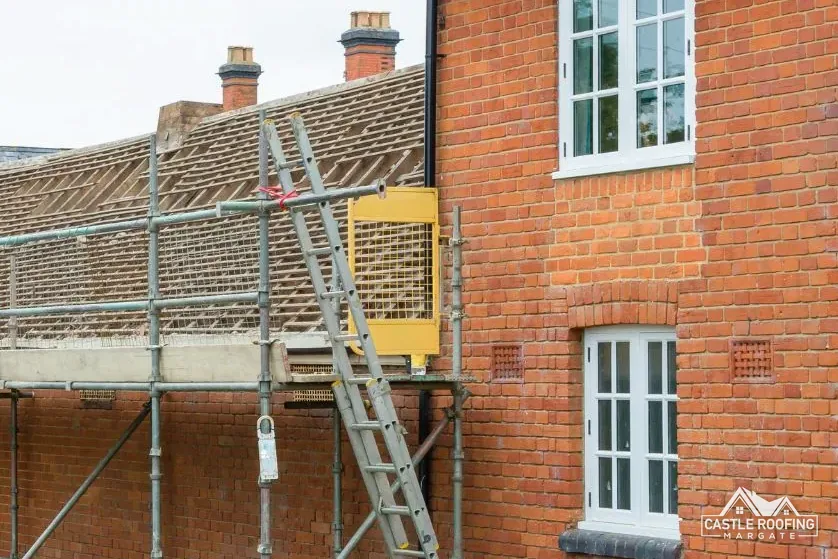
- Scaffold goes up first, licensed if any of it stands on the highway, and stays until the gutters and fascias are done.
- The old slates or tiles come off a section at a time, and whatever has been opened is covered before the working day ends.
- With the covering gone, the rafters, battens and wall plate (the timber the rafters sit on) can be seen properly. Any rot is dealt with now, not buried.
- New underlay, the waterproof sheet, goes over the rafters, and new battens are fixed over it, set out to suit the chosen covering.
- Slates or tiles are laid from the eaves upward. The standard for this is BS 5534, amended in 2018 to take in ordinary re-roofing as well as repairs. It is guidance on good practice, not an act of Parliament, and the number and type of fixings follow from how exposed the site is.
- Ridge, hips and verges are fixed next. After the 2015 amendments to BS 5534, mortar alone stopped being relied on as the only fixing for these, so each piece is mechanically fixed, over a mortar bed or in a dry-fix system to BS 8612.
- Lead is dressed round chimneys, abutments and valleys. Code 3 lead is kept for soakers, and the written specification fixes the code used on every flashing and valley.
- Gutters, fascias and soffits are checked, the waste goes in the skip, and the scaffold comes down last.
You are told at the end of each day what happens next, so the plan never lives only up on the roof.
When the job stops: roosts, nests, asbestos and shared walls
Four things can pause a re-roof, and all are better found at the survey than on day three.
- The law gives bats and their roosts full protection, and GOV.UK names re-roofing and roof repair as work that can affect them. Regulation 43 of the Conservation of Habitats and Species Regulations 2017 treats damage to a place where a species breeds or rests as an offence, and intent need not be proved. If a bat or droppings turn up mid-job, work stops and a specialist is called.
- Under section 1 of the Wildlife and Countryside Act 1981, a person who intentionally damages a bird's nest that is occupied, or still under construction, commits an offence. A roof is not stripped around an active nest, and the start date moves.
- HSE's rule of thumb is to treat any building built or refurbished before 2000 as one that may contain asbestos, and asbestos cement roofing is always treated as fragile. Removing it with care, keeping the sheets whole, is non-licensed work, but it still needs care, double-wrapped waste and a lockable or sealed container, never an open skip.
- If the work cuts into a wall or chimney breast shared with a neighbour, the question belongs to a party wall surveyor, not to building control. Under section 3 of the Party Wall etc. Act 1996, a party structure notice is served on the neighbour no less than two months before work starts.
At the close of the job, Thanet's register charges £54 including VAT for each copy of a completion certificate, so keep the original when it arrives.