Older roofs fail in older ways. This guide covers what an inspection checks on a period house, what Thanet's own appraisals say about its roofs, how nails and lead age, and when a listing or conservation area changes the route.
A roof that has been up for a century or more is a different thing to inspect from one built a decade ago. The covering may have been patched many times. The timbers beneath have moved. The lead has been renewed in one place and left in another. An inspector reading such a roof is reading its history as well as its condition, and the history explains a good deal of what is wrong.
Period roofs also carry rules that modern ones do not. A conservation area, a listing or a direction removing some permitted rights can change what work needs consent before it starts, and an inspection is the moment to find that out, not after a scaffold is up. The report should say which applies.
This guide sets out what the visit covers and why. It is part of our roof inspections work, and it is written for houses in Margate, Cliftonville, Ramsgate, Broadstairs and the older parts of Thanet. For a listed building specifically, the page on listed roof inspection goes further.
Starting with what Thanet says about its roofs
Thanet District Council publishes appraisals for its conservation areas, and two of them describe roofs in words an inspector can use. Both describe their own streets only, and neither should be stretched to the whole district.
The Cliftonville Clifftop appraisal describes a mix of roof materials, naming red clay tile and natural slate as two of the coverings, and notes that many tall chimney stacks are still standing. The Northdown Road appraisal describes roofs of slate or tile, many of them hidden behind parapets when seen from the road, and it records some roofs finished in fishscale slates.
Each of those observations turns into something to check:
- Mixed coverings: an inspector notes which covering each slope has, since a repair in the wrong material shows as a patch.
- Tall chimney stacks: the stack, its pots, its flaunching and its flashings are checked from a ladder or a camera.
- Parapets: the gutter behind a parapet wall is checked, because it is hidden from the street and fails unseen.
- Fishscale slates: these are small, decorative slates in a scalloped pattern, and every slipped one is checked on its own.
The page on how old is my roof shows how an inspector estimates age from the covering, which helps when a house has had work done in several decades.
None of this says what your own roof is made of. It tells an inspector what to expect nearby, and the survey records what is actually there.
Stacks, parapets and the details high up
The parts of a period roof that stick up get the closest look. A chimney stack is exposed on all four sides to wind and rain, and its joints weather faster than a wall's. Flaunching is the mortar slope around the base of the pots, and if it cracks it lets water into the stack. The flashings, strips of lead dressed where the stack meets the roof, are the next line of defence.
Parapets are walls that rise above the roof edge. The gutter behind one is often lined with lead or asphalt and drains through an outlet in the parapet wall or a hidden downpipe. A blocked outlet floods the lining, and the water goes where it can, which is usually into the wall below. Our page on parapet gutter repairs explains the repairs that follow.
A short checklist for the high details:
- Stack: mortar joints, cracked or leaning courses, pots, flaunching.
- Flashings: cover over the upstand, gaps at the stack, cracked or lifted lead.
- Parapet: coping stones, pointing, gutter lining and outlets.
- Valleys: the internal corners where slopes join, with their lead or slate lining.
- Verges and ridges: whether tiles are held by mortar alone or by mechanical fixings.
On an older roof, the last point matters. Marley notes that the 2015 amendments to BS 5534 ended the practice of leaning on a mortar bed on its own to keep the covering in place. A ridge bedded in mortar alone is therefore noted in the report, and BS 8612:2018 covers the dry-fix alternative, where mechanical fixings do the holding.
Where the stack is shared with a neighbour, or the parapet sits on a party wall, say so at the start of the visit, because it changes who must be told before work begins.
Nail fatigue, slipped slates and ageing lead
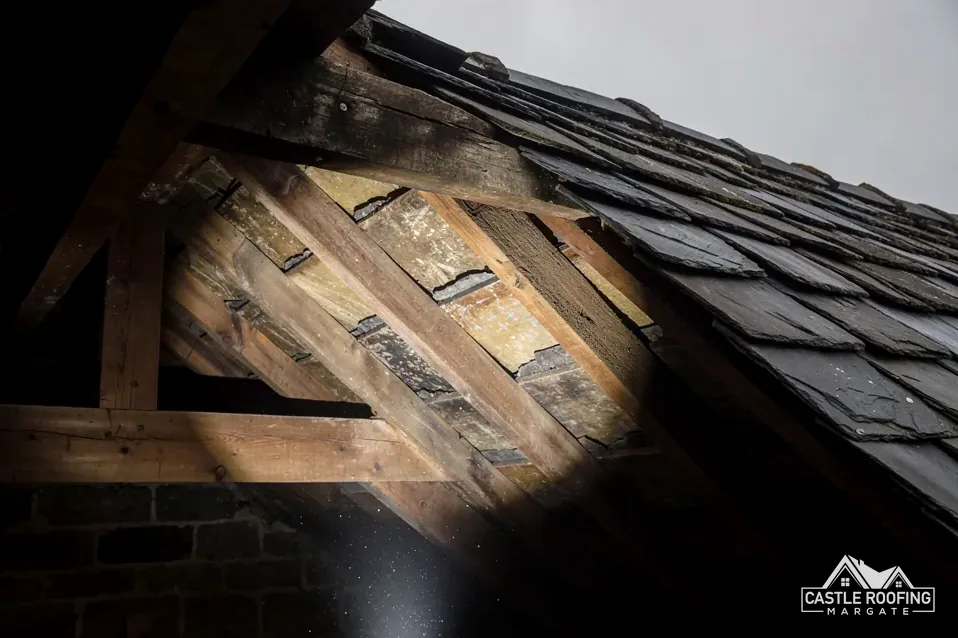
On a slate or old tile roof, the covering often outlives its fixings. Each slate hangs from nails, and a nail that corrodes, thins and finally gives way lets the slate slip. This slow failure of the fixings is sometimes called nail fatigue, and it explains slates sliding out of a roof that looks sound from the road. HomeBuilding puts Welsh slate at 100 years or more, so the slate can be sound long after the nails are not.
That is why an inspector looks for patterns. One slipped slate may be an accident. A slipped slate every metre across a slope points to fixings that are failing together, and patching them one at a time spends money on a roof that will need stripping.
| Covering | Typical life | Source |
|---|---|---|
| Welsh slate | 100+ years | HomeBuilding |
| Reclaimed Welsh slate | 50 to 80 years | HomeBuilding |
| Clay tile | 60 to 80 years | HomeBuilding |
BRE puts a minimum life expectancy of 60 years on clay tiles, and Marley notes that figure is for clay only. These are typical ranges, not promises.
Lead ages differently. MyJobQuote puts lead flashing at over 80 years, which is a lower bound. Old lead splits at folds, thins where water has run and lifts where it has been dressed badly. Lead comes in numbered codes by thickness, Code 3 at 1.32 mm up to Code 8 at 3.55 mm. Code 3 suits soakers, the small sheets tucked under slates beside a wall, and every other detail takes its code from the specification. Our pages on lead roofing cover the repair side, and an inspector notes which lead looks original and which has been replaced.
Conservation areas, listing and the consent route
Whether a period roof is in a conservation area or is listed decides what permissions its repair needs. Thanet District Council lists 27 conservation areas, among them Margate, Cliftonville, Broadstairs and Ramsgate, and its conservation area page adds that work matching the existing roof exactly is less likely to need permission. That is Thanet's wording, for Thanet addresses.
| Situation | What changes |
|---|---|
| Conservation area | Dormers are not permitted development |
| Listed house | Listed building consent for work affecting character |
| Article 4 area | Further rights may be withdrawn |
Article 2(3) land, which includes conservation areas, removes the permitted development right for dormers, while Class C, the class for other roof alterations to a house, keeps going. A listed house keeps both classes, but under section 7 of the Planning (Listed Buildings and Conservation Areas) Act 1990, anything that alters a listed building's character needs listed building consent. Re-covering a listed roof can do so, which is why the consent question comes first.
Article 4 is a direction that withdraws specified rights across a defined area. Thanet's Article 4 directions cover addresses in three of its conservation areas: Pegwell, Ramsgate and its Marina extension. Which rights each withdraws is for the council to say, so check with Thanet District Council. In other districts, ask that council if a direction touches your street.
Inside the boundary of the Canterbury World Heritage Site, which is also article 2(3) land, dormers lose their permitted right in the same way. Our guide to roof window planning permission sets out the conditions that apply to roof alterations.
What the report should tell you
The product of the visit is a written report with pictures taken on your roof. For a period house it should go further than a modern one would, because the consent questions and the age questions both need answers. A report that records only the defects leaves the real choices unmade.
Things a period roof report records:
- each covering, where it is and its apparent age
- the state of every stack, flashing, valley and parapet gutter
- any pattern of slipped slates or tiles that suggests failing nails
- the lead details and any that look original
- whether the house is listed, in a conservation area, or in an Article 4 area, and who to ask
- what could not be reached, and why
Age shapes the advice. A roof with sound slates and tired nails is a candidate for re-fixing, and sound slates can be stacked and reused. A roof of crumbling clay and failed mortar may need a different answer. Our guide to roof inspection photos shows what the pictures in a report should show.
Expect the report to separate urgent work from work that can wait. Weather matters here: the Met Office records a mean wind of 9.86 knots and about 613 mm of rain a year at Manston, in averages for 1991 to 2020, and an exposed older roof has to cope with that through the year. Anything the report marks as urgent is dealt with first.
Extensions, past repairs and mixed-age roofs
A period house is rarely all one age. A rear addition, a loft room or a bay may have been built decades after the main roof, with a different covering and a different standard of workmanship. An inspector treats each part as its own roof and records where one meets the next, because the junction is where the old and new materials move differently.
Past repairs leave their own marks:
- cement fillets along a ridge or a wall, which crack and let water behind them
- slates of a different colour or thickness, laid in as patches
- tiles screwed or clipped where nails once held them
- sealant smeared over a lead joint that needed re-dressing
None of these is a fault in itself. Each is evidence of a problem someone met before, and the inspector's job is to ask whether that problem has returned. A cement fillet that is hairline-cracked on one side is worth a closer look, since water can run along the crack to the timber behind it.
Roof windows and dormers added in later years get the same scrutiny, and in a conservation area the report notes whether they were ever approved. If the answer is unclear, the council can say what is on record. That matters when the house is sold, so keep any letter or certificate with the other papers, and hand copies to whoever works on the roof next.