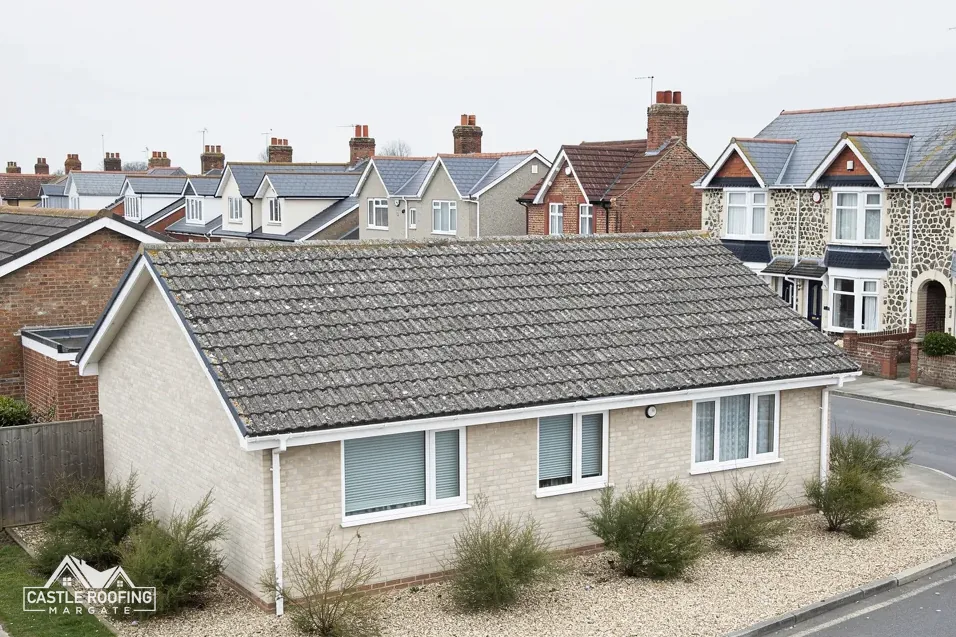
Marley's minimum pitches
Pitch is how steeply a roof slopes, measured in degrees up from level. Steeper slopes shed water faster, so a flat-faced tile with a deep lap needs more slope than one with channels that carry water away. A shallow slope also lets wind push rain further up under the laps, which is why each product has a floor.
Marley publishes a table of minimum pitches for its range. These rows give a spread of concrete and clay types:
| Tile | Type | Minimum |
|---|---|---|
| Plain | Concrete | 35° |
| Double Roman | Concrete | 22.5° |
| Mendip | Concrete | 15° |
| Lincoln pantile | Clay | 15° |
| Canterbury | Clay | 40° |
Other products sit between those rows. Marley lists Edgemere and Modern-Duo at 17.5°, Ludlow Major and Ludlow Plus at 22.5°, Anglia at 25° and Mendip 12.5 at 12.5°. In the clay range, Ashdowne is 35° and Hawkins and Acme Single Camber are 30°. Because the table mixes materials, compare tiles of the same kind before treating a lower figure as a sign of a better tile.
A tile called Canterbury
In Marley's table, Canterbury names a clay tile, with a minimum pitch of 40°. It is a product, not the city. Roofs in Canterbury, Whitstable or Herne Bay do not need 40°. They need whatever the tile on that particular roof calls for.
A table like this is easy to misread. Places, ranges and product names get mixed up, and a pitch limit belongs to a product, not to a postcode.
The same goes for Thanet. The covering you choose and the slope you have set what you can use, so a low slope on a rear extension might suit a Mendip but not a plain tile. Two details have to agree:
- Same tile name on the data sheet and the order.
- Same slope angle, measured not estimated.
For the roof you actually own, the figure to find is the one printed for your tile, on the maker's data sheet. If the tile has no label, the steps in matching old roof tiles help identify it, and a lifted tile with its profile and thickness noted narrows the search quickly.
Give the product name, not just the colour, when you ask a merchant or the maker, so the right data sheet comes back.
Slate, and fixings at low pitch
Natural slate follows a different rule. Cupa, the slate maker, says BS 5534 indicates a minimum roof pitch of 20 degrees for natural slate. That figure assumes moderate exposure, a 500 mm slate and a 115 mm lap.
For fixing, Cupa's guidance is to avoid hooks below 25°. So a slate roof between 20° and 25° needs nails, which changes how the slates are laid and how repairs are made later.
Lap and exposure change the position. A longer lap makes a lower pitch workable, and an exposed site pushes the other way, which is why one product can show more than one limit. The standard sets out the calculation, and the maker's sheet gives the figure to use for that product.
If your roof is close to a limit, three things are worth checking before you order:
- The true pitch, measured with a digital level, not guessed.
- The maker's minimum for that exact tile and lap.
- The fixing method the maker requires at that angle, which can differ from the one used on steeper slopes.
The BS 5534 tile fixing page covers the fixing side.
What to do on a low slope
If the roof is shallower than the tile allows, there are three routes. Choose a tile with a lower minimum, such as a Mendip or a pantile at 15°. Keep the existing covering and repair it. Or change the structure so the pitch rises, which is a larger building job.
A roof that is already covered and leaking is a case for asking why. A wrong pitch for the tile is one possible cause, alongside worn underlay and failed flashings. The survey measures the slope and reads the tile's name before any price is given.
Where a lean-to or porch has a very low pitch, a tiled covering may not suit at all, and a flat roof system may be the better fit. That is a different service, and the survey says so when the numbers point that way.
Until you know the tile, look at a lifted one or ask the maker. Our wider guide is on the pitched roofing page, and switching concrete tiles to clay notes how pitch limits change with the material. A photo of the tile and the measured angle are enough for us to start.