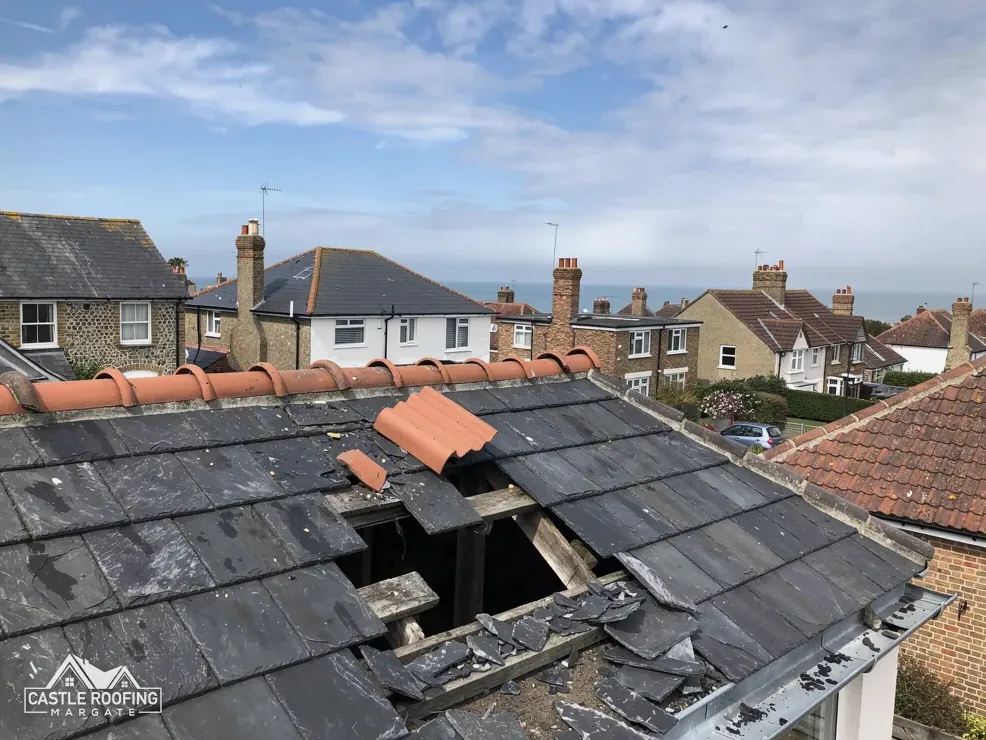
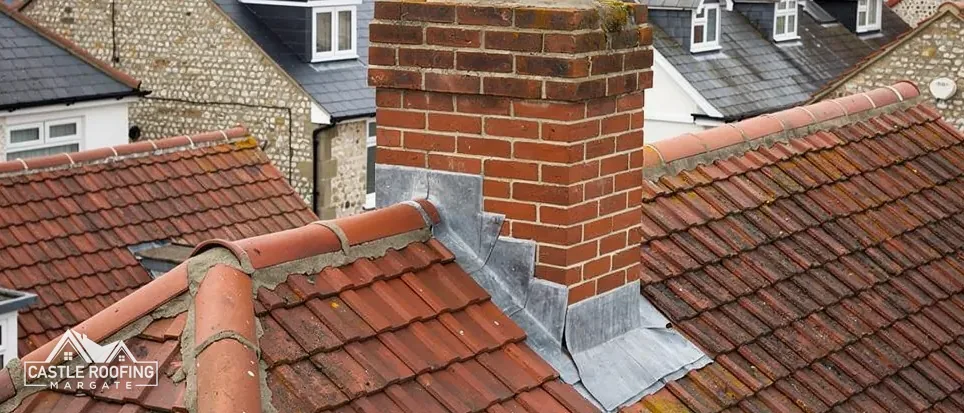
Profile, material and colour
Matching starts with three questions. What is the tile made of, clay or concrete? What is its profile: flat plain tile, curved pantile or interlocking tile? And what is the colour, which includes the surface finish?
Photographs help, but a tile in the hand is better. One lifted tile gives the length, width, thickness, nib or lug arrangement and the maker's mark if there is one. On a clay roof the shade is the hardest part to get right, because decades of weather alter it.
Roofers handle the colour question in a few ways:
- Take a tile from a hidden part of the roof, such as behind a chimney, as a sample.
- Use reclaimed tiles of the same profile, which already carry weathering.
- Mix new and reclaimed tiles across a slope so the change is gradual.
- Put repairs on the rear or less visible slope where the house allows, though never at the cost of a poor fit.
Fresh tiles stand out against weathered ones until the surface dulls over a few seasons. Reclaimed stock narrows that gap, and it is the reason for the search.
Why the product name on the tile matters
Tiles that look alike are not interchangeable. Each product has its own size, lap and fixing details, and Marley's table of minimum pitches shows how far they vary: a plain concrete tile needs 35°, a Double Roman needs 22.5° and a Mendip needs 15°.
Swapping in a lookalike with a higher minimum pitch on a low slope can let rain blow under the laps. A tile with a different gauge can leave the battens in the wrong place. And in Marley's clay range, "Canterbury" is a tile name, with a minimum of 40°, not a reference to the city.
So a repair quote should name the tile being used. Ask for the maker and the product name, then check the pitch table against your roof. The minimum pitch for roof tiles answer lists the common values.
If the tile cannot be identified, the safe course is to compare measurements against current ranges or find reclaimed tiles with the same profile and lap, then test a few on the slope before committing.
Where a home is listed or in a conservation area
A listed building keeps its Class B and C permitted development rights, but consent under section 7 of the 1990 Act is needed for work that changes its character. Canterbury City Council gives the same message for any change touching what makes the building special, so a tile swap is not exempt just because it is small, and the council decides what counts as character.
In practice a repair to a listed roof is planned as like for like: same material, same profile, same colour, same laps, and the same fixing style where it can be told. Replacing clay with concrete, or hand-made with machine-made, can alter the character even if the roof still looks tiled from the road.
Conservation areas work differently. Class C is not removed by the designation, but the council may have added an Article 4 direction. Swale's Faversham direction, for example, takes in roof coverings on the main elevations facing the street. Ask the council's planning team which rules cover your street, and get the answer in writing before ordering stock.
Our page on listed house tile repairs goes further on the consent route.
What a good repair quote says
Matching is decided at the survey, so the quote should reflect it in plain words. Look for the tile named by maker and product, whether it is new or reclaimed, and where on the slope it will go. A quote that says only matching tiles leaves every choice to the day.
If reclaimed tiles are used, ask how they were sourced and checked. Reclaimed stock should be sound, with no cracks or flaking, and match the gauge of the existing tiles, since a tile a few millimetres short sits wrong in the course.
A few points are worth asking about:
- Which tile, by maker and product name?
- New, reclaimed or a mix?
- Does the pitch suit that tile?
- If the home is listed or in a conservation area, which consent applies?
Once the answers are in writing, the work itself is straightforward, and the next roofer inherits a clear record. Small patches are covered in replacing a single roof tile, and the wider tiled service is on the pitched roofing page. A close photo of one tile and the slope around it is a good way to begin, ideally with a coin or ruler beside the tile for scale.