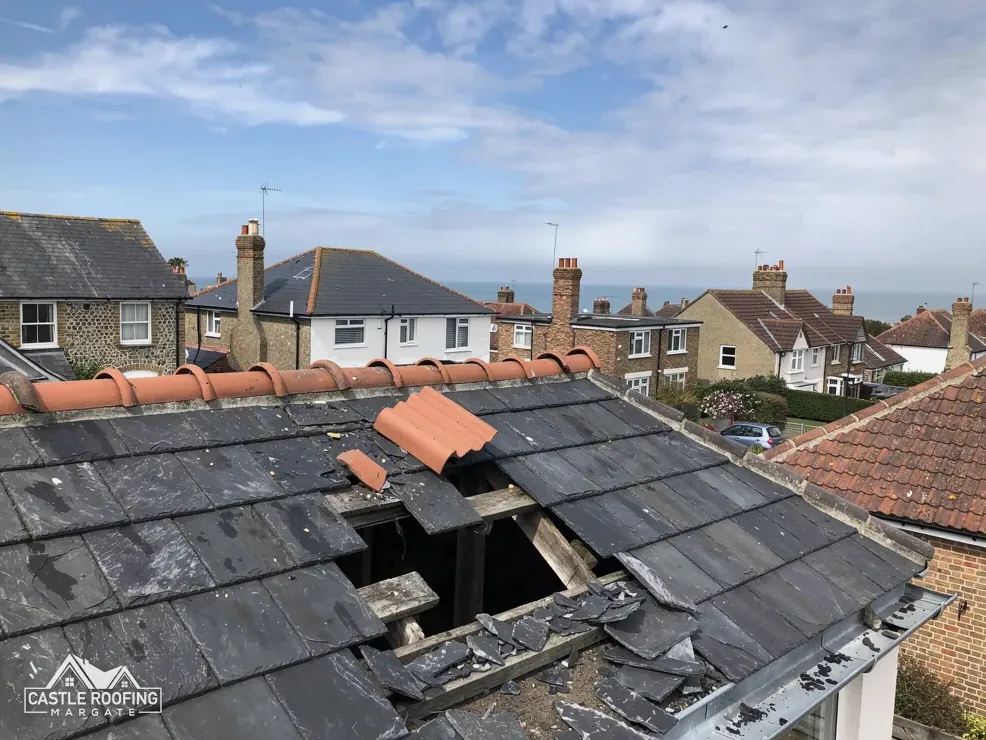
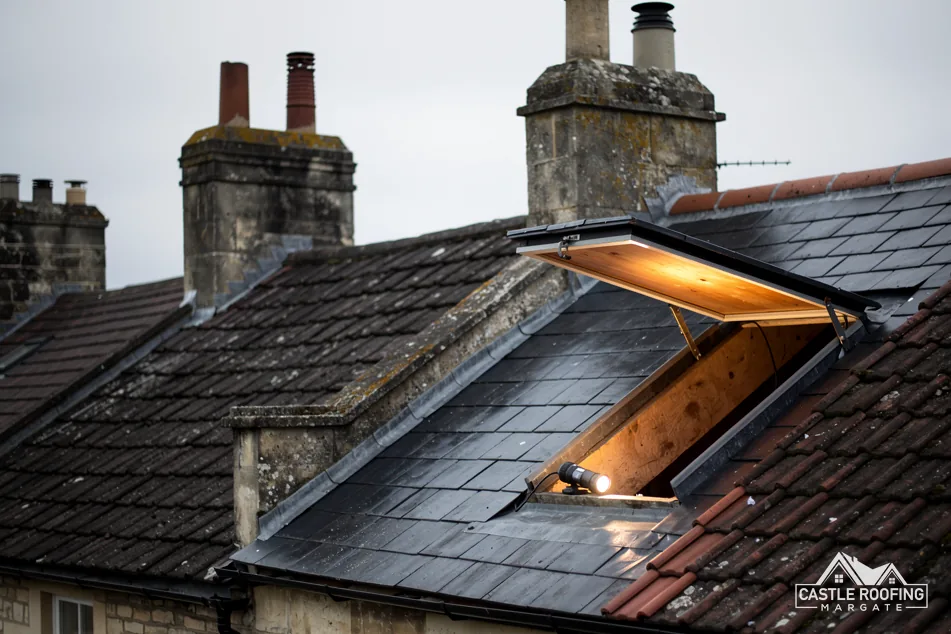
A dated list of the Margate, Seafront and Cliftonville conservation areas, how like-for-like roof work is treated, why dormers are different, and the checks to make before any work is priced.
A conservation area is an area the council has designated for its special architectural or historic interest. Margate has several, and the town's older streets, the seafront and a run of Cliftonville neighbourhoods all fall inside one or other of them. If your house is in one, re-roofing is not forbidden. The rules simply shift in a few places, and it pays to know which before you book a scaffold.
The practical questions run like this. Do I need planning permission to replace slates on a house in a conservation area? Can I swap the covering for something cheaper to look after? Can I put in a dormer? The honest answers depend on what is being done and which area the house is in, so this post sets out the designated areas as Thanet District Council lists them, the council's own words on like-for-like work, and the one clear change to permitted development that conservation areas bring. It does not restate the conditions of the permitted development classes; the planning guide linked below does that. For the roof work itself, see our pitched roofing page.
The conservation areas in and around Margate
Thanet District Council says it has 27 conservation areas. The ones that matter for a Margate address are below, with the dates the council publishes. Where the council records an extension, it is noted.
| Conservation area | Designated |
|---|---|
| Margate | 7 February 1978, extended 7 July 1994 |
| Margate Seafront | 29 January 1997 |
| Dalby Square | 15 July 2010 |
| Clifton Place and Grotto Gardens | 20 October 2016 |
| Clifftop | 20 October 2016 |
| Edgar Road and Sweyn Road | 20 October 2016 |
| Norfolk Road, with Warwick Road and Surrey Road | 20 October 2016 |
| Northdown Road | 20 October 2016 |
| Ethelbert Road and Athelstan Road | 20 January 2015 |
| Northdown | 20 August 1985 |
Designation is the council's way of recognising that the character of a whole area matters, not only individual buildings. For a roof the practical effects are narrow but real. Dormers need permission, an Article 4 direction may withdraw further rights, and the council looks closely at visible changes. A roof at the back that nobody sees from the street is still inside the area, so the dormer rule applies to it just the same.
The list is not the whole of Thanet's, and a street may sit just outside a boundary that looks obvious on the ground. Boundaries are drawn on the council's maps. If your road is not in the table, that is no proof it is outside an area: check the map or ask the council before you assume.
What like for like means for conservation area roofs
Thanet's conservation area page gives a short steer: work that repeats what is already there makes a planning application less likely. The wording is the council's and it repays a careful read. 'Less likely' is not 'never', and the safest reading of 'like for like' is identical material and colour, laid the same way, to the same profile. Natural slate replaced by natural slate, clay tile by clay tile of the same kind, a ridge renewed to match.
What a change of look can do is lose you that protection. The council's conservation area appraisals describe roofs in their own words, and they are useful for knowing what a match means:
- The Cliftonville Clifftop appraisal describes the roofing as quite mixed, with red clay tiles beside natural slate, and notes that tall chimney stacks remain in many locations.
- On Northdown Road the appraisal finds slate or tile roofs, frequently concealed behind parapets when viewed from the street, and some finished in fishscale slates.
Neither description is a rule about what you must use. Each is the council's account of the character it is protecting, and each appraisal is written for its own area, so your street may differ. Reading the appraisal for your own street tells you what the council is trying to protect. A replacement that keeps the covering, the colour and the detail of the existing roof is the safest case, and the one the council has said is less likely to need permission. Our page on slate roofs in a conservation area covers that situation for slate.
Planning permission and permitted development in a nutshell
Most houses have permitted development rights, which allow certain works without a planning application. Class C of those rights is the one for roof alterations to a house that are not dormers, and a re-roof of a house normally sits inside it. Class C has conditions of its own on projection, height, chimneys and flues, solar equipment and side-slope windows. For a house with a rear roof slope, a side return or a loft room, those conditions matter as much as the area does. They are set out on our roof window planning permission guide and not repeated here.
Three points apply to a Margate house:
- Flats and maisonettes have no permitted development rights, because the legal definition of a dwellinghouse excludes a building containing flats and a flat within one. Planning permission may be needed for outward changes to a flat roof or a converted house in several flats.
- A conservation area changes the dormer rules, as the next section explains. It does not take away Class C.
- Permitted development is about planning. A separate check applies to building control, and a separate one to listed building consent.
Whether a particular job is permitted development is something the council can confirm. Put the question to Thanet District Council's planning team in good time, describe the covering you have and the covering you intend, and file the reply with your photographs so it is to hand when the work is priced.
Dormers: where Article 2(3) land makes the difference
The clearest effect of a conservation area on roof work is on dormers. A conservation area is what the Order calls article 2(3) land, and Class B, the permitted development right for adding to or altering a roof such as a dormer, does not apply to a house on that land. A dormer in a conservation area therefore needs planning permission. That holds for a terraced house, a semi-detached house and a detached one alike, and the size of the dormer does not enter into it.
Class C is a different class and has no exclusion for article 2(3) land. That is why re-roofing in a conservation area can stay inside permitted development when a dormer cannot.
The same exclusion applies to other article 2(3) land:
- An area of outstanding natural beauty, including the Kent Downs National Landscape.
- A National Park.
- A World Heritage Site, such as the Canterbury sites.
The principle is the same wherever the house stands. For any new dormer in Margate, assume you will need to ask. Roof windows and skylights fall under Class C rather than Class B, and the same planning guide covers their conditions.
It also helps to keep demolition in mind. GOV.UK says that in a conservation area it is an offence to undertake relevant demolition of an unlisted building without the necessary planning permission. A roof repair is not demolition, but taking down a part of a building is the sort of work to ask about first.
Article 4 directions and listed homes
A council can use an article 4 direction to remove particular permitted development rights over a set area. Thanet names three conservation areas for its Article 4 Directions: Ramsgate, the Marina extension to it, and Pegwell. The classes covered vary by address, so for any Thanet property ask the council which rights, if any, are withdrawn. Do not rely on a neighbour's experience or a general guide: Article 4 is decided street by street.
Listed buildings are handled differently again. A listed house keeps its Class B and Class C permitted development rights, because neither class excludes listed buildings, but it also needs listed building consent where works would alter its character (section 7, Listed Buildings Act 1990). Canterbury City Council puts the same point to its own residents in plain words. What counts is how the building's character is affected, whatever the scale of the work.
A church in current Church of England use is a separate case again, because it goes through the faculty system instead of listed building consent. If your Margate home is listed and in a conservation area, both sets of rules run side by side. Neither rule is a reason to put off a repair that a roof needs. Our pages on listed house tile repairs and leadwork on listed buildings take you through what the work involves, and the council's conservation team tells you what consent is needed.
Before you ask for a price: a short checklist
A tidy start saves delay. Before anyone prices the job, gather the facts the council and your roofer will each want.
- Find out whether your address is in one of the areas above, using Thanet's map or by asking the council.
- Check whether the house is listed. The list entry gives the grade and date.
- Photograph the existing roof from the road and from any side the council might see, so the covering, the colour and the ridge can be matched.
- Decide whether the job is like for like, a change of covering, or a new dormer or window. Each leads to a different question.
- Write to Thanet District Council's planning team to ask whether permission or consent is needed, enclose the photographs, and keep the reply.
- Ask Thanet's building control team, on 01843 577522, whether the work needs approval.
On building control, the Planning Portal sets the test: fewer than 25 per cent of the building envelope and fewer than 50 per cent of the roof affected usually removes the need for an application. Approval is needed for a covering that is 15 per cent or more heavier, and for one whose fire performance differs significantly. These are national tests and Thanet defers to them. The building control side is a separate approval from planning, so both questions go to the council.
When you send the roofer your photographs and the council's reply, one total price in writing reaches you after the survey. Our post on re-roofing in Thanet and building regulations goes through the building control side.