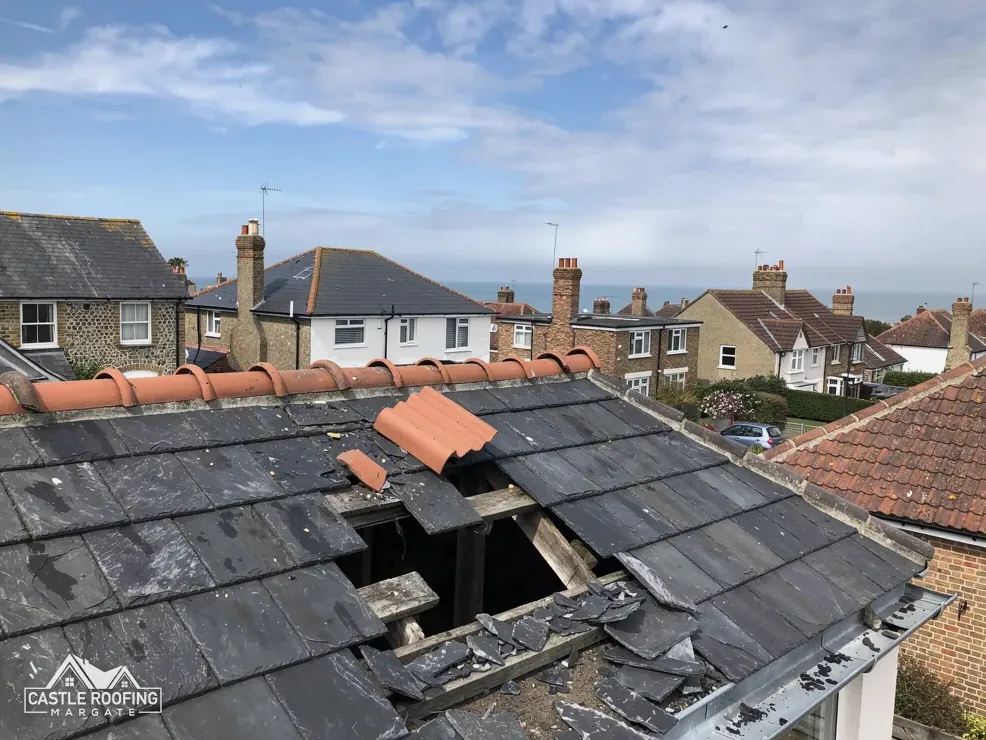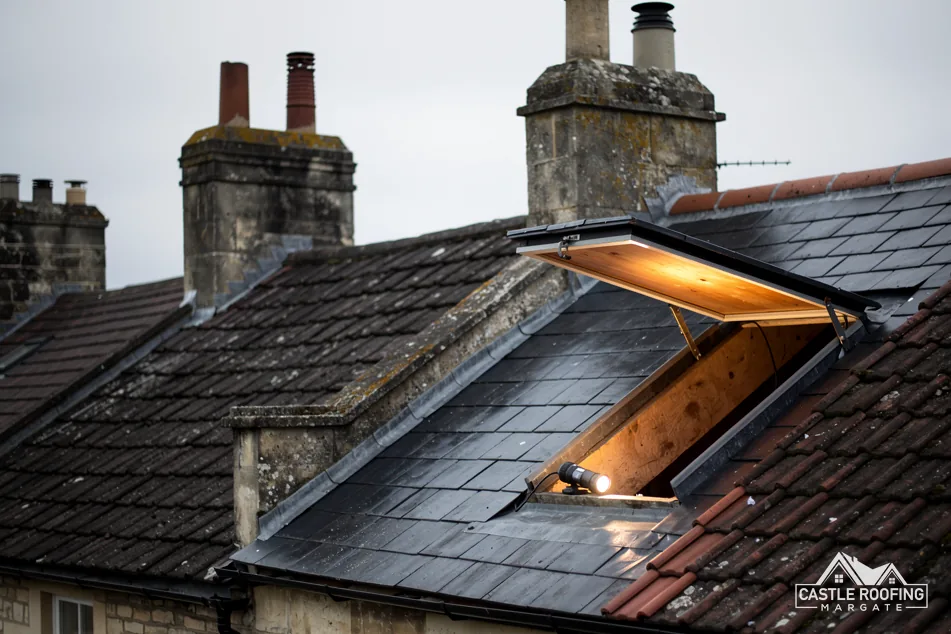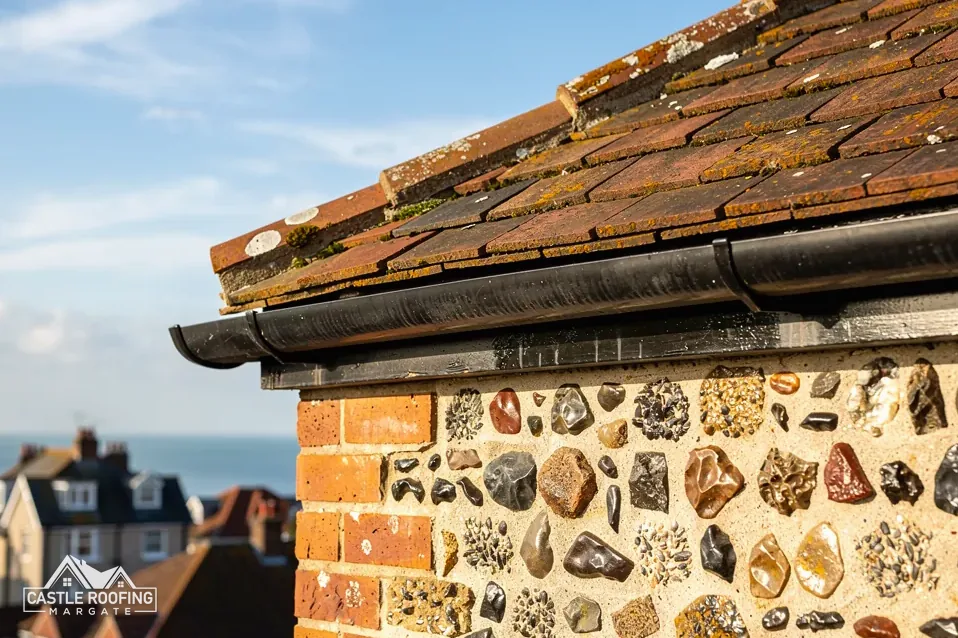
Use this to read the loft and the roof edges for signs that the layers under the tiles or slates have worn out, and to judge whether a patch will hold or the slope needs stripping.
Under every tile or slate sit two layers you cannot see from the street. Battens are the narrow timber strips fixed across the rafters, and the tiles or slates hang from them. Underlay is a felt or membrane laid across the rafters beneath the battens, and it gathers the rain and snow that blows past the covering and runs it to the gutter. Both are out of sight, so they are usually forgotten until something goes wrong.
When they fail, the roof covering can look fine. Tiles lie flat, the ridge is straight, and still the loft smells damp or a stain spreads on a bedroom ceiling. The cause is below the surface, and the only way to judge it is to look at the underside.
This guide sets out what failed underlay and battens look like from inside the loft and from the edge of the roof, why ventilation changes how long they last, and when the honest advice is to strip the slope and start again. If a roof has only a few slipped tiles, repair is the better buy; our pitched roofing page covers both repairs and full re-covers.
What the loft shows first
The loft is the best place to start, because the underside of the roof is on view there. Go up on a dry day with a torch and look at the rafters, the battens and the underlay between them. Do not step off the joists, and do not put weight on the ceiling boards.
Work through the roof slope by slope, and keep a note or a photo of anything that looks wrong:
- Daylight showing through the roof. A pinprick may be a gap between tiles, but a bright patch points to a missing tile, a hole in the underlay or both.
- Underlay that is torn, split along a lap, or hanging loose from the batten it should be fixed to.
- Underlay that has sagged between the rafters and is holding a pool of water or a dark damp patch.
- Dark staining on the rafters or the back of the battens, in the shape of a run-off line.
- Rusted nail tips pointing through the felt, and droplets on the underside after a cold night.
A fresh stain on a dry day tells you less than one that grows after rain. If you can, check again after a wet spell and compare the photos. Wet patches that appear in the same place every time usually trace to one point above, such as a failed lap, a split in the felt under a valley or a missing tile.
The loft cannot tell you everything. The underlay may be torn in a spot that is hidden by insulation, or the battens may have rotted inside a boxed eaves. That is why a survey includes the roof edges as well, and why photos taken from the loft are a starting point and not a verdict.
How a damp or rotten batten gives itself away
Timber battens give different signs from felt, and they are physical ones. Press gently on a batten with a screwdriver from inside the loft where you can reach one. Sound timber resists; rotten timber goes soft and the point sinks in. Battens that have dried out and split can look sound but let go of their nails.
From outside, a failing batten shows in the courses. A row of tiles may sit lower than the one beside it, or the lines of the roof may dip along one course. A batten that has rotted at the eaves, where water collects, can let a whole run of tiles slide a little each winter. Ridge or hip tiles that have moved can also point to loosened battens beneath them.
The patterns to match with a cause:
| Sign | Where | Likely cause |
|---|---|---|
| Dipping course | Along a slope | Rotted or snapped batten |
| Soft timber | Eaves, valleys | Long-term damp |
| Loose tiles | A row at a time | Nails lost their grip |
| Wet felt | Under a valley | Torn or lapped badly |
Treat these as pointers, not a diagnosis. A batten problem can start as an underlay problem, because water that gets past torn felt wets the timber. A survey from the roof, with photos of what is found when a few tiles are lifted, is how the two are told apart.
Old felt, HR underlay and why ventilation matters
Underlay comes in two broad kinds, and they behave differently in a loft. HR underlay is non-breathable. It stops liquid water but does not let water vapour from the house pass through it, so the air in the roof space has to be ventilated to carry moisture out. A breathable membrane lets vapour through, and its maker's instructions say how the roof is ventilated with it.
BS 5250:2021 is the standard on moisture in buildings. A cold roof has its insulation along the loft floor, so the void above stays unheated, and there Marley sets the eaves ventilation for HR underlay by pitch: 10mm of continuous gap at the eaves above 15°, and 25mm at 15° or less. The Building Regulations' Approved Document C, on resistance to moisture, treats ventilating cold deck roofs as the way its requirement is met.
This matters when you judge old underlay, because a blocked eaves gap changes what the felt has to cope with. A roof with its eaves vents stuffed with loft insulation can run damp even when the covering is perfect, and the signs overlap with failure:
- Water droplets or frost on the underside of the felt in winter.
- Blackened rafters near the eaves and the lowest battens.
- A musty smell without a matching stain on the ceiling.
- Damp insulation along the eaves while the middle of the loft is dry.
If the felt looks fine and the timber is damp, look at the ventilation before blaming the covering. Our guide to the eaves ventilation gap shows what is checked.
Patching a slope or stripping it
A repair is the right choice when the fault is local. A few slipped tiles, one cracked ridge tile or a small tear in the felt beside a missing tile can be put right in a morning, and the rest of the roof carries on. For a few damaged tiles, Which? Trusted Traders gave £75 to £400, ex VAT, in November 2025, a typical UK range, and prices sit higher across the South East, which includes Kent.
Patching stops working when the fault is spread across the slope. Strip and re-cover becomes the straight answer when:
- the underlay is torn or perished across a large part of the slope, not just at one point;
- several battens are soft, split or have lost their nails;
- the same area has been patched more than once and keeps leaking;
- tiles are lifting in rows because the battens will not hold a nail;
- the original felt is brittle enough to crack when it is moved.
The reason is simple. New tiles on rotten battens or torn felt only restart the fault. When we lift a few tiles at the survey, you see photos of what is underneath, and the choice between a repair and a re-cover rests on that.
A full re-cover is a larger job, and the national guides vary widely. Which? gives £7,000 to £21,000, ex VAT, for re-roofing an average three-bedroom house. MyJobQuote, in October 2026, gives around £5,250. HomeBuilding gives £10,000 to £15,000 for plain concrete tiles on a 65 m² semi. Roof size, covering type and the state of the timber all move the figure.
What a strip and re-cover involves underneath
On a re-cover the old tiles or slates come off one slope at a time, followed by the old battens and the underlay. Only now can the rafters be inspected end to end. A soft or rotten rafter is photographed and shown to you before any timber repair begins, and new work is not started over timber that cannot hold it.
The new layers go on in a set order:
- New underlay is rolled across the rafters from the eaves upward, each sheet overlapping the one below so water runs over the laps, not into them.
- New battens are fixed at the gauge set by the tile or slate length and the lap.
- The covering goes on, course by course, fixed to the pattern worked out under BS 5534:2014+A2:2018.
- The ridge, hips, verges and valleys are finished, with lead at a wall abutment or a chimney.
The choice of underlay is a decision for the roof, not a price decision. A breathable membrane and an HR underlay need different ventilation, as set out above, and the specification names the one used and the ventilation that goes with it. Tell us if you have noticed condensation in the loft before the work starts, because it changes what is specified.
Scaffold standing on the pavement or road needs a Kent County Council licence, and the scaffolding firm applies. The fee is £52 per week for 2026 to 2027, and the council asks for 5 working days' notice. Kent County Council permits skips on the road separately, at £45 per week for 2026 to 2027. The scaffold stays up for the whole job.
Questions to put to any quote that mentions felt
If a quote offers to renew the felt or the battens, it should say what is being renewed and over how much of the roof. A line that reads "new felt" can mean new felt over the whole roof or new felt in the patch around a leak, and the two are very different jobs. Ask for the answer in plain words, and ask what the roofer will do if the battens turn out to be worse than they looked from the loft. A sound answer names the extra work, shows it in photos and waits for your go-ahead before anything beyond the quote is done.
Points that make a quote easy to compare:
- Which slopes are stripped, and which are only repaired.
- Which underlay is specified, and what ventilation the roof space gets alongside it.
- Whether the battens are all new, or only replaced where they fail the check.
- Whether the price includes scaffold and VAT, and how the price changes if rotten timber is found.
- What the roofer will show you in photos once the tiles are off.
Citizens Advice also advises collecting written quotes from at least 3 different traders, so put the same questions to each and compare the answers on the same slopes and the same layers. When the loft is damp but the roof checks out, our page on damp lofts looks at the causes that are not the roof at all.