Read this to understand what holds a plain tile roof together, what pitch it needs, how long the tiles last and why a sound repair uses tiles that match the ones on your roof.
A plain tile roof is covered in many small, flat tiles rather than a few large ones. Each tile is small beside an interlocking tile, so a single slope carries a great many joints, and every joint is covered by the tile above it. Rain does not meet one sealed sheet. It meets rows of overlapping tiles that pass the water downhill, with a second layer of tile under each joint as a back-up.
That overlap explains most of what goes right and wrong with the roof. It depends on the lap between courses, on the nibs and nails that hang each tile from its batten, and on the timber and underlay beneath.
This guide covers how a plain tile roof is built, the pitch it needs, how long the tiles last and how a repair is done so that it blends with what is already there. It applies to clay and concrete plain tiles across Thanet and East Kent. Where a figure depends on the tile maker, the product data sheet is the place to check, because limits differ from one range to the next. Small repairs sit within our pitched roofing work, and a full re-cover belongs to the same service when a slope has reached that point.
How the small tiles shed water
Plain tiles are laid in horizontal rows called courses, working up from the eaves, where the slope ends over the gutter. Each course overlaps the one below it. Within a course the tiles sit side by side with their vertical joints staggered, so a joint in one course lands over the middle of a tile in the course beneath. Water that finds a vertical joint runs onto the tile below it, not straight through.
The overlap that matters most is the lap, the distance each tile reaches down over the tiles below. Plain tiles are laid to a double lap, which means every point on the slope sits under at least two thicknesses of tile. No single tile has to keep the weather out alone. If one cracks, the tile under it still carries the water away, and that is why a plain tile roof with a few broken tiles can go on shedding rain for some time before anyone sees a stain indoors.
The edges of the roof need different pieces so that the pattern of joints can run all the way across:
- At the eaves and the top course, short tiles let the courses finish square, and the lowest course is doubled so water clears into the gutter.
- At the verge, the sloping edge where a roof stops against a gable wall, a tile-and-a-half or a half tile keeps the stagger running to the edge.
- At the ridge, ridge tiles cap the join along the top of the roof.
- At a hip, the outward corner between two slopes, and in a valley, the inward corner, the courses are cut to fit or finished in lead.
Hips and valleys are where the neat pattern is hardest to hold, so they are the first places we look when a roof has started to leak.
Nibs, nails and the nailing courses
Look at the back of a plain tile and you will find a pair of nail holes near the top and, on most, two small projections called nibs. The nibs hook over the batten, the horizontal timber strip fixed across the rafters, so the tile hangs from it. The tile is then held by the nibs, by its own weight and, where it is nailed, by the nail through the hole. Because each tile hangs from a batten, the gauge, which is the spacing of the battens up the slope, sets how much of each tile shows and how big the lap is.
Not every tile is nailed in a plain tile roof. A common method is to nail some courses and let the nibs hold the rest, with the exposed and edge positions fixed more fully. The right pattern depends on the pitch, on the exposure of the site and on the tile maker's instructions, which is why the fixing is worked out for each roof under BS 5534:2014+A2:2018, the slating and tiling standard. Marley, a tile maker, says that BS 5534 sets out how wind uplift is worked out for fixings, and that following it is not required by law. We calculate the fixings for the site's exposure, not from a rule of thumb.
The places where fixings fail first are easy to name:
- Nails that have rusted through at the shank, so the tile is held by its nibs alone.
- Nibs that have snapped, usually found when a tile is lifted for a repair.
- Battens that have gone soft or split, so a whole row loosens together.
- Tiles in the eaves and verge courses, where the wind lifts first.
Pitch and the 35 degree line for concrete plain tile
Pitch means how steeply a slope rises, and every tile has a minimum below which water can be driven back up under the lap. A shallow slope needs a larger lap or a different tile altogether. Marley's published minimum pitch for its concrete Plain tile is 35°. That is a steep roof, so a slope below it needs a different tile or a different approach.
Marley's own table shows how much the figure moves from one product to the next. These are the manufacturer's minimums, and its page asks you to check the product data sheet for the tile on your roof:
| Tile | Material | Minimum pitch |
|---|---|---|
| Plain | Concrete | 35° |
| Ashdowne | Clay | 35° |
| Hawkins | Clay | 30° |
| Acme Single Camber | Clay | 30° |
| Canterbury | Clay | 40° |
Here Canterbury is a Marley product name and not the city, so the 40° figure says nothing about roofs in Canterbury. A clay plain tile from another maker has its own limit, set out on that maker's data sheet. Where a roof is close to its minimum, we measure each slope at the survey before any tile is chosen, and we do not match a replacement tile to a pitch it was never made for. On a roof close to its minimum, a deeper lap or a different covering may be the better answer than a like-for-like patch.
Our guide to minimum pitch sets the same idea out for other tile types.
What ages first on a tiled slope
The tile is often the longest-lived part of the roof. HomeBuilding gives a typical life of 60 to 80 years for clay tile and 40 to 50 years for plain concrete tile. The BRE, whom Marley quotes, puts a minimum life expectancy of 60 years on clay tiles; that figure is for clay only and does not apply to concrete. Marley cautions that its concrete figure does not promise how long any one tile will last. Treat each as a range, not a promise about any one roof.
What fails sooner is usually what holds the tile up. A roof can look sound from the street and still be near the end of its fixings. A sensible look from the ground, and from the loft where there is a hatch, picks up:
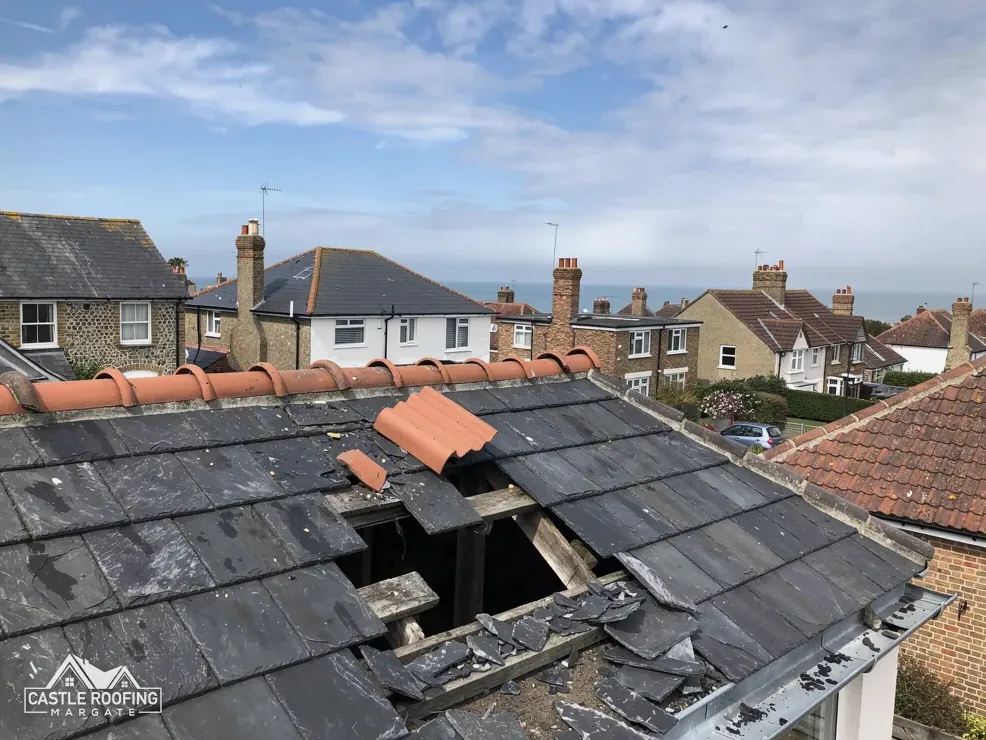
- Slipped or missing tiles, seen as gaps in the courses or tiles sitting proud of their neighbours.
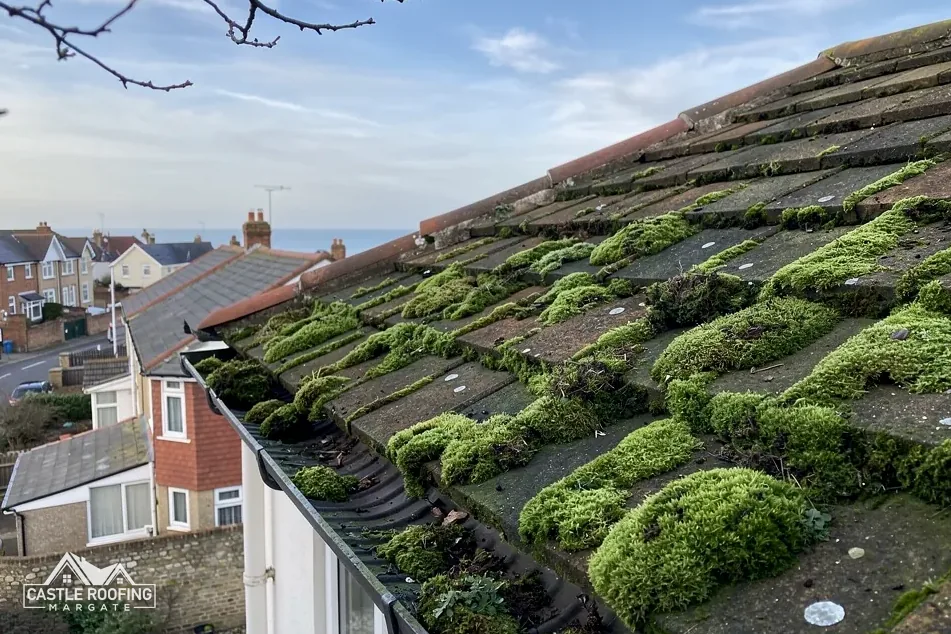
- Tiles with a flaking face or a crumbling edge, where frost has got into the body of the tile.
- Sagging along a course or across a slope, which points to batten or rafter trouble and not a tile fault.
- Daylight through the roof from inside, or damp patches on the underside of the felt.
- Broken tiles lying in the gutter or on a flat roof below.
Climbing a tiled roof to check is a poor idea, because plain tiles are thin and a foot on the wrong one breaks it. Our page on clay tile life goes through the ageing of clay in more detail.
Repairs that match the existing tile
The tile that goes in decides how good a repair is. Plain tiles are made in a range of sizes, colours and surface finishes, and weathering changes the look of a tile over decades. A new tile pushed into a slope of old ones shows up as a patch in the wrong colour, and a tile of the wrong thickness or camber can sit proud or leave a gap. For a few missing tiles the usual route is to find tiles that match, either new ones of the same make and size or reclaimed tiles from a source that suits the age of the roof.
How the repair is carried out goes in this order:
- Identify the tile: its material, its size, its colour and how it hangs from the batten.
- Lift the courses above the damaged tile so the nails can be reached and the tile can be drawn out without cracking its neighbours.
- Check the batten and the underlay under the gap before a new tile is hung.
- Set the replacement so that it takes the same lap and the same fixing as the tiles around it.
- Close the courses back down and check the line with a straight edge.
Sometimes the honest answer is that a patch is the wrong buy. When a slope has many slipped tiles, the nails are rusted through or the battens are failing, new tiles only restart the same fault. The next section covers when a re-cover makes more sense, and our guide to replacing a single tile covers the one-tile case in more detail.
Repair or re-cover: what sets the price
For a small plain tile repair, national guides give a typical UK range. Which? Trusted Traders, in November 2025, gave £75 to £400, ex VAT, to fix a handful of broken or missing tiles (one to six), and warned that the upper end is likely in the South East, where Kent sits. MyJobQuote, in October 2026, gave around £215 as an average for replacing tiles.
Checkatrade, in June 2026, gave repair rates per square metre, ex VAT, and says they apply to areas up to a maximum of 3m²:
| Tile type | Per m², ex VAT |
|---|---|
| Concrete tiles | £90 to £120 |
| Clay tiles | £110 to £160 |
Those rates are for small repairs and cannot be scaled up to a whole slope. A full re-cover is a different job and the national guides disagree widely about it: Which? gives £7,000 to £21,000 ex VAT for a whole new roof on an average three-bedroom home, while for a 65 m² semi-detached three-bed in plain concrete tiles, HomeBuilding gives £10,000 to £15,000.
What moves the price on your roof is the size of the slopes, the tile you choose, the state of the battens and underlay once the old tiles are off, and whether a scaffold licence is needed. Scaffolding is priced after a survey, so check that any quote you hold says whether the scaffold is included. The roof is looked at first, photos of your own slopes come back to you, and a single written total follows.