You get a working definition in trade terms, a way to check your own roof from the street and from inside the loft, the faults to watch for, and the consent route if the house is protected.
Put the question to three people in Thanet and you could hear three different replies, since the name gets used loosely. In trade terms it is a plain clay tile, small and flat, hung in overlapping courses from timber battens. Battens are slim lengths of timber nailed across the rafters to carry the tiles. The tiles lie in staggered rows, each course covering the joints of the one below.
On the roof, a peg tile is judged like any clay plain tile: by its fixings, its laps and the battens behind it. What a roofer can usefully tell you is how to recognise the covering on your own house, how it fails, what a sound repair looks like and which permissions apply when the house is old.
This guide takes those in order. If you already suspect a fault, the pitched roofing page explains how a tiled roof is surveyed and what sits behind a repair or a re-roof.
What the name describes in trade terms
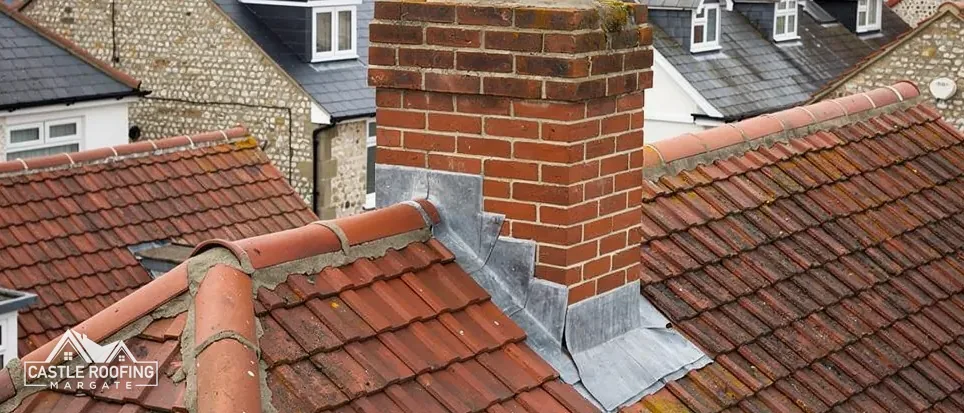
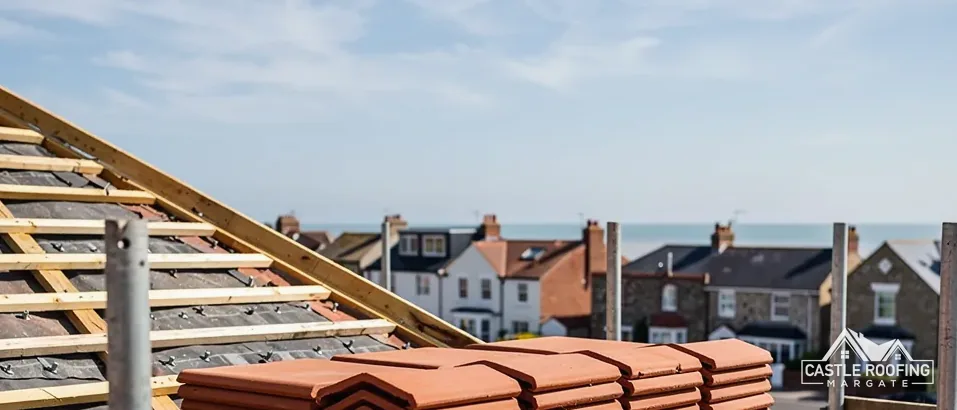
A peg tile roof is built from many small, thin clay plain tiles rather than a few large units. Every course laps over the one beneath, and that overlap, called the lap, is what sheds the water. Under the tiles sit the battens and, on a roof that has been renewed, a layer of underlay, the membrane that catches wind-blown rain. An older roof may have no underlay at all, only the tiles and sometimes a pointing of mortar inside the laps called torching.
Because the tiles are small and numerous, the roof has many joints and many fixings. That is the whole practical difference from a roof of large concrete tiles, and it explains most of what follows. A fault tends to be local: one slipped tile, one cracked tile, one stretch of failed batten. It can usually be mended without disturbing the rest of the slope.
Four words are worth knowing before you speak to a roofer:
- Course: one horizontal row of tiles, running from one side of the roof to the other.
- Lap: how far each course overlaps the course below it.
- Verge: the sloping edge where a gable wall meets the roof, where the last tiles are bedded in mortar or held by a dry-fix system.
- Eaves: the bottom edge of each slope, above the gutter, where the first course starts.
Our answer on what torching is explains the mortar pointing inside the laps and why its condition matters.
How to tell what is on your roof
There is no need to climb up. Much of what identifies the covering is visible from the pavement, a garden or a bedroom window, and a phone with a zoom lens fills in the rest. Never walk on the roof: old clay cracks under a boot, and a wet or mossy pitch gives no grip.
- Compare the tile size with a window or a door. A roof of plain tiles shows many narrow rows close together, where a large-format tile shows broad, widely spaced ones.
- Look at the surface. Clay runs from reds and browns to weathered orange, with variation from tile to tile, and an old face often carries lichen or moss.
- Sight along the courses. The rows should run straight and the surface should not dip. A dip across several rows points to a batten or a rafter, not a single tile.
- Take a torch up to the loft while it is light outside. Check whether underlay lies beneath the tiles, whether the batten ends look dark and soft, and whether pinpricks of sky show between the tiles.
- Photograph anything odd, from the ground and from inside, and note the date.
Photos of your own roof are the first thing we ask for. Send them through the quote form or on WhatsApp and we study the covering before any figure is mentioned.
Some owners find the covering is not clay at all, or that one slope was re-covered at some point with something different. That is worth knowing early, because it changes what a matching repair means.
What goes wrong with small clay tiles
Clay is durable and it is also brittle. A knock from a ladder or a branch cracks a tile cleanly, and a tile that has soaked up water can lose its face to frost. On an older roof the fixing can fail before the tile does. Nails rust, the points that hold each tile wear, and a tile that was firm long ago slides a little lower with every hard wind until it drops.
The faults to look for on a tile roof, and what each one means:
- A slipped tile sitting lower than its neighbours: the fixing has failed, and the tiles around it are worth checking.
- A cracked or split tile: replaced singly, with a matching tile from stock or from a salvage source.
- A rotten batten end: this shows as a sag across several tiles and needs the tiles lifted.
- Crumbling mortar under the ridge: the ridge tiles lose their bed and can shift.
- Perished underlay: dry and brittle when handled, with water marks on the timbers beneath.
- Moss in the laps: it holds water against the clay and can lift tiles apart when it thickens.
Our guide to why roof tiles slip goes through the fixings in detail. A repair answers the fault, so one cracked tile is one tile, not a reason to strip a slope. If the pattern is wider, with slipped tiles across the whole pitch and rusted nails wherever anyone looks, you are told plainly and shown what a larger job involves.
Listed and conservation area homes
Roof work on an older house sometimes needs a consent that an ordinary re-roof does not. Which one depends on how the house is protected, and the checks come before the scaffold goes up.
- Listed building: a change that alters a listed house's character needs listed building consent, under section 7 of the Planning (Listed Buildings and Conservation Areas) Act 1990. The house keeps its permitted development rights for roof alterations, and still needs that consent.
- Conservation area: these count as article 2(3) land, which removes the permitted development right for dormers. It does not remove the right to re-roof a house. Thanet's own page on its conservation areas treats like-for-like work as a lesser trigger for planning permission, which is a likelihood and not a guarantee.
- Article 4: Thanet District Council has Article 4 Directions in the Pegwell, Ramsgate and Ramsgate Marina extension conservation areas, and for what they cover it asks you to contact the council.
Thanet lists 27 conservation areas in all, among them Cliftonville, Broadstairs and Ramsgate. For a house outside Thanet, the council for that address holds the answer.
The practical order is simple. Find out whether the house has a listing or is inside a conservation area, ask the council before ordering tiles, and have the matching question settled in writing before work starts. Our guide to listed house tile repairs covers the listed route in more depth.
Matching tiles when part of a roof is repaired
A repair that stands out is rarely a failure, but on a house where the roof is part of the look, matching matters. New clay tiles are usually brighter than old ones and weather down over the seasons. Reclaimed tiles from a salvage yard, or from a part of the same roof that cannot be seen, blend in at once.
| Check | Why it matters | How it is judged |
|---|---|---|
| Colour | New tiles sit bright beside old | Held against the slope in daylight |
| Thickness | A thicker tile will not sit in the lap | Laid beside a sound tile |
| Size | Mixed sizes upset the courses | Measured on the roof |
| Face | Textured and smooth faces differ | By eye and by touch |
The size check is also what fixes the gauge, the distance between one batten and the next. If replacement tiles differ, the gauge cannot be kept and the course lines wander.
Reclaimed tiles come with checks of their own. Lay them out, set aside any with cracks or flaked faces, and ask the seller for a count with spares, because a batch can run short halfway up a slope and a second batch may not match the first.
On a protected house, ask the council whether it wants to see a sample before the tiles are ordered. Photographs of the existing roof in daylight, taken square-on, help that conversation and help the roofer too.
Repair or re-roof, and what sets the price
For a few failed tiles, a repair is the honest answer. Which? Trusted Traders (November 2025) gives a typical UK range of £75 to £400, ex VAT, when between one and six tiles are broken, and MyJobQuote (October 2026) gives around £215. Checkatrade (June 2026) lists clay tile repairs at £110 to £160 per m² ex VAT, on rates that apply up to a maximum of 3m². Which? expects South East jobs toward the top of its scale, HomeBuilding reports higher labour rates there, and Kent falls in that region.
A full re-roof is a different decision. Which? gives £7,000 to £21,000, ex VAT, for stripping and replacing the whole roof on a three-bedroom house of average size, while HomeBuilding suggests £10,000 to £15,000 for plain concrete tiles on a 3-bed semi of 65 m². The sources differ widely, and neither is a Castle price.
On the rules side, the Planning Portal sets a double test for skipping a Building Regulations application: less than 25 per cent of the building envelope and less than 50 per cent of the roof affected. A new covering at 15 per cent or more above the old covering's weight needs approval, and the Planning Portal suggests a structural engineer or surveyor look at the roof before work starts. In Thanet, building control is Thanet District Council's own team, on 01843 577522.
What sets the price is the area, the pitch, the access, the batten and underlay condition once exposed, and how closely new tiles must match. A written price follows the survey, not a phone description.