You get the four things that let a tile move, what BS 5534 asks of a fixing, why exposure changes the specification, and how a lasting repair differs from pushing a tile back.
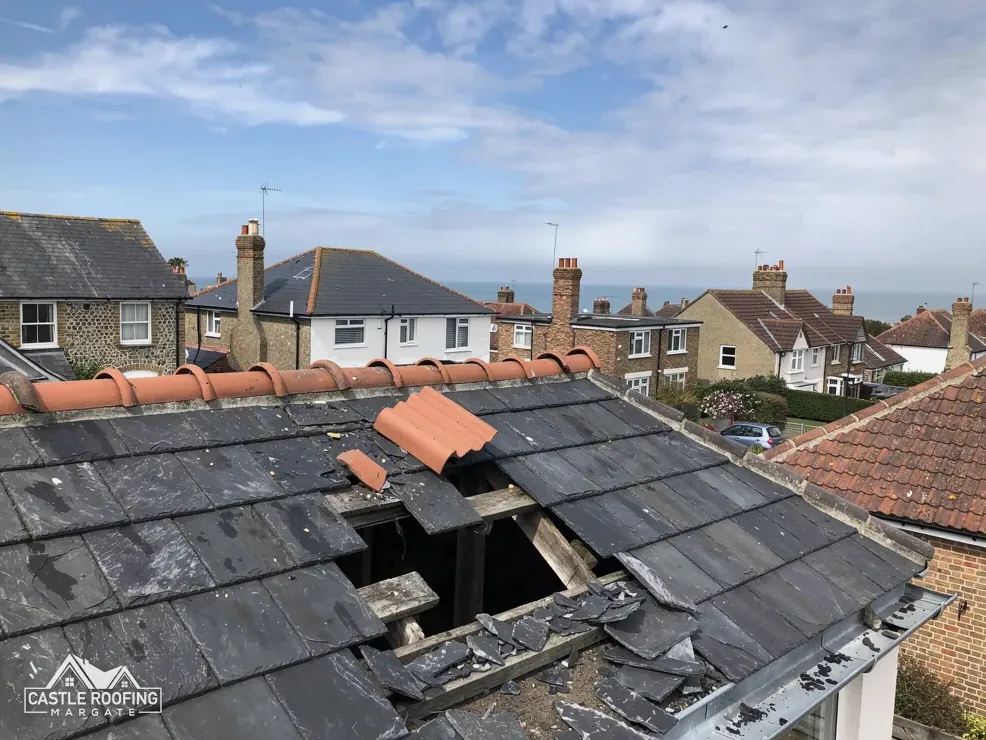
A slipped tile sits a few millimetres lower than the ones beside it, or rides up at one corner, or lies in the gutter after a blow. The natural reading is that the wind did it. The wind usually supplied the final push, but the tile had already lost its grip, and the reasons are mostly quiet ones: a nail that rusted through, a clip that was never fitted, an underlay that has gone brittle, a batten that has softened.
Understanding which of those applies decides the repair. Pushing the tile back and moving on cures nothing if the batten beneath it is rotten, and replacing a batten does nothing if every nail on the slope is thin with rust. This piece goes through the causes in turn, then covers the standard that now governs how tiles are fixed and why a coastal roof is worked out differently from a sheltered one.
If tiles are already coming off, the pitched roofing page sets out how we survey a slope before any repair is planned.
The four usual reasons a tile moves
Water, weather and age act on four parts of a pitched roof, and a tile slips when one of them lets go. Not all four fail on the same house, and many slipped tiles trace back to a single weak part that has been dragging its neighbours along.
| Cause | How it shows | Usual answer |
|---|---|---|
| Corroded nail | Tile slides down, nail head rusted or gone | Refix with new fixings |
| Missing clip | Tile lifts or rattles in wind | Add the clips |
| Perished underlay | Brittle sheet, water marks below | Renew the sheet |
| Rotten batten | Sag across several tiles | Lift tiles, renew batten |
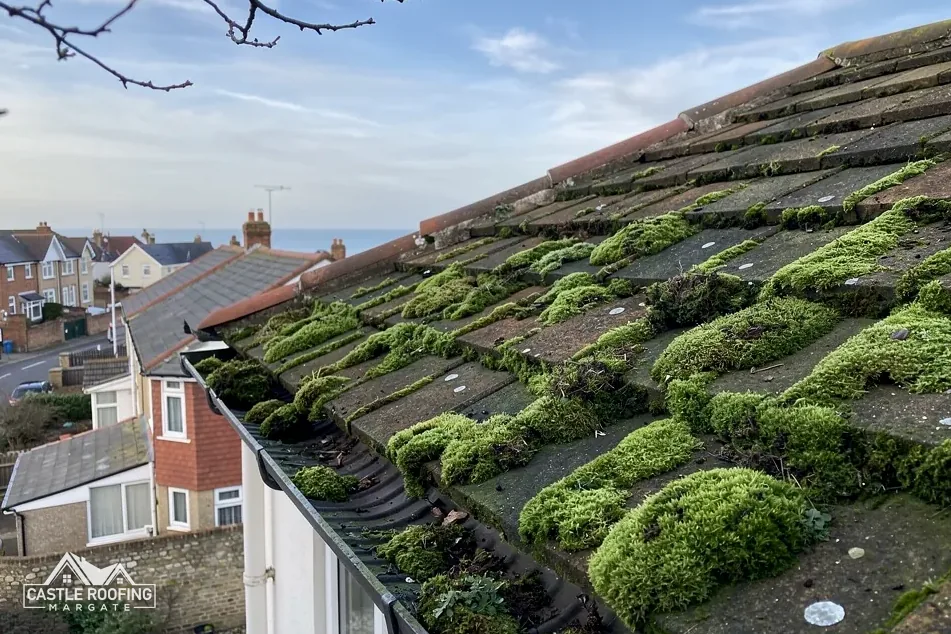
A batten is the timber lath running across the rafters, and the underlay is the sheet below it that catches wind-driven rain. Both sit out of sight, so a fault in either only shows once a tile has gone. The slope may look sound from the road while the timber behind it is already giving way, which is why one visible slip deserves a proper look underneath.
The first thing a surveyor does is lift a tile near the slip, look at what is under it and test the nearest fixings by hand. That tells whether the problem is one tile or a slope. Our answer on whether roof tiles need clips covers the second item in the table in more detail.
Nails that rust through
A nail is a small piece of metal holding a tile against wind and its own weight for a very long time. Moisture sits in the joint where a nail passes through, and over the years the shank thins. Eventually the head can part from the shaft, or the tile drags the nail out of a softened batten. Nothing visible changes until the tile drops by the width of a thumb, and by then others around it may be loosening too.
You can spot the early signs from the ground or from a loft:
- Rust-coloured staining under the tiles, or on the batten beneath them.
- A tile sitting slightly proud of its row, or a row that no longer runs straight.
- Flecks of corroded metal lying in a gutter or on a lower roof.
- Daylight showing at a joint where it did not before.
Nails are cheap and the fault they cause is expensive, which is why the material matters when a repair is done. Fixings are chosen for the covering and the setting, and a roofer can name them when asked. A nail that has failed once on a slope is a hint to test its neighbours, because they were fitted at the same time and have faced the same weather.
Never go onto the roof to check. A tile with a failed nail has nothing to hold it, and it can slide under a boot as easily as in a gust. Photographs from the ground and a phone zoom show a great deal.
Clips, mortar and what BS 5534 says
Older tiled roofs were often laid with the tiles hanging on their own nibs and a few nails, with mortar bedding at the ridge and the verge. That was accepted practice. The current code of practice, BS 5534:2014+A2:2018, asks for more, and it is worth knowing what it does and does not say.
- Marley notes that fixing to BS 5534 is not a legal requirement. It is the standard slaters and tilers work to, and a roof built to it is easier to defend.
- Marley reads the 2015 amendments as ending the days when mortar alone could hold a covering in place. Mortar was not banned. It stopped being enough by itself.
- Amendment A2:2018 brought routine re-roofing, repairs included, into the scope. That matters when a slipped tile is mended: a repair now sits inside the standard, not outside it.
- BS 8612:2018 is the specification for dry-fix systems at ridges, hips and verges, which hold the capping with a mechanical fixing instead of relying on the mortar.
In practice that means a ridge that has come loose is not simply re-bedded. It is held with a fixing that does not depend on mortar, or the mortar is backed by one.
For clips specifically, the question to ask a roofer is which tiles on a slope are clipped and what the specification says, instead of whether clips are used at all. The detail is in our guide to BS 5534 tile fixing.
Perished underlay and rotten battens
The sheet under the battens takes a surprising amount of work. Wind-blown rain and fine snow get past tiles, and the underlay carries them down to the gutter. When it perishes it can crack or crumble, water reaches the batten, and a batten that stays damp softens. Softened timber loses its grip on nails, and that is how a rotten batten and a corroded nail end up working together to let a tile go.
You can tell the sheet's state in the loft. A bitumen felt that has gone hard and split, or a plastic membrane that has gone brittle and torn at the laps, is perished. Dark staining on the timber under it shows water has been entering over a long period. It is also worth looking at the batten ends against the rafters: soft, dark or crumbling timber there means the problem is not confined to one tile.
Underlay type matters when a roof is ventilated. Marley describes HR underlay as non-breathable, and under it a cold loft needs ventilation in line with BS 5250:2021 on moisture in buildings. A roof that traps damp air under a non-breathable sheet can rot its own battens, whatever the tiles above are doing.
- Lift one tile near the slip and look at what lies under it.
- Press the nearest batten with a screwdriver tip; sound timber resists, rotten timber gives.
- Note whether the underlay is intact, torn or missing.
When these come out poorly, a repair means stripping a section, renewing the battens and underlay and relaying. Our guide to roof underlay and battens shows what sound ones look like.
How exposure changes the fixing specification
A tile on a sheltered street and a tile on an open clifftop road face different loads, and the fixing specification is supposed to reflect that. Marley says BS 5534 supplies the wind uplift calculations and a way to arrive at each fixing specification. Under BS 5534 the fixing schedule follows how exposed the individual site is, and one rule does not cover everywhere.
Cupa, the slate maker, puts the principle simply: coastal sites and hillsides grade as more exposed, and so do tall buildings. A roof on a high, open plot may therefore need a different fixing pattern from the house in the next street.
Weather records show why the question matters on this coast. The Met Office's Manston averages for 1991 to 2020 put the mean wind at 9.86 knots, and 11.21 knots in January, with 110.05 days on which 1 mm or more of rain fell, and about 613 mm over a year. South Farnborough, an inland station, shows 7.07 knots and 715 mm over the same period. Manston is windier and drier. Those are averages, which say nothing about any single gale.
For a homeowner, the practical result is this. A roof that has lost several tiles in ordinary weather deserves a closer look at its fixing, and a re-fix should be done to a specification fitted to the house, not to a habit. Small clay tiles in particular carry many joints and many fixings, which makes that checking worthwhile.
A lasting repair, step by step
Setting a slipped tile back without asking why it moved tends to last only until the next strong wind. A repair that holds follows an order, and it is the same order whether one tile or twenty are involved.
- Photograph the slope from the ground and note which tiles have moved.
- Lift the tiles around the slip and inspect nails, clips, battens and underlay.
- Renew whatever has failed, whether fixings, battens or underlay.
- Refit the tiles with the fixing the specification calls for, adding clips where the slope is exposed.
- Check the ridge, hip and verge beside the work, since a loose edge lets wind under the next course.
- Clear the gutter of broken fragments and mortar before anyone leaves.
As for cost, Which? Trusted Traders (November 2025) gives a typical UK range of £75 to £400, ex VAT, for a small tile job, and MyJobQuote (October 2026) gives around £215 as the average for replacing roof tiles. A new ridge tile runs at £80 to £300 on the Which? figures, ex VAT. What decides the cost for your roof is the access, the number of tiles and the state of the timber beneath them.
If tiles blew off in a storm, contact the insurer first, then make the roof safe and keep photographs and receipts. Whether the event counts as a storm turns on the wording of your own policy. The Financial Ombudsman Service's description centres on violent winds, with rain, hail or snow usually alongside.