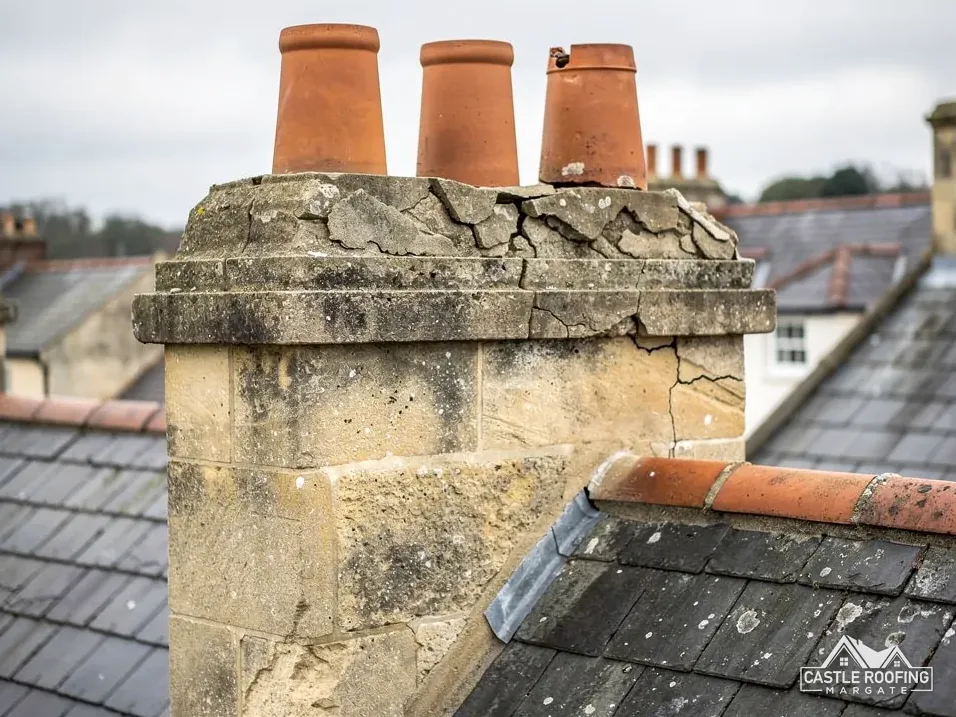
Where the apron sits on a stack
A stack that passes up through a sloping roof has four faces, and each one has its own flashing. The face on the downhill side, the one that faces the eaves, is the front. Rain running down the slope meets it head on, so it gets the full flow of water from everything above.
The apron is the flashing for that face. It is a single piece of lead, wide enough to cover the stack's width, with its top edge turned into a joint in the brickwork and its lower edge lying over the tiles. It meets the stepped flashings at the sides, and the joins at the corners are where the detail has to be right.
The sides of the stack carry stepped lead with soakers beneath, and the rear usually has a back gutter, a channel that carries water round the stack. Together the four make a continuous collar. The stepped lead flashing page describes the sides.
Because the apron faces the oncoming water, it is a part of the stack's lead worth checking first.
How the apron laps over the tiles
Lap is what makes any flashing work. A lap is an overlap, and it is arranged so that water running downhill always passes from a higher piece onto a lower one, never under it.
The apron's lower edge lies over the covering so that rain leaves the lead and runs onto the tiles or slates below. The lead is dressed down so that it follows the profile of the covering, so it is shaped on site to fit the tiles below.
The top edge turns up the face of the stack and is tucked into a cut-out joint between the brick courses. That is where the wall and the roof meet, and where a mortar fillet used to be put. A rigid fillet there cracks as the stack moves, which is why lead is dressed into the joint instead.
The same shape is used below a roof window. A roof window set into a slope has a frame to protect, and the lead along its lower edge turns up under the frame and laps down over the tiles, so water running down is led around the opening and not into it. Whether lead or the window maker's own flashing is used depends on the product, and the installation instructions for the window decide that.
Signs that an apron is failing
An apron is simple, so its faults are simple too. You are looking for any of the following:
- a gap between the top edge and the brickwork, where the pointing has fallen out;
- lead that has lifted at the lower edge and no longer follows the tiles;
- a split or crack, often along a fold at one corner;
- staining on the front of the stack or the tiles directly below it;
- a damp patch on the ceiling or in the loft close to the chimney breast.
A pair of binoculars from the garden is enough to see most of these. A gap or a dark line along the front of the stack is the clearest sign.
Do not climb to check. A stack sits above the slope and is awkward to reach safely, and a ladder against a chimney can disturb a flashing that is only just holding. Photos from the ground, with the date, are the best record.
A small fault at the apron can sometimes be repaired in place, and our lead flashing repairs page covers what that involves. A lead apron that has worn thin along its whole length is better replaced.
Replacing the apron with the rest of the stack
When an apron needs replacing, it is sensible to look at every other flashing on the stack at the same time. The four pieces overlap each other at the corners, and a new apron that has to join an old, worn stepped flashing will be only as good as that join.
Doing the whole stack in one visit also means the scaffold or access is set up once, the tiles beside the stack are lifted once, and the soakers below can be checked while the covering is open. If the soakers are fine, they stay. If any have slipped, they are replaced while the covering is already up.
The sheet thickness for each of these details is set in the specification. The what code of lead is used for flashing page explains why there is no single answer.
For price guidance, MyJobQuote gives a typical UK range of £350 to £920 for chimney leadwork (September 2026), which treats the stack as a whole. Where the work stands in relation to that range depends on the stack, so the written price follows the survey. The wider list of what we do is on the lead roofing page.