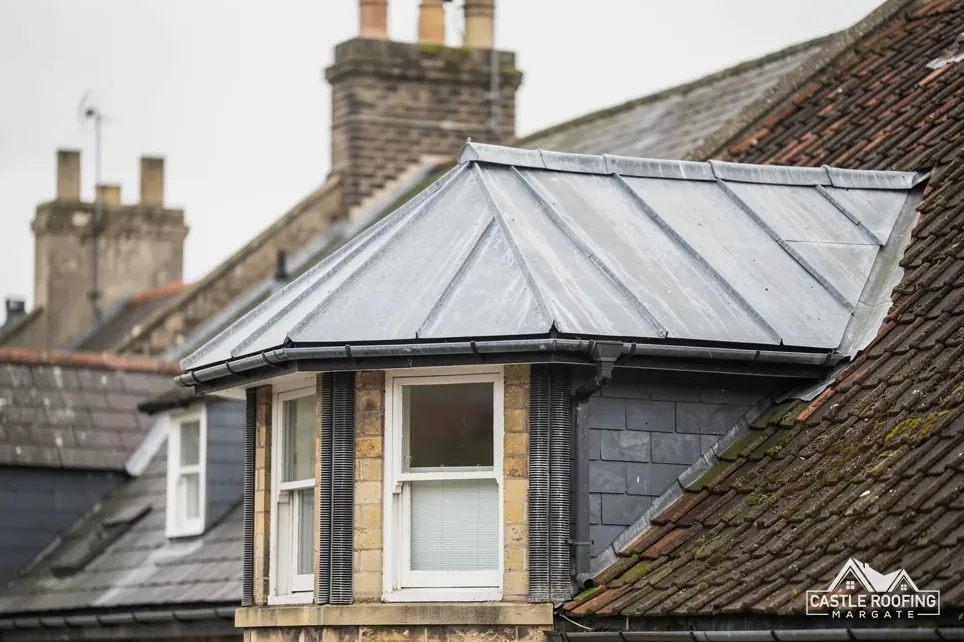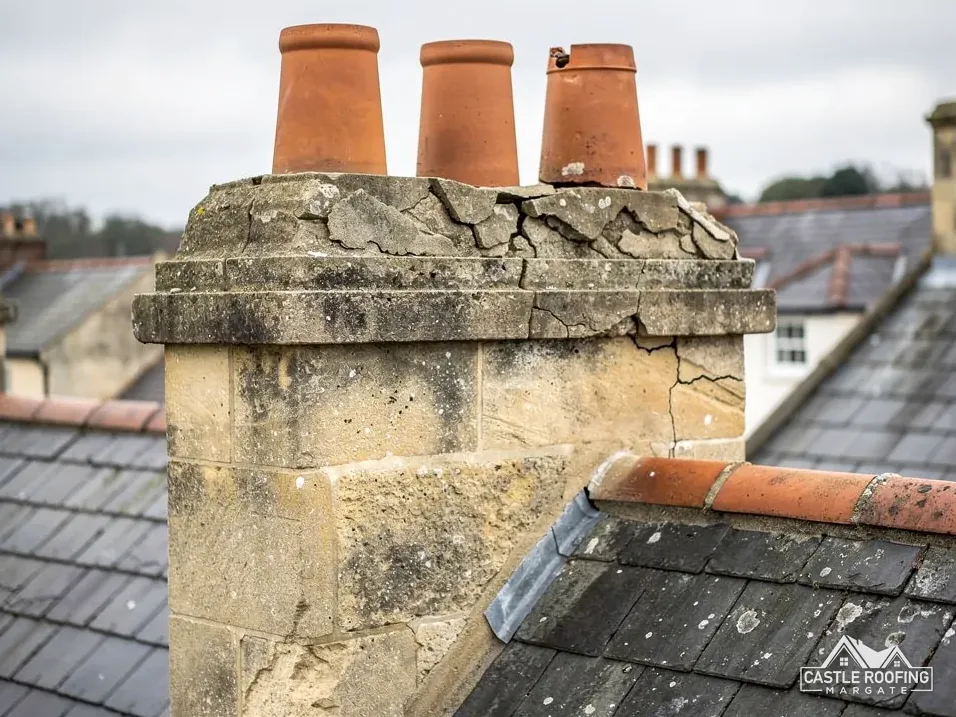
A chimney is wrapped in several separate pieces of lead, and how many of them need renewing, plus how hard the stack is to reach, set the total. Here is how to read a quote for it.
Where a chimney stack passes through a roof, the joint between brick and slope is closed with lead. That lead is the flashing: sheet metal dressed over a joint so water runs off it and not into it. Around a stack it is not one piece but a set of them, each made for one side of the chimney, and the set is called the chimney leadwork.
MyJobQuote's page on replacing leadwork on a chimney, dated 22 September 2026, puts the cost between £350 and £920 as a typical UK range. It comes from a national cost guide, so it is no Castle Roofing Margate price and it says nothing about your own stack. Which? puts its own figures toward the top for the South East, and HomeBuilding says labour costs more there; Kent counts as South East.
This guide explains the pieces, so you can see what a quote is replacing. It belongs to our lead roofing work. It deals with how a price is made up in general terms, because a quote is one written total and not a list of parts.
What the £350 to £920 range is a range of
A spread of more than two and a half times between the low and the high figure tells you that chimneys differ more than the word suggests. A range from one guide is no rule for the next stack, and the gap between its two ends shows how much the stack in front of you decides. A small stack on a single-storey rear addition at one end of the scale and a tall shared stack on a three-storey terrace at the other are both "chimney leadwork".
MyJobQuote gives this range for replacing the leadwork. It also publishes a separate page for replacing a roof valley, where it gives around £540 (7 September 2026). Set beside a whole roof, the lead round a stack is a modest repair, and it is a repair where access does much of the arguing about price.
Three things the range cannot tell you:
- how many sides of the stack carry lead that is failing
- how the stack is reached, from a roof ladder or from a scaffold
- what condition the brickwork and the mortar it is fixed into are in
Repointing the stack is a separate job, and it is priced after a survey. If the mortar in the stack is loose, it is dealt with at the same visit, because fresh lead fixed into crumbling joints does not stay put. The range helps you understand a price. It never stands in for one.
The pieces of lead round a stack
Each side of a chimney meets the roof differently, and each gets its own piece of lead. Knowing the names lets you follow a surveyor's description and check that a quote covers the whole set.
| Piece | Where it sits | What it does |
|---|---|---|
| Apron | Front face, lower side | Sheds water onto the slates |
| Step flashings | Sides, along the slope | Follow the brick courses |
| Soakers | Under the slates, at the side | Link slates to the step lead |
| Back gutter | Behind the stack | Carries water round it |
An apron is the piece of lead across the lower face of the stack, dressed down over the slates. Step flashings are the stepped pieces up the sides, cut to follow the brick courses. A soaker is a small folded lead sheet that sits under the slates against the stack, and the step flashing is dressed down over its upstand. Soakers go in as the slating is laid, which is why renewing them can mean lifting slates beside the stack. The back gutter, sometimes called a back tray, is the lead channel behind the stack that stops water running into the back of it.
A stack on the ridge has little or none of the back gutter, and a stack against a gable wall has a different arrangement again. The set a stack needs depends on where it stands, which is one more reason the survey comes first. Our pages on the lead apron, stepped lead flashing and the chimney back gutter go through each piece in turn.
Lead codes and what the specification sets
Lead sheet is graded by code, each number standing for a thickness. The Royston Lead cast-lead brochure lists them from Code 3, at 1.32 mm, to Code 8, at 3.55 mm. Each code has a colour mark on the roll, so a roofer can see at a glance which is which.
The same brochure says Code 3 is recommended for lead soakers only. It lists the other details a stack needs, such as cover and chimney flashings, alongside valley gutters and parapet walls, and the one pairing this guide relies on is Code 3 for soakers. The code for every other piece is set in the specification, which is the written description of the work.
That has a practical consequence for a quote. A good one says which code it uses for which part, or states that the work follows a specification you can ask to see. Where it says only "lead flashings" and nothing more, there is no way to compare it with another quote, and so it is worth asking before you sign.
On life, MyJobQuote gives lead flashing as able to last over 80 years. Read that as a floor for well-fitted lead, and never as a promise. The lead itself usually outlives what is under it. What fails first on a chimney is often the mortar the lead is tucked into, a slate or a nail, so the visit that looks at the lead looks at those too.
What moves the price within the range
A national average cannot see your roof. Several factors push a quote towards one end of the range or the other, and they are why a roofer wants to see the stack before naming a figure.
- The size and number of stacks. A stack with several flues is larger, and a roof with two stacks needs the work twice.
- How many sides need new lead. Renewing the apron alone is a smaller job than stripping all four sides.
- The state of the brickwork. Lead fixed into a joint that crumbles has nothing to hold it.
- The pitch of the roof and the height of the stack above the ridge.
- Whether a neighbour shares the stack, which affects who can work on which side.
- Whether the lead is being repaired or renewed. A split in a back gutter can sometimes be mended, and an aged apron may not be worth patching.
Chimney repointing, flaunching and any rebuild of the stack are separate jobs, priced after a survey. Flaunching is the mortar cap around the pots at the top. If your stack needs work above the roofline as well as lead at the base, the quote should say which of these it covers.
The back gutter sits on the uphill side of the stack, where water gathers and where leaves and moss collect, so it is worth asking about it by name when a quote lists the lead pieces.
Access and scaffold decide the rest
Two roofs with the same lead on the same stack can cost very different amounts, because of how the roofer gets to it. A stack on a low rear slope may be reached from a roof ladder and a crawl board. A stack on a tall front elevation, above a pavement, usually needs scaffolding, and that changes the cost more than any lead does.
A scaffold that stands over a public highway comes under section 169 of the Highways Act 1980, and the licence is Kent County Council's to grant. The firm erecting the scaffold makes the application, with 5 working days' notice, and Kent County Council's fee is £52 per week for 2026 to 2027. It also charges £78 for a site inspection where it considers one necessary.
What scaffolding costs on a given house is settled after a survey, because the height of the stack, where a scaffold can stand and how long it has to stay up all set it. For that reason, read any quote for chimney work with these questions in mind:
- find out whether scaffolding is in the total or on top of it
- find out whether VAT is in the total
- ask how the stack will be reached if there is no scaffold
- ask who arranges and pays for the highway licence
A stack reached with a roof ladder and a safety line, with nothing standing on the highway, sits towards the low end of the range. A front stack above a busy pavement does not. The difference is access, and the lead is the same.
Reading a chimney leadwork quote
A good quote for this work is short and specific. It names the stack or stacks, says which sides of each are getting new lead, and says whether the brickwork or flaunching is included. Every point that moves the price is named, then one total is given, and the stack is described well enough that a second roofer could price the same job.
The written price follows the survey. A figure given over the phone for chimney leadwork, before anyone has looked at the stack, is guesswork, and guesswork tends to grow once the ladder is up. Photos from the street and from the loft help the surveyor prepare, but the stack gets looked at in person before a price is given.
A few tests for any quote you receive:
- Does it say which pieces of lead are being renewed?
- Does it say what happens to the old lead and the rubbish?
- Does it make clear whether scaffold and VAT are in the total?
- Is it a single written figure that you can sign against?
Citizens Advice advises collecting at least 3 written quotes from different traders. Lay the totals side by side, then read what each one covers, because a low total that leaves the access out is not low at all. If a stack has failed more than once, ask the surveyor why, since a repeat failure usually points to the mortar or the detail and not the lead.