Steps that follow the brick courses
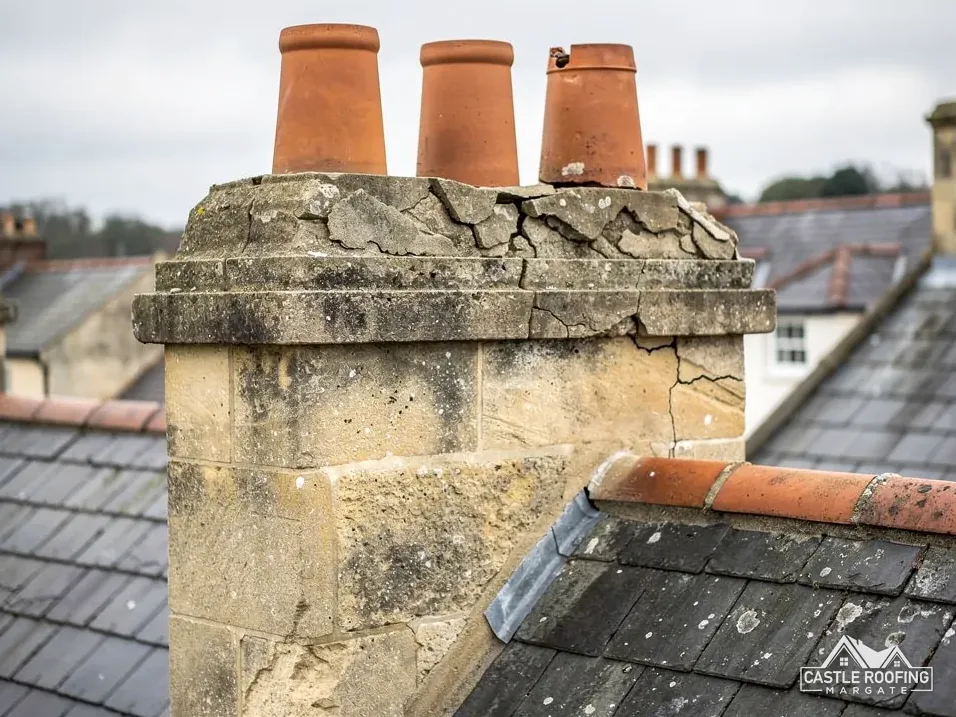
Brickwork is laid in horizontal rows, and each row is called a course. When a pitched roof runs up against a wall, as it does beside a chimney stack, along a gable or against a neighbouring house, the line where the two meet slopes upward. A straight strip of lead cannot sit in a level brick joint along a sloping line, so the flashing is cut into a stair of steps.
Each step is tucked into its own course of brickwork. The wall joint is cut out, or chased, to take the top edge of the lead. The edge is wedged in and the joint is sealed. The stepped lead then lies down over the roof covering, so rain that runs down the wall is carried over the lead and onto the tiles or slates.
The shape matters because rain does not travel along a joint, it follows gravity. A flashing that rises in steps keeps every part of the top edge above the water line of the course below it, and the water has nowhere to run behind.
This is the neat alternative to a mortar fillet, which cannot follow the movement of a wall and cracks along the joint when the wall shifts.
Soakers lie beneath the steps
Stepped lead is the cover flashing. It is not usually working alone. Under it, where a roof is covered in tiles or slates, sit soakers: little lead pieces folded into an L-shape, one leg under the tile or slate and the other leg turned up against the wall. Each soaker is interleaved with the courses of the covering, so water that gets past the edge of one tile is caught and sent out onto the next.
The two parts have different jobs. Soakers keep water out of the joint between the covering and the wall. The stepped flashing covers the top of the soakers and the wall joint, and it keeps rain from running behind them.
Together they let the roof and wall move without opening a gap. Our what are lead soakers page covers the lower layer in more detail.
Some coverings call for a slightly different detail at the wall, and the roofer decides on site which one suits. What does not change is the principle: cover flashing above, soakers below, each one lapping the next so water always runs over the top of the layer beneath it.
Where stepped flashing usually fails
A stepped flashing is a long run of small joints, and each one can fail on its own. These are the places to check on a stack or gable:
- pointing along the wall joint has cracked or fallen out, so the top edge of a step is loose;
- a step has lifted away from the brick and no longer lies flat on the covering;
- a split has opened in a step, often at a corner where the lead is folded;
- a soaker below has slipped, so the cover flashing sits on a gap and not on the tile;
- the lead is short at the head of the stack and rain is running in at the corner.
Most of these can be seen from a ladder-free angle with binoculars, as a dark line, a gap or a streak of staining on the wall below. Inside, a damp patch beside the chimney breast, or a stain on the wall of a bedroom under a gable, can be the first sign.
A loose step or a split can sometimes be repaired in sections, which is what the lead flashing repairs page explains. If soakers have slipped across a long run, lifting the covering and replacing the whole line is the surer fix.
What replacing a stepped flashing involves
The work starts with the covering. The tiles or slates beside the wall have to be lifted so the old soakers and steps can be taken out, which is why the roof is surveyed before a price is given. The wall joints are then cleaned out and, if needed, cut in fresh so the new lead has sound brickwork to sit in.
New soakers go in as the covering is put back, and the cover flashing steps are formed to the brick courses, fixed, and sealed along the top edge. The thickness of lead for each of those details is set in the specification, and it is not a number to pick from a chart. Our what code of lead is used for flashing page explains how that works.
A flashing next to a chimney is usually done with the back and front flashings of the stack at the same time, since all of them share the same corners. Doing one side only can leave the joints at each corner as the weak points.
MyJobQuote gives a typical UK range of £350 to £920 for chimney leadwork (September 2026), which covers a stack, while a long gable run is priced on its length after the survey. The lead roofing page sets out what we cover.