How a soaker is shaped and laid
A soaker is a piece of lead sheet, cut to a rectangle and folded along its length into an L. The long leg is laid flat on the roof, tucked under the tile or slate above it. The short leg stands up the face of the wall. Its job is to catch any water that gets through the joint between roof and wall and pass it out onto the covering.
Each soaker is fitted as its course of tiles or slates goes down. They overlap one another, tile by tile, up the slope, and each one is held by the covering that sits over its flat leg. The result is a continuous watertight lining with a built-in lap at every course, which a single sheet could not provide on a pitched edge.
That interleaving is what makes soakers different from other flashings. A cover flashing sits on the surface and is fixed to the wall, while a soaker is part of the roof covering itself, set in as the courses are laid. It is also why they are hard to replace one at a time, as the covering must come up around them.
Soakers are sized to suit the tile or slate in use, so their length follows the gauge and lap of the covering on that roof.
Where soakers are used
A soaker belongs wherever a tiled or slated slope runs up against something vertical. The common positions are these:
- the sides of a chimney stack that rises through a slope;
- the edge of a gable wall or party wall where the roof meets it at an angle;
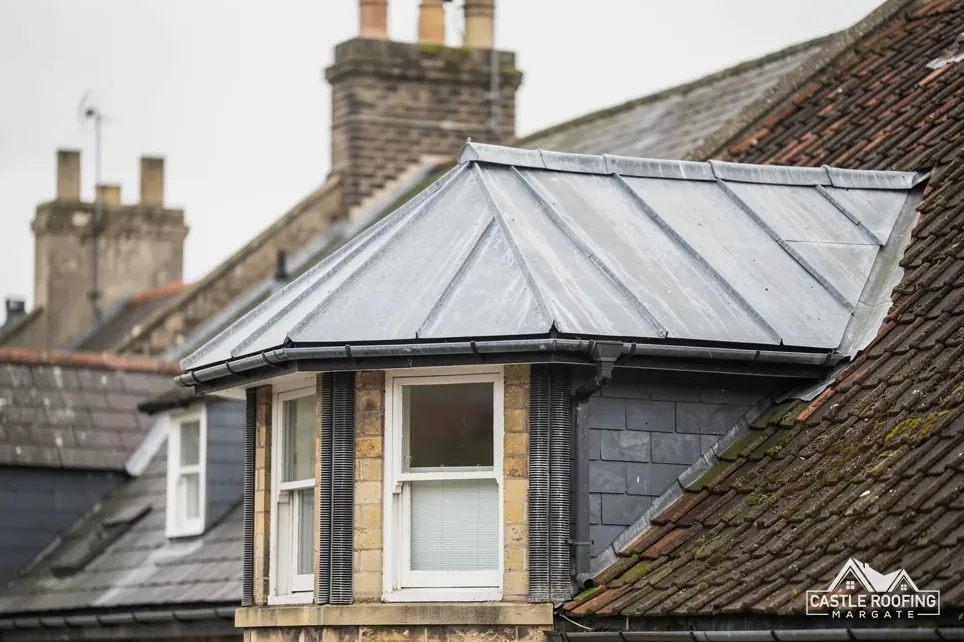
- the cheeks of a dormer, the side walls of a small projecting window;
- the sides of a roof window or rooflight set into a tiled slope.
On a plain tiled or slated roof, soakers are the standard lower layer under a stepped lead flashing. Our stepped lead flashing page shows how the pair work together.
You will not see them from the ground. What you see is the cover flashing, with soakers buried in the courses beneath. A leak at the side of a stack can be a failed cover flashing, a slipped soaker, or both, and only lifting the edge of the covering shows which.
The principle is the same everywhere: the covering overlaps each soaker, each soaker overlaps the next, and water is always passed downhill from a higher piece to a lower one, never under it.
Code 3 lead is for soakers only
Lead sheet is sold in codes, numbered by thickness. The Royston Lead brochure gives Code 3 as "Recommended for lead soakers only". That suits the way a soaker works: it is small, protected beneath a covering and bent into a tight L.
Code 3 is the thinnest in the table, at 1.32 mm, with a colour mark of green. A thin sheet suits soakers because it folds and sits flat under a tile without distorting the course above it.
It does not follow that Code 3 suits other work. The thickness for a cover flashing, a valley or a flat roof comes from the specification, so ask to see the code written against each detail. Our what code of lead is used for flashing page goes through the codes.
Lead sheet roofing follows BS 6915 through Approved Document C, and the specification is where that standard is applied to your building. Ask for that specification before work starts, so the code for every detail is fixed in writing rather than chosen on the roof.
Why a cover flashing goes over the top
A soaker on its own stops water at the covering. It does not seal the wall. The wall is brick, and rain runs down its face, finds the joint between brick and roof, and could run behind the upturned leg. A cover flashing is fixed into the wall above the soakers and laps over their short legs, so rain runs over the cover onto the soaker, then onto the tile.
If the cover flashing fails, water gets behind the soakers. If the soakers fail, water gets under the tiles even with the cover intact. The two are a pair, and a good repair addresses both.
That is also why replacing only the visible lead can be disappointing. A new stepped flashing laid over soakers that have slipped, split or corroded rests on a weak base. A roofer lifting the edge of the covering can see which layer has failed.
If you have a damp patch beside a chimney or along a gable, the lead flashing repairs page covers the repairs, and the lead roofing page shows the wider range of work.