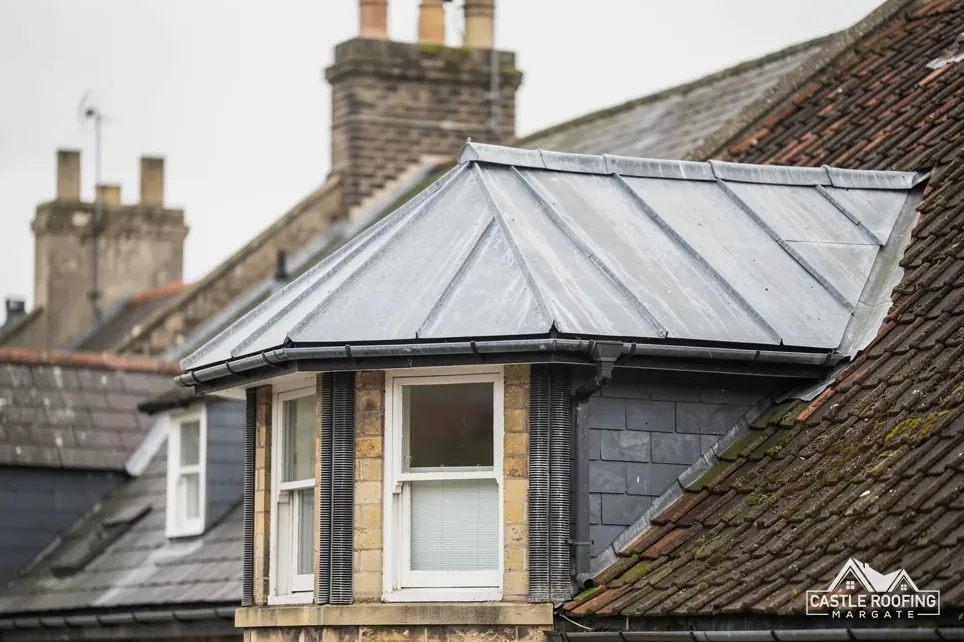
Five steps in sequence: stop the water getting in, photograph what is left, tell the police and your insurer, weigh lead against the alternatives, and check the consent route if the building is protected.
The usual discovery is a drip, or a roofer, or a neighbour who noticed a bare patch on the slope, sometimes only after the first wet night. Lead flashings, valleys and flat-roof sheets have a scrap value, and a roof that has lost them is open to the weather at exactly the points that were built to keep it out. A chimney with its flashing stripped, or a parapet gutter lined in bare boards, will let rain into the house on the next wet day.
Two things are true at once. The roof needs protecting quickly, and a theft is a matter for the police and an insurance claim, where order and paperwork count. Do the physical job and the paperwork in the right sequence and the second does not get in the way of the first. This post follows that sequence. It covers what a make-safe involves, what to record before anything is moved, what the repair choices are in neutral terms, and what changes where the building is listed or lies within a designated area. For the full picture of the work itself, see our lead roofing page.
First job: stop the water and keep the evidence
Do not climb on the roof yourself. A roof that has been stripped of lead has bare timber and open joints, and the people who took the metal may have left slates loose or the deck weakened. Begin with what the ground, the loft hatch and the upstairs windows show.
Inside the house, deal with the water before anything else. Shift furniture and anything electrical clear of the drip and catch it in a bucket lined with a folded towel. A ceiling that is sagging with trapped water is best left alone and the room closed off.
Then record what you can see, before anyone touches it:
- Photograph the bare area from the ground, wide enough to show which part of the building it is.
- Photograph any damage to slates, tiles, brickwork or the deck beside the missing lead.
- Photograph the inside: stains, wet insulation, a damp wall plate, daylight through the roof.
- Note the date and time you found it, and when you last remember seeing the lead intact.
- Leave any dropped pieces, tools or marks on the ground alone for the moment, in case the police ask to see them.
A roofer called to make safe will cover the exposed area with sheeting or boards, fix down loose slates and protect the joint. A make-safe is temporary by design. It stops more water getting in; it does not replace the lead. Ask the roofer to tell you exactly what was fixed down and what was left, so the later repair can pick up from there, and keep that note with the photographs.
Tell the police and the insurer before the repair
Theft of metal from a roof is a crime, and the police need to be told. Report it as soon as you find it and ask for a crime reference number; your insurer will want it. If the building is a church, a school or a business, the same applies, with the premises' own insurer as well.
On the insurance side, IStructE's storm-damage advice runs in three steps: the insurer hears first, the building is made secure, and photographs and receipts are kept. The same order suits a theft claim. Which? notes that most insurers have 24-hour emergency helplines, so the first call can be made the same day, however late you find the damage. Ring before you agree to the permanent repair, so the insurer can say what it will accept.
Things worth keeping, as a pack for the claim:
- The crime reference number and the date you reported the theft.
- Your photographs, with dates.
- The receipt for the make-safe, and anything you bought, such as sheeting or a dehumidifier.
- The written quote for the lasting repair, when you have it.
Cover for theft, for damage to the roof and for the water that comes in afterwards is set by your own policy and its wording. Whether a claim succeeds depends on the policy wording, and the claim itself is a matter for you and the insurer alone. A disagreement over a decision can go to the Financial Ombudsman Service on 0800 023 4567. Our short answer on lead theft and insurance claims covers the paperwork in more detail.
Lead again, or something else
Once the roof is dry and the claim has begun, the lasting repair is a choice. Replacing like with like is the simplest answer, and it keeps the roof as it was built. An alternative can make sense where theft is a worry, or where a detail suits another material. Set the options side by side before you decide.
| Option | What to compare |
|---|---|
| New lead | Matches the original detail; flashing is put at over 80 years, a lower bound |
| Zinc | The maker states 100 years in its BRE declaration |
| Copper | Ask for the make and expected life in writing |
| GRP | HomeBuilding gives 25 to 30 years, Less 25 to 40 |
The zinc figure is VMZinc's own, as the maker. HomeBuilding puts lead on a flat roof at 60 to 100 years, and MyJobQuote has lead flashing lasting over 80 years. None of these amounts to a promise, and a guarantee period says nothing about how long lead lasts.
Which is better depends on the detail, the building and your priorities, and our pages on lead alternatives for flashings go through the trade-offs, including GRP against lead in a valley. The price follows the survey as one written total, and it is worth asking each option to be quoted on the same basis, with the same scaffold and the same clear-up, so the totals can be compared fairly. Lead goes back more quickly on a small flashing than on a large flat area, which is part of why the answer differs from roof to roof, and why a survey comes before a recommendation.
Listed and conservation homes: like for like, and consent
Section 7 of the Listed Buildings Act 1990 applies to whoever carries out the work: a listed home needs consent before works that change its character. Replacing stolen lead with a different material is a change of that kind, and an unauthorised change can cause trouble later, when the house is sold or inspected. Putting lead back to the same pattern and thickness is the route most likely to match what was there, but it is the council's conservation officer who confirms what needs consent for your building, not a roofer. Our page on replacing lead on a listed roof covers the process.
A conservation area is a separate matter. Thanet District Council's conservation area page leans towards work that matches what was there, saying matching work makes it "less likely" that planning permission is needed. Note the wording: "less likely" is not a clearance, and a change of profile or colour weakens the case. Ask the council before you change the material, the colour, the profile or the shape of a detail.
Two further points belong here.
- A scheduled monument needs scheduled monument consent before works begin, so ask first. For a church, the route turns on who uses it: the faculty system while the Church of England worships there, the denomination's own procedure where Baptists, Roman Catholics, Methodists or the URC hold services, or listed building consent where Quakers or Unitarians meet, or where the Churches Conservation Trust now looks after it.
- The Margate, Margate Seafront and Cliftonville conservation areas are all on Thanet's list; Article 2(3) land removes the permitted right to add a dormer there, but it does not stop like-for-like re-roofing under Class C.
Access, scaffold and when the work can start
Replacing a lot of lead on a chimney, a parapet or a high valley usually needs scaffolding, and any scaffold standing on the public road must be licensed. Under the Highways Act the licence is issued by Kent County Council, on an application from the scaffolders rather than the owner. The fee for 2026 to 2027 is £52 per week, with 5 working days' notice, and a site inspection, if one is needed, costs £78.
That notice period shapes the timetable. A temporary sheet buys you time while the application goes through, and the permanent work cannot start on the road side until the licence is in place. If your house stands back from the road with room for a scaffold in the garden, no licence is involved, but the scaffold is still a cost the quote must cover.
The same quote should state what happens to waste, because old or damaged lead is taken away after the job. Before accepting, check that the written price:
- names the lead code or the alternative material for each detail;
- includes VAT, which is charged at 20 per cent on this kind of work;
- includes the scaffold, and says which scaffolder will apply to Kent County Council for any licence;
- sets out what has been agreed with your insurer or a conservation officer.
Kent County Council's highways team, on 03000 41 81 81, can answer questions about the licence itself.
Making a repeat theft harder
No roof is theft-proof, and a few measures only reduce the chance, but several things are within reach of a householder.
Tell your insurer what you intend to put back, before the order is placed, lead or an alternative, and ask whether the policy sets any conditions for the new roof. The wording is in your own policy, and only the insurer can say. If you choose an alternative, ask the roofer to explain how each junction is made and fixed.
Beyond the roof itself:
- Look at how someone reached it. A flat extension roof, a garage roof, a low wall, a drainpipe or a scaffold left standing can all serve as a ladder.
- Trim climbing plants from the walls under the roof.
- Keep the property lit at the back and sides, where a roof is out of view of the road.
- Ask neighbours to ring you, and the police, if they see someone on a roof at an odd hour.
- Keep a dated photograph of the finished roof, which also helps a later claim.
- Ask the roofer for a short note of what has been fitted, where, and in what material.
The theft can leave water damage inside that only shows weeks afterwards, so take another look at the ceilings and the loft after the first heavy rain, and keep photographing. If the stain grows or a patch stays damp after the roof is repaired, tell the roofer and your insurer, because the original claim may still be open.