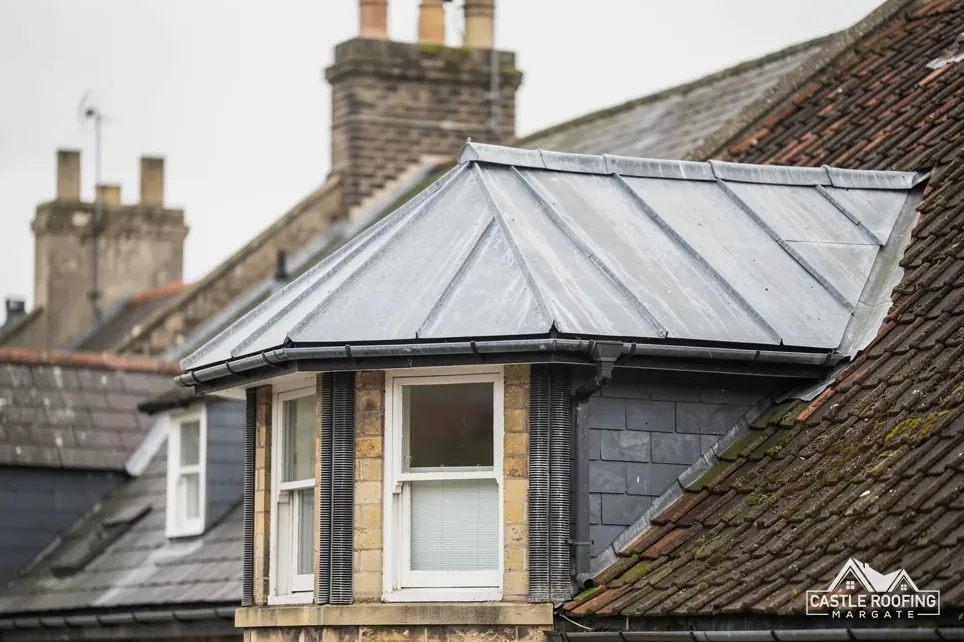
Some joints suit another material, some suit lead only, and a protected house may leave no choice at all. Here is how that decision is made, and what we check before one is suggested.
A flashing is a strip of waterproof material that closes the joint between a roof and anything that rises through or beside it, whether that is a stack, a gable wall, a dormer or a bay. For centuries the material was lead, and it is still found on period houses today. There are several reasons to weigh an alternative, and a fair answer starts by treating the alternatives on their merits.
The choices fall into four groups. Lead-free flashing is sheet or strip made of another material, such as zinc, aluminium or a bonded membrane. GRP, glass-reinforced plastic, is a moulded or laid-up fibreglass finish used for valleys and flat areas. A mortar fillet is a sloped bead of mortar between roof and wall, and is not a flashing at all. And there is lead itself, which remains the traditional choice on pitched roofs.
Which of these is right depends on the joint, the house and the rules that apply to it. This guide belongs to our lead roofing work, and it covers the statutory side as well as the practical one, because a protected building changes the answer.
The four options and what each is
Before comparing, it helps to know what is being compared. Each of these does the same job, which is to stop water getting past a joint, and each does it differently.
- Lead sheet, dressed by hand into the joint, which gives a flashing that follows the shape of whatever it is fixed to.
- Lead-free sheet or strip in zinc, aluminium or a similar metal, or a bonded membrane that is stuck down. Each needs its own detail and its own fixings.
- GRP, a fibreglass layer laid on a timber base, used as a valley or an upstand rather than as a flashing sewn into brickwork.
- A mortar fillet, a sloping band of cement-based mortar between the roof covering and the wall.
None of them is a lesser or greater option in the abstract. Lead is workable, which means it can be shaped into awkward angles on site, and it has a long record. Other materials bring their own strengths and their own limits, and each suits some joints better than others. The first job of a surveyor is to look at the joint before any material is named, and to find out why it is failing if it is. A flashing that fails because it was fixed badly will fail again in any metal.
A fair comparison is only possible joint by joint, never for a roof as a whole. A valley at the back of a house, a step flashing against a party wall and a lead apron at a chimney are three different situations, and a material that works in one need not work in the others.
Comparing them joint by joint
The table sets out where each option is usually considered and what to watch for. It describes how the options behave in general terms, and the right choice for a particular house is decided at the survey.
| Option | Where it is considered | Watch for |
|---|---|---|
| Lead sheet | Chimneys, walls, dormers, bays | Right code and fixing |
| Lead-free sheet | Walls and abutments | Its own detail |
| GRP | Valleys, flat upstands | Movement at edges |
| Mortar fillet | Gable and party walls | Cracks as parts move |
The "watch for" column is where the real choice lies. A mortar fillet is simple to make and quick to fit, but a roof and a wall move by different amounts through the year, and the joint between them can open as a crack. Our page comparing lead and a mortar fillet looks at that trade-off.
GRP is a different animal. It is laid in place as a continuous skin and set in a resin, so it has no seams to open, but it needs the right substrate under it and a clean edge where it meets the slates. We compare it against lead for valleys in a separate page on GRP and lead valleys.
Where a roof meets a wall and the wall is rendered, a different problem arises, because the render has to be cut back for the flashing to be tucked in properly. That detail is worth raising at the survey, since it affects how any material is fixed.
Life spans, and why they are hard to compare
A single number per material would make one easy to set against another. The published figures exist, but they describe different things, and they are typical ranges and never promises.
- Lead: MyJobQuote's figure for lead flashing is over 80 years, which is a lower bound.
- Zinc: VMZinc, which makes it, says the BRE Environmental Product Declaration states 100 years. A maker's figure, for its own product.
- GRP: HomeBuilding gives 25 to 30 years, and the Less cost guide gives 25 to 40 years. Both are for GRP as a flat roof covering.
So the three lists do not line up. The lead figure is for flashing, the zinc figure is for sheet covering and the GRP figures are for whole roof coverings. A GRP upstand or valley is a smaller detail than a whole roof covering. Comparing 25 to 40 years with 80 or 100 years is comparing a roof surface with a flashing detail.
What the figures do tell you is that lead is a long-lived material when it is fitted well, and that a long life depends on the fixing, the code, the substrate and the movement at the joint just as much as on the metal. A poorly fixed length of any material will fail early, and a well-fixed one will last. The lifespan of the detail is the thing to ask about, since the lifespan of the material on its own settles little.
Listed buildings: like for like
On a listed house the starting point is different. Section 7 of the Planning (Listed Buildings and Conservation Areas) Act 1990 requires listed building consent before alterations that would affect a listed building's character as a place of special interest. Canterbury City Council puts it simply for its own addresses: consent is needed for any change that affects the building's character. A flashing is part of how a roof looks and ages, and the material it is made from can be part of that character.
Like for like is the usual way through. It means the same material, in the same form, in the same place, so the building looks and performs as it did before. Replacing a lead flashing with new lead of the right code, dressed in the same way, is like for like. Replacing it with a different metal or with GRP is a change, and whether it needs consent is a question to put to the council's conservation officer before anything is ordered.
A few points follow:
- Ask the council before changing the material of any visible flashing on a listed house.
- Ask at the same time how the scaffold will be fixed to a listed wall, so there is one conversation and not two.
- Keep the old lead until the council has said what it wants, because it shows what was there.
Our page on leadwork on listed buildings goes further into the consent routes. Where a church or another denominational building is involved, the route is different again, and it is not the owner's choice to make.
Where a conservation area changes the answer
A conservation area works differently from a listing. Planning law has its own test in section 55(2)(a) of the 1990 Town and Country Planning Act: works that leave the building's outward look materially unchanged do not count as development. For a flashing, that means a repair in the same material usually raises no planning question. A change of material on a visible flashing is where the question can arise, and the council decides whether it does.
Thanet District Council's conservation area page frames it as a likelihood: like-for-like work stands a lower chance of needing a planning application. Note the words "less likely". They are not "never", and they are Thanet's own wording for Thanet's addresses, not a rule for every council.
Then there are Article 4 directions, the means by which a council removes particular permitted development rights from a set area. What a direction covers varies by council:
- Swale Borough Council's Article 4 direction in the Faversham conservation area covers roof coverings, doors and windows renewed on the main faces of a house that look onto a public road.
- Dover District Council says its Article 4 directions can take in roof alterations to a home, for any face of a house that overlooks the street, a waterway or open public land.
- Thanet District Council applies Article 4 directions within three conservation areas, namely Ramsgate, the Ramsgate Marina extension and Pegwell, and it confirms the classes for an address.
For every other address, ask your council whether an Article 4 direction applies before choosing a material. A council cannot be assumed to have none.
What we check before suggesting an alternative
On every survey of a joint where lead has failed, the question is not whether another material exists. It is whether another material suits this joint on this house. These are the checks, in the order they are made.
- Listed status, conservation area status, and whether an Article 4 direction covers the address.
- Why the existing flashing failed. A split from movement, a nail that has rusted, a fixing that never held and a flashing that was too thin are different causes, and a new material does not cure the first.
- The detail itself: a chimney apron, a step flashing, a valley, a bay or a parapet. Each has its own geometry.
- The condition of what lies underneath, which is the boards, the brickwork and the mortar the new material would be fixed to.
- The maker's instructions for the alternative. A lead-free product comes with a fixing method that has to be followed.
Lead for roof work follows BS 6915, which Approved Document C points to for lead sheet roofs, and the Royston Lead table puts Code 3 at 1.32 mm and says it is recommended for soakers only. Beyond soakers, the specification sets the code detail by detail. Where we do suggest a different material, the reason is written into the specification, so it can be read back.
Where a repair with like-for-like lead is the honest answer, that is the advice, however keen the owner may be on something else. You then receive one written price for the one material that suits the joint.