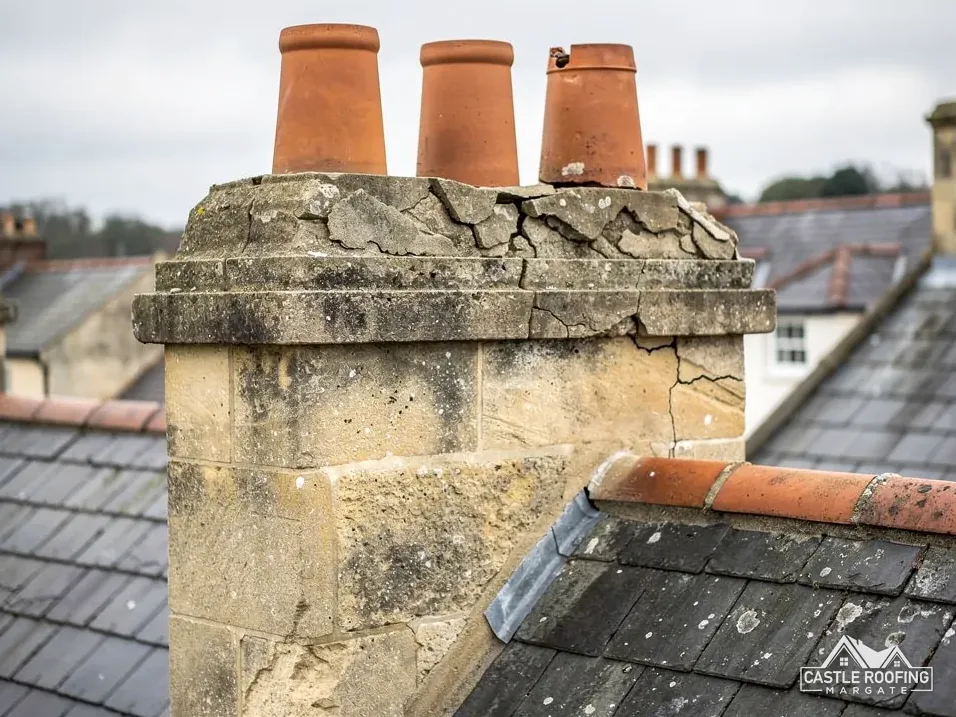
Why a mortar fillet cracks at the wall
A mortar fillet is a wedge of mortar pressed into the angle where a roof slope meets a wall, such as beside a chimney stack or against a gable. It looks neat when it is new, and it does seal the joint for a time. The trouble is that the two surfaces it joins do not behave alike.
Brickwork and roof timbers expand and contract with temperature and moisture, and they settle at different rates. Mortar is hard and has almost no give, so the movement shows up as a thin crack where the fillet meets the brick. Once that crack opens, rain runs behind the fillet instead of off it, and the water reaches the timbers or the wall below.
Frost makes it worse. Water held in a hairline crack freezes, widens the gap and loosens the fillet from its edge. A fillet that has come away from the brick can sound hollow when tapped, and pieces can drop into the gutter.
That is why a cracked fillet is rarely a one-visit patch. Raking out and refilling gives the same rigid joint, and it tends to part along the same line the next time the wall moves.
What a lead flashing does differently
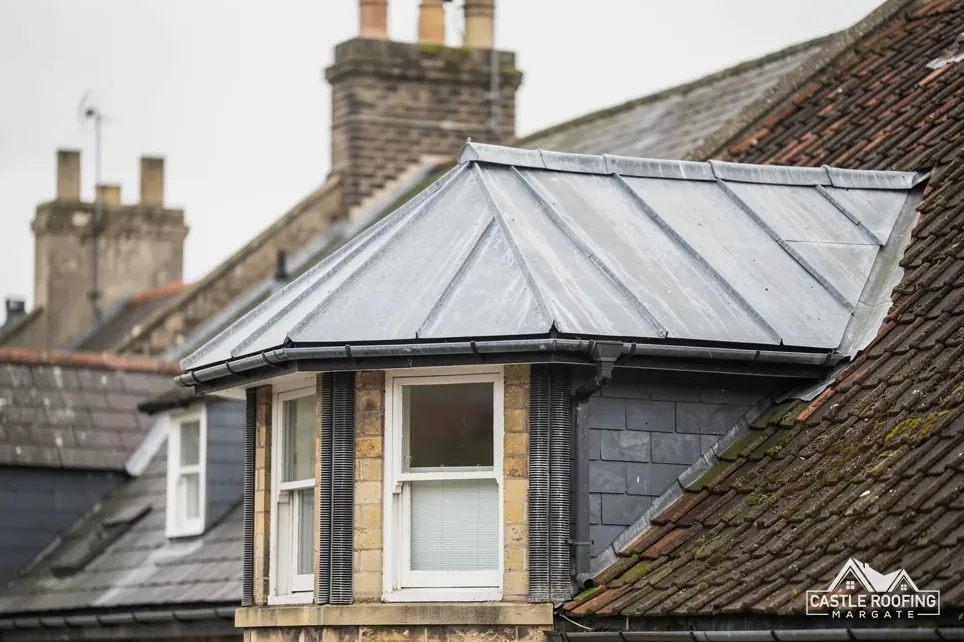
Lead flashing is a strip of lead sheet. One edge is tucked into a joint cut into the brickwork and held there, and the other edge lies over the roof covering. Because the metal is soft, it can stretch and settle as the roof and wall shift, and it does not snap along a line the way mortar does.
Lead also sheds water outward. Rain runs off the strip and onto the tiles or slates, away from the joint. Where the abutment climbs a sloping edge, the lead is cut into steps, which our stepped lead flashing page describes.
On life, MyJobQuote's leadwork page puts a lead flashing at over 80 years. That is a lower bound for a well-fitted strip, not a promise for any one roof. The thickness of sheet, called the lead code, is written into the specification detail by detail, and lead sheet work follows BS 6915 through Approved Document C.
Lead is not immune to damage. A split, or an edge that has lifted, lets rain in just the same, and the cracked lead flashing page covers what to do about one.
The two joints side by side
The differences are easier to see in a table.
| Point | Mortar fillet | Lead flashing |
|---|---|---|
| Movement | Rigid, so it cracks at the edge | Flexes with the joint |
| Water path | Rain can run behind a crack | Rain runs over the lead onto the covering |
| Frost | Gaps widen and the fillet loosens | No hard line to open up |
| Repair | Refilling repeats the same joint | Replace the failed strip or run |
| Look | Grey mortar line | Metal strip, weathering to a grey surface |
On cost, MyJobQuote gives a typical UK range of £350 to £920 for chimney leadwork (September 2026). Where one stack lands in that range turns on its size and how many faces need flashing, so the written figure comes after the survey.
Neither joint is perfect. A well-pointed fillet on a sheltered, sound wall can hold for a good while, and lead that is fixed badly, or left with a lifted edge, fails too. The comparison is about the moment the wall and roof move against each other, and that is where mortar has nothing to give.
Matching what a listed house already has
On an older house the question is often what is on the wall now, not what is best in the abstract. Some older abutments were finished with a fillet, and on a listed house the choice of material can change how the building looks from the road.
Works that affect a listed building's character need listed building consent under section 7 of the Planning (Listed Buildings and Conservation Areas) Act 1990. Swapping a fillet for lead, or lead for a fillet, alters the joint's look and behaviour, so it is worth asking the council before anything is ordered. Our page on replacing lead on a listed roof explains the consent route.
On an unlisted house we look at the stack or wall first and check how far the old fillet has failed. Where the brickwork is sound and the fillet has cracked in one place, a short run of lead may be all the joint needs. Where it has gone hollow along its whole length, lead right along the abutment is the sounder repair. The full range of work is on the lead roofing page.