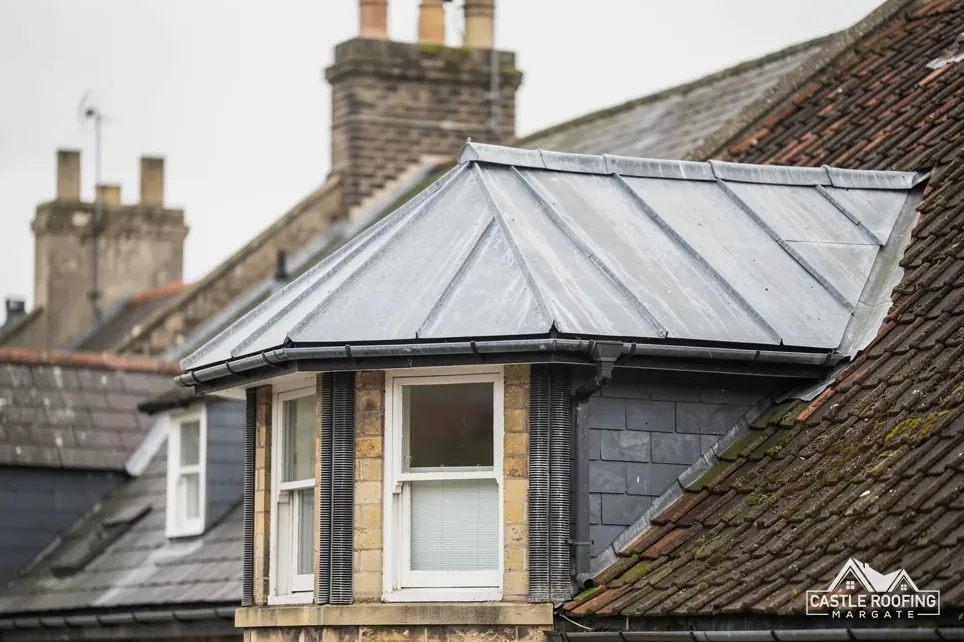
Stains beneath the valley line
Where two slopes meet at an inward corner, that corner is the valley. A lead valley lines it with a channel of sheet metal, and the tiles or slates are cut back along both sides. Every drop of rain on both slopes runs down it, so a fault there gets more water than almost any other part of the roof.
The signs show up below. Stand where the ceiling meets the wall under the valley and look for a brown or yellow ring, a patch that stays damp for days after rain, or paint that bubbles and flakes. In the loft, the timbers and underlay beneath the valley are the next place to check, with a torch and from the hatch, without stepping off the joists.
The mark seldom sits directly below the hole. Water can run along a rafter before it drops, so the mark may sit some way downhill of the hole. That is why it is worth tracing the line of the valley from inside as well as from the garden.
A mark that shows up only after rain points to a valley, a flashing or a gutter. A mark that appears in dry weather points to condensation or a pipe, which is a different search.
Debris and moss in the channel
A valley that looks fine from the ground can still be failing because of what is sitting in it. Leaves, moss, silt and roof-tile grit collect in the channel and form a dam. Rain that cannot run down the channel rises, spills over the edge of the lead and soaks into the tiles or slates beside it.
You can often check from the ground, with binoculars, without going near the roof. Look for:
- green growth or dark staining along the line of the valley;
- leaves or twigs caught where the valley meets the gutter;
- water overflowing the gutter at one point during a heavy shower;
- tiles beside the valley that look wet long after the rest of the roof has dried.
Clearing the channel can stop an overflow, but it only treats the symptom if the lead has already worn through. Debris can also hold moisture against the metal for long periods and speed up wear. Never climb onto a wet or mossy roof to clear it yourself, and do not push a ladder against the valley. Send us the photos instead, and we will see what is in there.
Splits, short laps and worn lead
If the channel is clear and water still gets in, the lead itself is the next suspect. Two faults are worth looking for, though neither can be proved from the ground.
The first is a split. Lead is soft, but a long sheet that has been fixed too tightly can crack at a fold or along a line of stress after years of heating and cooling. A split may be a hairline, and rain finds it just as easily as a large tear.
The second is a short lap. A lap is the overlap between one length of lead and the next, and in a valley it must be long enough to stop rain being driven under it. A lap that was short from the start, or one that has crept open, lets water through under heavy rain only. That makes it hard to trace.
Wear is a third cause. Lead thins slowly where water runs, and the edges next to the tiles can wear through as well. Older valleys also fail where the tiles beside them have slipped. The lead valley replacement page describes how a worn valley is stripped and re-laid.
What to do next and what it costs
Start by taking dated photos of the stain inside, the line of the valley from the ground and the gutter below it. Put a bowl under any drip and note which rain brings the leak on. That record helps a roofer find the fault quickly, and it is useful if you later talk to your insurer.
Then ask for a valley inspection rather than a quote over the phone. A split or a short lap can only be confirmed up close, and the answer decides whether a section of lead can be patched or the whole valley needs replacing. Our page on can lead be repaired sets out when a patch is enough.
On cost, MyJobQuote puts a typical UK cost for replacing a roof valley at around £540 (September 2026). Your own valley's price turns on its length, the tiles that must be lifted and the access needed, so it follows the survey. If you are weighing lead against a plastic alternative, the GRP valley or lead valley comparison may help.
See the lead roofing page for the wider picture.