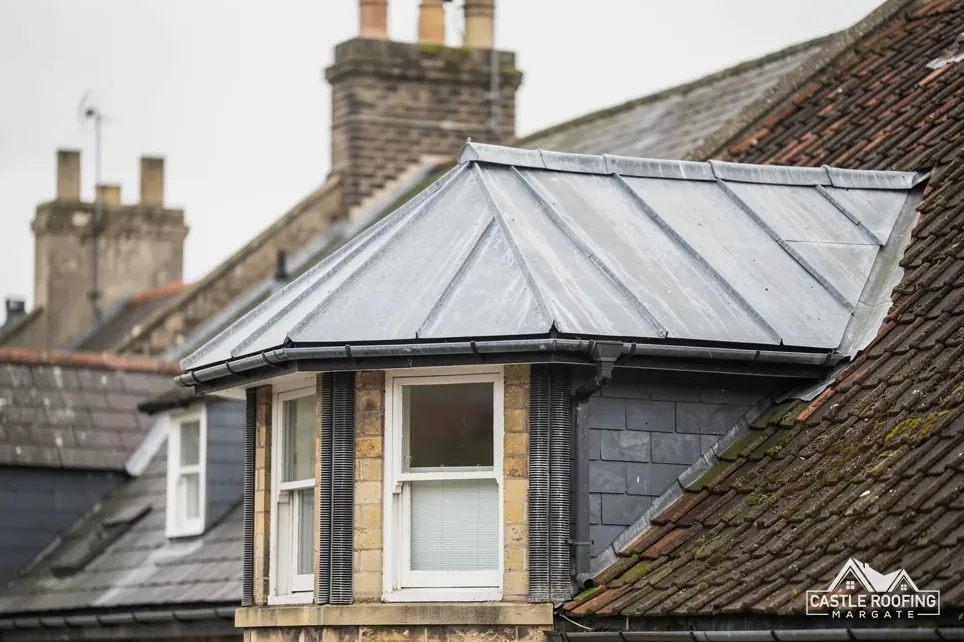
Learn how to recognise a failed lead valley from the ground and from inside the loft, what a replacement involves step by step, why laps and falls matter, and a typical UK figure from MyJobQuote that gives a sense of cost.
Where two roof slopes meet at an internal angle, the line between them is a valley, and everything that falls on both slopes ends up flowing down it. A lead valley lines that angle with sheet metal shaped as a gutter, while the tiles or slates are trimmed to follow its edges. The channel is narrow and the flow through it is heavy, which puts it under more strain than the open slopes either side.
The trouble is that a valley hides itself. The slopes overlap its edges, and from the street you may only see a thin grey line. A failing valley can therefore leak for a long time before it is noticed, soaking the timbers beneath and staining a ceiling that sits well away from the line itself. Replacing a lead valley on a pitched roof is the answer when the lead has split, worn thin or been repaired too often to be reliable.
This guide sets out the signs that a valley has failed, how the replacement is carried out, what the laps and the falls do, and why the specification, not a rule of thumb, sets the lead thickness. It gives MyJobQuote's typical figure with its date, then explains how a written price is formed.
Signs that a valley has failed
A valley leak can be quiet. Some of these signs show from the ground and some only from inside.
- Brown or yellow stains on a ceiling or at the top of a wall, in line with where the two slopes meet on the roof above.
- Damp or dripping in the loft, along the rafters or boards beneath the valley line.
- Slates or tiles along the valley edge that have slipped or broken, leaving a gap beside the lead.
- Moss, leaves or debris packed in the valley channel, holding water against the lead.
- Visible splits, holes or thin patches in the lead, often near the bottom of the valley where the most water arrives.
It helps to know what is not a fault. Lead weathers to a dull grey, and a dark channel with a mat of dirt may simply need clearing. White powdery marks on the surface are a surface effect, covered in the guide to white staining on lead.
When a leak is found, resist the urge to trace it only to the stain. A leak can run along a rafter and fall from a spot well away from its entry point, so the entry point may be higher up the roof than the mark suggests. A survey with photographs of the valley, the loft timbers and the ceiling lets the roofer follow the water to its source and decide whether the lead can be repaired or must be replaced.
Why a valley wears out
Understanding the causes makes the choice between repair and replacement clearer. Valleys fail for reasons you can name.
Volume, movement and blockage
Water volume is the first. A valley collects the run-off from the whole of two slopes and passes it through a single channel, so it takes a heavy load in every shower, and the load grows with the area of roof draining into it. Thermal movement is the second. Lead expands in warm weather and contracts in cold, and over many years the repeated movement can fatigue the metal at its folds and edges.
The third cause is blockage. When leaves, moss or a fallen slate fill the valley, water backs up and runs sideways under the tiles or slates. A lead valley that is kept clear lasts, and one that is allowed to silt up fails early.
Earlier repairs and exposure
The fourth is earlier repair. Sealant smeared along a split, felt strips pushed under the edge or patches of different metals leave a valley that looks mended but is weaker than it was. After several such repairs a section of new lead is better than another patch.
Exposure plays a part too. The Met Office records for Manston (1991 to 2020) show about 613 mm of rain a year and 110.05 days with 1 mm or more. Those are averages, but a valley sees all of that rain, concentrated into one line.
How a lead valley is replaced
Replacing a valley means opening the roof along its length. The tiles or slates on both sides are lifted back, so the work is bigger than the strip of lead suggests.
- The covering is stripped back along each side of the valley, far enough to expose the full width of the old lead and the boards under it.
- The old lead is lifted out and the boards or valley boards are inspected. Wet or rotten timber is cut out and renewed before anything else is laid.
- A new underlay or separating layer is laid, and the valley boards are checked for a smooth, even fall from top to bottom.
- The new lead is laid from the bottom of the valley upwards, in lengths that overlap, with the upper length lapped over the lower so water always runs from one onto the next.
- The edges are dressed up under the tiles or slates, which are cut and re-laid beside the lead.
- The valley is cleared and the lead is checked for kinks, nail holes and tight folds.
Working from the bottom up is what makes the laps shed water. If the order is reversed, the laps face the wrong way and rain gets into the joint. Each length also needs room to move, so the lead is held at its upper edge and left free along its sides, the same principle used for lead on any roof.
New slates or tiles are needed only where the old ones cannot be re-used. Pieces that crack on lifting have to be replaced, and a survey can estimate how many that may be. Your written price is one total after that survey.
Laps, falls and the specification
Three words on a lead specification decide how well a valley works: lap, fall and code.
A lap is the overlap where one length of lead meets the next. Its length must be enough to stop water being driven or drawn under it. How long is enough is not a fixed figure on every roof, because it depends on the pitch of the slopes and on how exposed the site is. The specification gives the length for your roof.
The fall is the slope of the valley floor. The valley follows the slope of the rafters, and on a steep roof the water leaves quickly. On a shallower roof, the valley carries water more slowly, so laps and edge upstands need more care.
The code is the thickness of the lead. Lead sheet is made in codes from 3 to 8, and the Royston Lead brochure lists their thickness and weight. Code 3 is described there as for soakers only, so it is not the code for a valley gutter. Beyond that, the brochure lists valleys among the uses of sheet lead without pairing a code to each, so the code for your valley is set in the specification.
| Code | Millimetres | Kilograms per m² |
|---|---|---|
| 4 | 1.80 | 20.41 |
| 5 | 2.24 | 25.40 |
| 6 | 2.65 | 30.05 |
A heavier code is thicker and stiffer, and it costs more because it weighs more. Neither fact, though, tells you which one the valley needs. That comes from the specification, which looks at the length of the run, the pitch and the exposure together.
What a valley replacement costs
MyJobQuote, on a page updated on 7 September 2026, gives the cost of replacing a roof valley as around £540. It is a typical UK figure and a rough marker for the work, not a quote for any particular roof. The real price for a Kent roof depends on the length of the valley, its height above ground and how many tiles or slates need replacing.
| Source | Work | Figure |
|---|---|---|
| MyJobQuote, 7 September 2026 | Replacing a roof valley | Around £540 |
What moves the price up or down:
- the length of the valley and the number of valleys on the roof;
- whether the boards underneath are sound or need renewing;
- how many slates or tiles break when lifted and must be replaced;
- the access needed, since a valley two storeys up may need a scaffold.
If scaffold poles reach the pavement, the licence comes from Kent County Council on an application by the scaffolding firm, at £52 per week for 2026 to 2027.
You receive one written total after the survey. When you set it beside another quote, ask whether the replacement includes making good the roof either side, because a quote for lead alone leaves the edges to somebody else. Ask also whether it covers any boards that turn out to be rotten, so the total is not reopened halfway through the job.
Lead is also heavy to carry up and to cut on the roof, so the length of the valley and its pitch both change the hours involved.
Repair, replace or choose another material
A split in one place with sound lead around it can sometimes be repaired with a patch of new lead or by replacing one length. That is a sensible route when the valley is otherwise in good order and the cause of the split is clear.
When to replace
Replacement is the better answer when the lead has thinned along its length, when there are splits in several places, or when the valley has been patched more than once. A valley is a hard place to repair twice, because each repair makes the next one harder. The old patches have to be cut out, and the neighbouring lead can be damaged in doing so.
Another material is possible. A glass-reinforced plastic valley is one alternative, and it has its own strengths and its own weak points, as the guide on GRP valleys against lead valleys explains. Lead remains the traditional choice, and the right one where the character of the roof matters.
If water is already coming in, the guide on a leaking lead valley covers the immediate steps. The wider range of lead work, from flashings to flat roofs, is on the lead roofing page.
Consent on older houses
On a listed house, changes that affect its character need listed building consent, and the council will say whether a like-for-like valley counts. On a house in a conservation area, ask the council whether anything beyond a straightforward repair needs approval. Settle both before the scaffold goes up, not after.