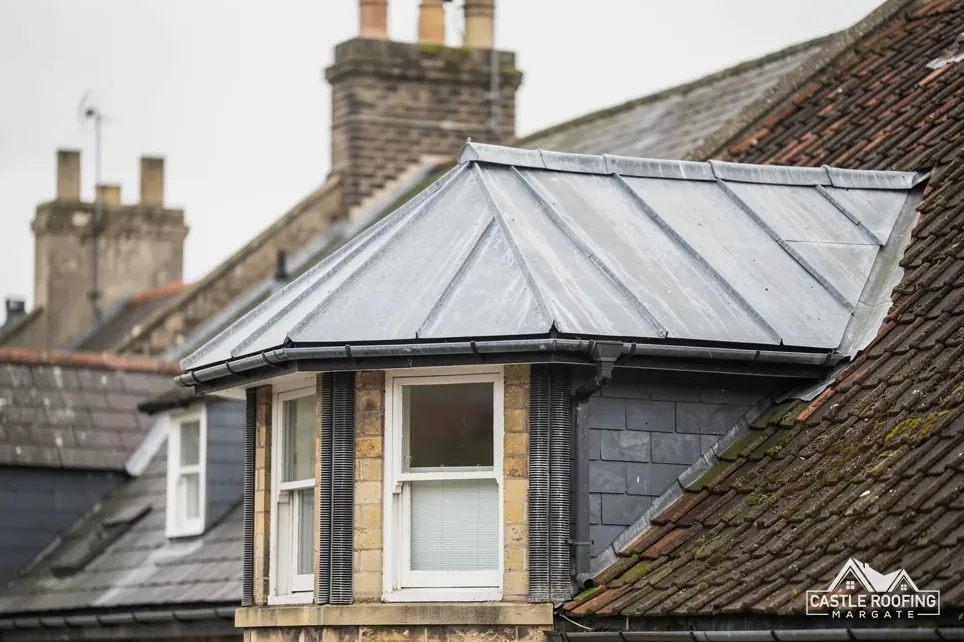
Lead itself keeps working in the cold
Lead is one of the softest roofing metals. It is dressed, meaning shaped by hand into the angle of a wall and a slope, with a wooden dresser and a mallet, and it holds its new shape once it is placed. A cold morning does not make the sheet unworkable in the way a cold day can stop other trades.
The reason winter leadwork sometimes stops is the surface it is going onto. A flashing sits against brick, tiles and timber, and each of those can be iced over, soaked or frozen when the lead arrives. Metal laid onto a wet bed cannot be checked properly, and it cannot be fixed into a joint that is still frozen.
So the decision on a cold day is made roof by roof. A dry, frost-free morning on a sheltered side can be a perfectly good working day. A wind-driven sleet shower on an exposed gable is not, whatever the thermometer says.
Where a flashing is only being repaired, a short section can often be replaced in a gap between showers. A full run along a stack, with a new chase cut into the brick, needs a longer dry spell and more care.
What the cold changes on the roof
Four things matter more than the temperature of the lead.
- Ice or frost on the tiles, which makes the slope unsafe to work on and hides the edges the lead has to lap.
- Wet or frozen joints in the brickwork, where the top edge of the lead is fixed and sealed.
- Sealants and pointing, which cure more slowly in cold and wet conditions and can fail if rain reaches them before they set.
- Wind, which makes a loose sheet awkward to handle and is a risk on a scaffold.
A roofer working in these conditions has to judge each one on the day. The point is not to push on because a date was agreed. A flashing laid onto a damp joint, or sealed just before a shower, can look fine on the day and fail by spring, when it is harder to trace back.
That is also why we ask for photos of the area before a visit. A picture of the stack, the wall and the slope shows what is exposed and what the likely working window is.
Making safe first when water is coming in
If a lead flashing has failed and rain is getting into the house, the order of work is different. The first job is to stop the water, not to finish the permanent repair in poor weather.
Making safe usually means a temporary cover over the failed area, fixed so that wind cannot lift it, with the opening protected until conditions allow proper work. It buys time. The permanent flashing follows when the surfaces are dry enough to take it.
Inside, the same rules apply as for any leak. Move belongings from under the stain, put a container beneath any drip, and photograph the damage with the date. If a storm caused the damage, let your insurer know before the permanent repair is booked, and hold on to the photos and the receipts for the make-safe. Check your policy's own storm wording as well; the Financial Ombudsman notes that some insurers set their own point on the Beaufort Scale.
For the permanent side, the lead flashing repairs page explains what a repair involves, and can lead be repaired covers when a patch is enough.
Frost days at Manston and planning a winter job
The Met Office climate station at Manston averaged 21.43 days of air frost a year over 1991 to 2020. That is an average across those years, and a mild winter and a hard one both sit inside it. Which of those days fall in a given month, or on the day your leadwork is booked, is not something an average can say.
What the figure does tell you is that freezing mornings are a regular part of the roofing year here, so a winter booking should always allow for a postponed day. A good plan has three parts:
- Book the survey early, so the lead can be ordered and cut while the weather settles.
- Agree that the date can move if the slope is icy or the joints are wet.
- Keep the make-safe cover on until the flashing is finished.
Moving a day for the right reason is better than finishing on schedule in poor conditions, because a flashing laid onto a frozen joint is the one that has to be done twice. The lead roofing page sets out the whole range of leadwork we cover.