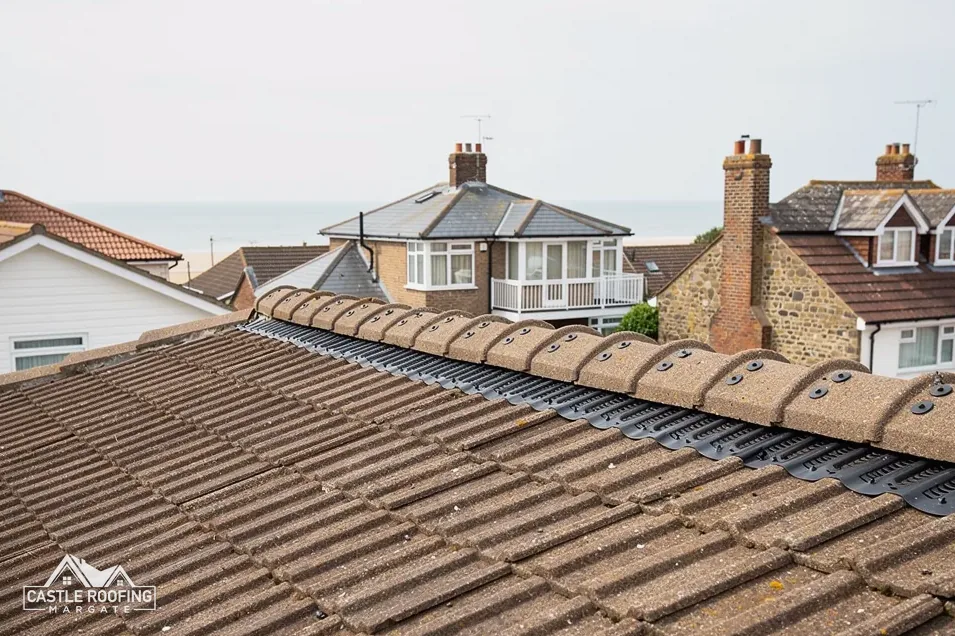
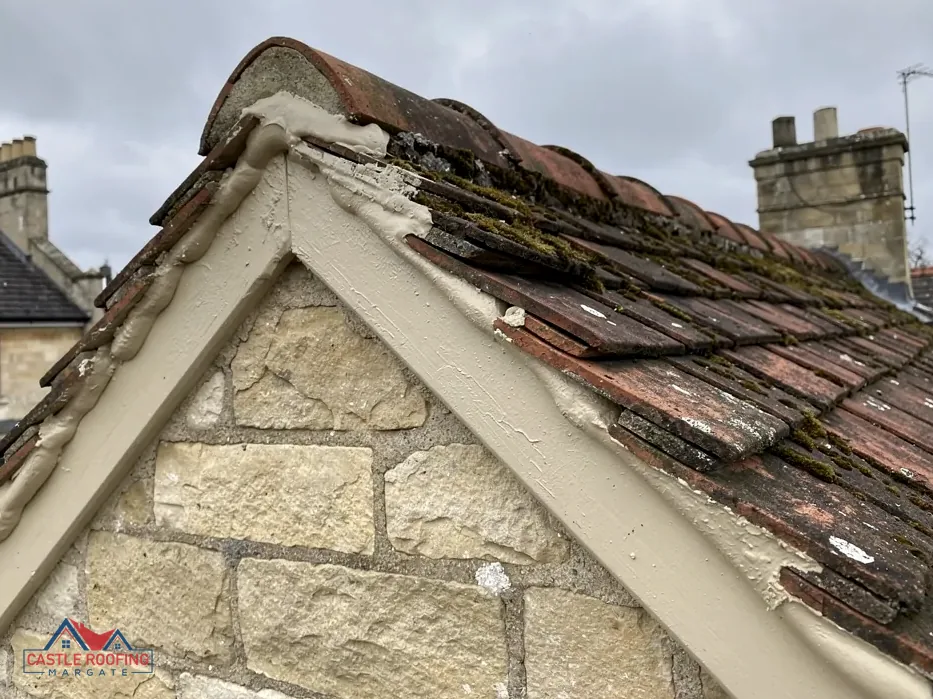
The cap that closes the join at the peak
Every pitched roof has a ridge, the horizontal line at the peak where the two slopes meet. The tiles on each slope run up to it and stop, which leaves a narrow gap along the whole length. Ridge tiles close that gap. They are wider than the gap, curved or angled, and they sit over it like a lid.
The tile does three jobs. It sheds rain from both slopes onto the roof below, it keeps wind and driving rain out of the loft, and it finishes the roofline with a clean, even edge that the eye picks out from the street.
Ridge tiles come in shapes to suit the roof. A half-round ridge has a smooth curve, an angled ridge has two flat faces and a crisp apex, and some profiles are made to match a particular tile range. Our page on half-round and angled ridge tiles compares them.
Hips, the sloping external angles where slopes meet, are capped with similar tiles, so the ridge and hip share a language and often a profile.
Bedded or dry-fixed: how they stay on
Traditionally a ridge tile is bedded in mortar along the apex, with the mortar both holding the tile and sealing the gap. That works well while the mortar stays sound, but a mortar line cracks as the roof shifts and the frost bites.
Standards now ask for more. BS 5534:2014+A2:2018 is the slating and tiling code, and Marley notes that it is not a legal requirement to install to BS 5534, though it is the code roofers work to. The 2015 amendments ruled out mortar as a stand-alone fixing, so a bedded ridge is usually fixed mechanically as well. The mortar then seals the line and the fixing holds the tile, which gives the ridge the best of both.
| Method | Held by | Standard |
|---|---|---|
| Bedded | Mortar plus a mechanical fixing | BS 5534 |
| Dry-fixed | Clips, brackets and screws | BS 8612:2018 |
BS 8612:2018 sets out the dry route for ridges, hips and verges. Our what is a dry ridge page explains how those systems are put together.
Faults to look for from the ground
You can read a ridge from the garden, with a phone zoom or binoculars. The signs of a ridge that needs attention are plain:
- Cracks, gaps or missing mortar along the joints.
- A tile that sits out of line with its neighbours or looks tilted.
- A missing tile or end cap, showing a dark gap.
- Moss and staining below the ridge, which can mean water is getting past.
- A visible dip in the ridge line, which points to a problem with the timbers beneath.
None of these is an emergency on its own, but all of them let water in over time. The mortar is the usual weak point because it ages faster than the tiles do. Our page on cracked ridge mortar goes through what each crack means.
Do not go on the roof to look. The ridge is the topmost line of the building, and a fall from there can be serious. A roofer can inspect it with proper access and photograph what they find, so that you see the same thing they do. A dip in the line is worth mentioning early, because it can mean the timber under the ridge has moved. The ends matter too, since an end cap that has slipped leaves the open end of the ridge exposed to rain.
Repair, re-bed or dry-fix
The choice depends on the state of the ridge. A few cracked joints may only need repointing. A ridge with hollow, crumbling mortar along its length needs the tiles lifted and re-bedded, or replaced with a dry-fixed system. A single missing tile is a patch repair with a proper fixing.
On cost, Which? Trusted Traders (November 2025) price a new ridge tile at £80 to £300 ex VAT, a typical UK range, and expect London and South East quotes to run higher. MyJobQuote (October 2026) puts a ridge replacement between £225 and £550. These are national ranges, and the length of ridge and the access shape any real price.
A roofer should explain why they suggest one route over another, not just the quickest. Ask what the ridge is fixed to, what happens at the ends and hips, and whether the tile profile can be matched if replacements are needed. Photographs taken before and after the work show what was done. For the full set of ridge and verge work, see our dry ridge and verge hub.