Read this if you own or manage a parade or high street building. It covers where shop roofs fail, why the flats above change the rules, and how repairs are run without closing the shop below.
A shop with flats above it has two kinds of roof problem at once. The shop has a flat roof at the back, over the stockroom or the old yard, and the main building has its own roof over the flats. A leak at either one can reach the shop ceiling, the stock and the tenants upstairs, and the people affected rarely share the same lease or the same landlord.
That mix is what makes shop roof repairs different from a house repair. Access is from a busy pavement. The flat roof is often boxed in by neighbouring walls, parapets and a rear service lane. The flats above are covered by different planning and Building Regulations rules from a house. And the shop wants to keep selling while the work goes on.
This guide looks at flat roofs over shops in general terms, then at the rules that follow from having flats in the building, and finally at the practical side of working above a trading unit. The same questions come up on a parade in Margate, Ramsgate, Whitstable or Deal. It sits within our commercial roofing work, and a written price follows the survey.
Flat roofs over shops, in general terms
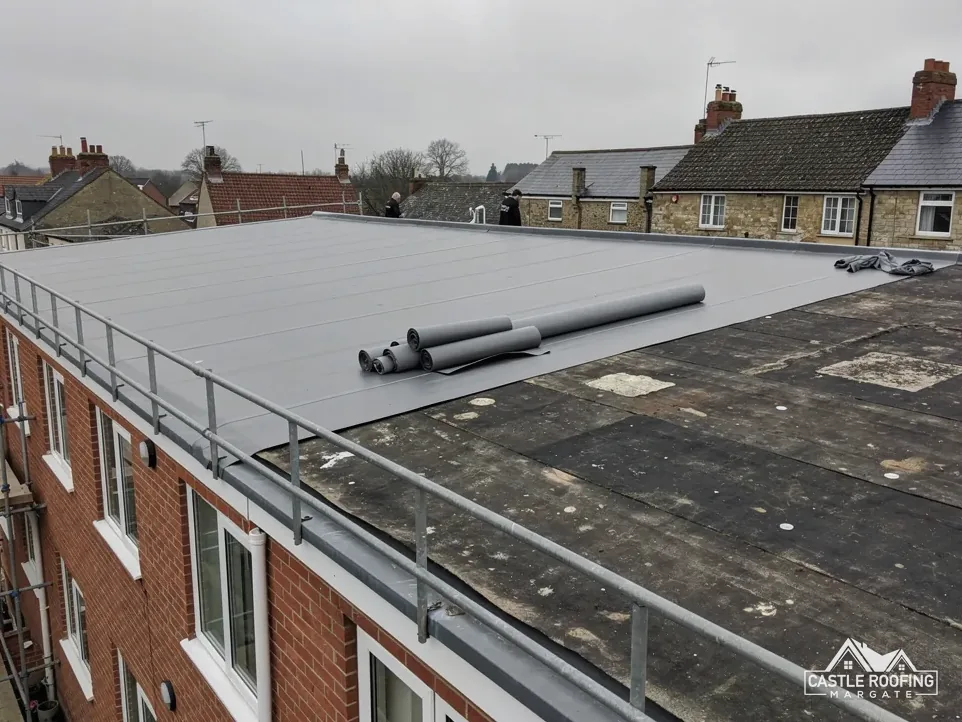
The flat roof behind a shop may be covered with a continuous waterproof layer: mineral felt, a liquid-applied coating, a single-ply sheet or asphalt. Each is laid over a deck of boards or concrete, and each depends on the water running off it, because a roof that holds water ages faster than one that drains.
BS 6229:2025 is the current standard for membrane flat roofs, and it leaves lead sheet out. Its minimum finished fall, 1:80, applies to the general roof area and to internal gutters, while IKO's guidance is to design a single-ply roof for 1:40. A shop roof that holds a pond after a shower is telling you about its fall, and the survey measures that fall before any covering is chosen.
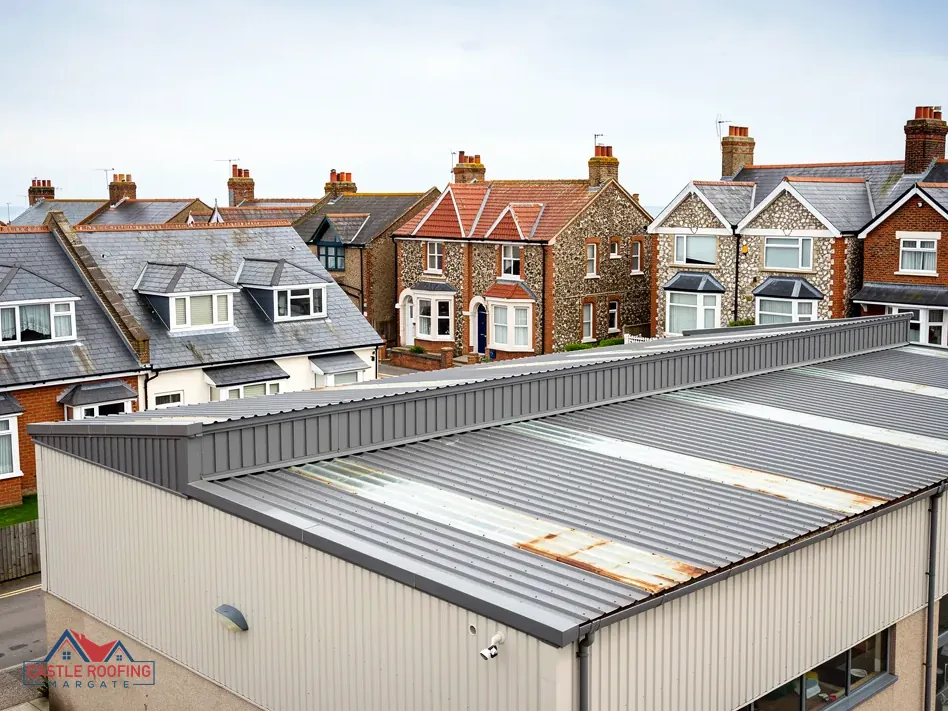
Shops add their own wear. Extraction fans, air-conditioning units and flues stand on the flat roof, with pipework running through the covering. Delivery staff and engineers walk the same routes to reach them, and the covering wears in lines along the route. Refrigeration or kitchen extract can also leave grease and heat at the roof surface.
A repair is the right answer when the fault is local and the rest of the covering is sound. Renewal is the right answer when the covering is cracking across its width, soaked beneath the surface, or has blistered and split in several places. The survey separates the two before any price is written.
Where a shop roof usually lets water in
Water gets in at the details as readily as through the open field of the covering. The places to look:
- the upstand, which is the short upturned edge of the covering where it meets a wall or parapet; if it has split or lifted, water runs behind it
- the outlet, where the roof drains into a downpipe; leaves and litter block it and the roof floods
- the parapet coping, the cap on top of a low wall, where open joints let rain into the brickwork
- the penetrations: flues, vents and cable entries where services go through the covering
- the junction with the wall of the main building, where a lead flashing or a mastic joint has failed
- the gutter along the shopfront, where overflow runs down the face and into the fascia
Staining on the shop ceiling tells you roughly where water arrives, though not always where it enters. Water can travel along a deck or a joist and drop well away from the real fault. A moisture reading and a close look at the details narrow it down.
Photos of each fault go with the price, ready to pass to a landlord, a managing agent or an insurer. A blocked outlet is the simplest fix of all, so a clear outlet is the first thing checked before anyone suggests a bigger repair. Wet insulation under a patched covering is the second, because a patch laid over a soaked layer holds the water in.
Flats have no permitted development rights
For a house, replacing a roof covering is normally permitted development under Class C. A building with flats in it is treated differently, because in the planning order the word dwellinghouse excludes a building with flats in it, and every flat inside one. Canterbury City Council's planning pages say the same in their own words: a flat or maisonette carries no permitted development rights, so a change to its outside appearance needs planning permission.
For a roof repair, that does not mean every job needs an application. Under section 55 of the Town and Country Planning Act 1990, a repair that does not materially change how the building looks from outside is not development at all. A like-for-like patch to a flat roof out of sight at the rear fits there. A change of colour or material on a roof the street can see is where a conversation with the planning team is worth having first.
Three situations tighten the rules further:
- the building is listed, so consent is needed for anything that touches its character
- the building is in a conservation area, where the council's heritage team will look at changes the street can see
- an Article 4 direction removes rights across a defined area; the council confirms whether one applies
The planning authority for the address is the right place to ask. A district council answers for its own district, and what Dover says does not carry along the coast to Thanet.
Building control when a flat roof covering is renewed
Building Regulations reach re-roofing, and the Planning Portal's national test sets two limits, under 25 per cent of the building envelope and under 50 per cent of the roof. A full renewal of a flat roof covering touches the whole of that roof, which is why the route is confirmed with the council first.
For the flats above, Approved Document L treats a replacement flat roof membrane as renovation of the roof. In an existing dwelling, renovation of a roof brings in Table 4.3: a roof threshold U-value of 0.35 and an improved value of 0.16. Paragraph 4.13 allows the best upgrade that is feasible when the improved value cannot be reached or would take longer than 15 years to pay back. The 2026 edition takes effect on 24 March 2027.
Who handles the paperwork
The district decides. Thanet runs its own team on 01843 577522. Folkestone & Hythe also runs its own, on 01303 853538. A shop in Wye or Chilham goes to Ashford Borough Council's own Building Control team.
In Canterbury and Swale the route runs through STG Building Control, on 01634 331133.
Dover District Council's own building control page includes renewing a roof covering, whether or not it copies the old one, among the jobs that need approval; a shop anywhere in that district therefore has the route confirmed first. A registered building control approver is the private route, in force from 6 April 2024 although private building control was around before then.
Scaffold, skips and the pavement outside
Where a shop roof cannot be reached from the rear, scaffold stands on the pavement. Under section 169 of the Highways Act 1980 it needs a licence, and in each East Kent district we cover, Ashford included, the licence comes from Kent County Council, with the scaffolding company making the application. The district council does not issue it.
Kent County Council sets terms that matter on a shopfront:
- fee: £52 per week for 2026 to 2027, with a site inspection at £78 if the council deems one necessary
- notice: applications go in 5 working days before the start date
- public liability cover of at least £5 million held by the applicant
- a minimum 1.2 metre distance between the scaffold and the carriageway
- upright poles painted white for the bottom 2.5 metres
- lighting after dark where the scaffold stands within 45 cm of the carriageway, or in it
Skip permits are separate, under section 139, and Kent County Council charges £45 per week for 2026 to 2027, asks for 5 working days' notice, and caps a skip at 5 metres by 2 metres. On the footway a skip needs express permission and leaves room for a 1.5 metre pedestrian walkway. The council's highways line is 03000 41 81 81 for questions before an application goes in.
Book the dates early. A shop whose delivery slots, bin day and customer footfall are known can have the scaffold go up on the quietest morning of the week.
Keeping the shop trading, and the tenants informed
Working over a trading shop is a matter of order and communication. A bay of roof is opened, repaired and made watertight before the next one is started, so the interior is never left under a bare deck overnight. Debris is lowered in sacks or chutes, never thrown, and the area beneath the work is cordoned off.
The shop front keeps its entrance. The scaffold is built to give a clear walkway under or beside it, signed and lit, and the shop sign and the opening hours are left alone. Noisy work such as cutting and stripping is timed for the quieter parts of the day, though a roof job always makes some noise, and you are told what to expect each morning.
The flats above need separate notice. Residents should know the day the scaffold arrives, which stairs and windows the work touches and when water or power might be affected. If a ceiling or a loft hatch is opened inside a flat, that is arranged with the tenant in advance, and a note through each door on the day before is the minimum.
Where the roof is leaking now, tell the insurer first, make the area safe and keep photos and receipts, which the Institution of Structural Engineers counts as vital proof for a claim. Whether a claim is paid depends on your policy's own wording. Our guides to roof work while a business stays open and roof repairs for landlords carry the same planning on.